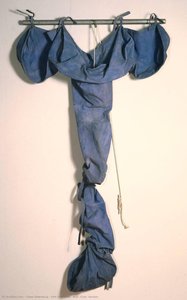
2018
2018 45.0 x 66.0 cm
Køb et højopløst, forbedret digitalt billede, der er langt bedre end online-forhåndsvisningen.
Hver fil er omhyggeligt forberedt af vores interne specialister ved hjælp af avancerede værktøjer og ekspertmæssig manuel retuschering. Vi sikrer, at hvert billede har enestående klarhed, præcis farvegengivelse og fine detaljer.
Den endelige fil leveres via e-mail inden for 72 timer og er optimeret til øjeblikkelig brug i professionelle, redaktionelle og trykte miljøer. Det er den samme kvalitet, som førende designstudier, forlag og gallerier har tillid til.
Download en højopløselig fil til personlig fremvisning, print og kreative projekter. ( Køb print Køb håndlavet maleri)
Når du vælger BuyPopArt.com, får du ikke blot et billede – du modtager et professionelt optimeret digitalt kunstværk, skabt med præcision og sikret med en tilfredshedsgaranti. Her er alt, hvad din ordre automatisk indeholder:

Din højkvalitets digitale billedfil vil blive sendt til din e-mail inden for 72 timer efter bestilling – klar til øjeblikkelig brug.

Dit kunstværk optimeres professionelt ved hjælp af avancerede AI-værktøjer og manuel redigering, hvilket sikrer maksimal detaljegrad, klarhed og farvenøjagtighed.

Har du ved en fejl slettet eller mistet din fil? Ingen bekymring – vi sender den igen til enhver tid, helt gratis.

Nyd dit kunstværk med det samme uden told, afgifter eller leveringsgebyrer – digitale downloads er altid skattefrie.

Vi sikrer, at dit digitale billede gengiver de originale farver så præcist som muligt ved hjælp af professionelle værktøjer og farvestyring.

Hvis du ikke er tilfreds med dit digitale billede, vil vi revidere det eller refundere 100% inden for 60 dage – uden spørgsmål.

Ik tilfreds? Få fuld refusion inden for 60 dage efter modtagelse af din digitale fil – uden spørgsmål.

Køb 3 billeder, spar 10% - Køb 5, spar 15% - Køb 10+, spar 20%. Ideelt til kreative projekter, gallerier og bureauer.

Mark Manders, born in 1968 in the quiet Dutch village of Volkel, embarked on an artistic journey that defies easy categorization. His path wasn’t one of immediate immersion into the fine arts; instead, it began with the pragmatic world of graphic design during his teenage years. This early exposure to visual communication, however, proved foundational. It was within the constraints and possibilities of design that Manders first encountered a fascination with language—specifically, poetry—and its capacity for layered meaning. He soon discovered the limitations inherent in direct expression through words, sensing an inadequacy in their ability to fully capture the complexities he wished to convey. This realization sparked a pivotal shift: a desire to replace verbal articulation with visual equivalents.
Manders’ formal artistic education unfolded at the Hogeschool voor de Kunsten in Arnhem (now ArtEZ Academy of Art & Design) from 1988 to 1992. It was here that his nascent fascination with design and language blossomed into a unique visual idiom, one where objects began to function as substitutes for words, carrying symbolic weight and narrative potential. The culmination of this exploration during his studies led to the conception of what would become his life’s work: Self-Portrait as a Building. This ambitious project, initiated in 1986, is not a literal depiction but rather an evolving, fictional architectural space—a constantly expanding structure divided into rooms and levels whose precise dimensions remain perpetually undefined. The very notion of a self-portrait rendered through architecture suggests a profound meditation on identity, memory, and the elusive nature of representation.
Upon graduating from ArtEZ in 1992, Manders received the second prize at the Dutch Prix de Rome for Art & Public Space—an early recognition of his innovative approach. This period also marked the founding of Roma Publications, a collaborative platform established with Roger Willems and Marc Nagtzaam to produce and distribute independent art publications. The spirit of this venture—a commitment to autonomous artistic expression—resonates deeply within Manders’ own practice.
The Self-Portrait as a Building is not merely a conceptual framework; it's an active, ongoing process. Manders describes the building as a “machine,” a self-regulating system that dictates the direction of his work. Each exhibition becomes another installment in this ever-expanding structure, featuring evolving floor plans alongside sculptures and installations that populate its imagined rooms. He populates these spaces with carefully chosen objects—tables, chairs, light bulbs, blankets—often imbued with a sense of melancholy or displacement. A recurring motif is the presence of figures resembling rough-hewn clay, perpetually on the verge of disintegration, evoking themes of fragility, impermanence, and the passage of time.
Manders’ sculptures are particularly compelling for their deceptive materiality. He masterfully employs bronze—a traditionally monumental medium—to create forms that appear remarkably soft and pliable, resembling wet or peeling clay. This deliberate contrast challenges conventional expectations of sculpture, inviting viewers to question the boundaries between solidity and ephemerality. The illusion is further heightened by his meticulous attention to detail, often incorporating realistic textures and subtle imperfections that mimic the organic qualities of natural materials.
He insists on using “real objects” in the “real world,” even while acknowledging a sense of alienation from conventional art settings. He tests his works in unexpected environments—supermarkets, for example—to assess their ability to exist independently of the label "artwork." This practice underscores his desire to create pieces that resonate beyond the confines of institutional contexts.
While Manders’ work resists easy categorization within established art historical movements, echoes of Surrealism can be detected in its exploration of subconscious imagery and dreamlike arrangements. The meticulous still life compositions recall the Dutch Masters of the 17th century, albeit imbued with a contemporary sensibility. However, it is perhaps his conceptual approach—the relentless pursuit of an overarching narrative structure—that sets him apart.
Manders’ work has garnered international acclaim, with solo exhibitions at prominent institutions including the Hammer Museum in Los Angeles, the Walker Art Center in Minneapolis, and the Dallas Museum of Art. His ongoing Self-Portrait as a Building represents a unique contribution to contemporary art—a profound meditation on identity, memory, and the elusive nature of representation. He is represented by Xavier Hufkens gallery in Brussels, Tanya Bonakdar Gallery in New York City & Los Angeles and Gallery Koyanagi in Tokyo.
His legacy lies not only in the striking visual impact of his sculptures but also in the conceptual rigor that underpins them. Manders invites viewers to engage with art as a process—a continuous unfolding of meaning rather than a static object of contemplation. He challenges us to question our perceptions of reality, illusion, and the very nature of selfhood.

1968 - , Netherlands


Hold dig opdateret med de seneste kunstnyheder, eksklusive tilbud og indretningsideer.
Fortæl os om dit projekt, og vores kunsteksperter vil give dig 3 personlige kunstforslag.
Vi kuraterer 3 valgmuligheder kun til dig – Gratis!


 Se i fuld skala
 Del
Del Del
Del
 Detaljer

 Download
 Lignende værker
 Røntgenundersøgelse
 Diasshow
 Se mere