

Håndmalet olie på lærred i din valgte størrelse og ramme, udført efter bestilling af vores kunstnere. ( Køb print Køb billede)





























Vælg mellem vores forudindstillede størrelser, der matcher kunstværkets originale proportioner.

Du kan indtaste dine egne mål for at passe til en bestemt ramme eller plads. Hvis den valgte størrelse ikke stemmer overens med det originale billedes proportioner, vil vi enten beskære kunstværket eller udvide maleriet med yderligere håndmalede elementer. En digital skitse sendes til din godkendelse, før produktionen påbegyndes.
Bemærk venligst, at forhåndsvisningen på skærmen ikke afspejler den faktiske beskæring eller udvidelse. Kun skitsen vil nøjagtigt vise den endelige komposition.
Selvom specialmål er mulige, anbefaler vi at vælge en dimension fra den foruddefinerede liste for at bevare de originale proportioner.
Levering i hele verden () på 3/4 uger i stedet for de standard 5 uger. (16 august). Ingen kompromiser med kvaliteten.


Jumping fish
Størrelse på reproduktion
The world of early 20th-century Japanese art is rich with figures who navigated the complex currents of modernization, seeking to reconcile tradition with the allure of the West. Among these pioneers stands Watanabe Seitei (1852–1918), a master of *kachōga* – bird and flower paintings – whose work represents a remarkable synthesis of Chinese landscape aesthetics, Western realism, and deeply rooted Japanese sensibilities. Seitei’s journey, marked by travel, experimentation, and a quiet dedication to his craft, offers a fascinating glimpse into the artistic ferment of a nation undergoing rapid transformation.
Born Yoshikawa Yoshimata in Edo (modern-day Tokyo), Seitei's early life was shaped by exposure to traditional Japanese arts. He began his training at the age of sixteen under Kikuchi Yōsai, a prominent figure known for his innovative approach to *Nihonga* – Japanese-style painting, which emphasized brushwork and subject matter distinct from Western techniques. This foundational experience instilled in him a deep appreciation for the subtle nuances of ink wash painting and the evocative power of nature imagery. Following his brief apprenticeship with Shibata Zeshin, he embarked on a pivotal chapter of his life: a journey to Europe in 1878.
Seitei’s arrival in Paris marked a turning point, not just for him personally but also for the trajectory of Japanese art. He participated in the International Exposition of 1878, an event that served as a crucial gateway for Japanese artists to engage with Western culture and artistic trends. This exposure ignited within him a desire to incorporate elements of Western realism into his own style – a daring move at a time when *Nihonga* was largely defined by its adherence to established conventions. He spent the next three years in Paris, immersing himself in the art world and forging connections with influential figures like Tadamasa Hayashi, an American art dealer who championed Japanese artists.
During his Parisian sojourn, Seitei’s style began to evolve dramatically. He absorbed Western techniques of perspective, composition, and color rendering while retaining the core principles of *Nihonga*, such as the emphasis on brushwork and the depiction of nature's essence. This fusion resulted in a unique artistic voice – one that blended the serene beauty of Chinese landscape painting with the meticulous detail and realistic portrayal characteristic of Western art. His paintings began to feature more defined forms, brighter colors, and a greater sense of spatial depth, all while maintaining a profound connection to the natural world.
Seitei’s mastery lay particularly in his *kachōga* – bird and flower paintings. These works are not merely decorative; they are imbued with symbolic meaning and philosophical depth, reflecting a core tenet of Japanese aesthetics known as *wabi-sabi*, which celebrates the beauty of imperfection, transience, and simplicity. He meticulously rendered delicate blossoms like peonies, cherry blossoms, and chrysanthemons alongside graceful birds – often cranes, symbolizing longevity and good fortune – creating scenes that evoke a sense of quiet contemplation and harmony with nature.
His technique was characterized by a remarkable control of ink washes, layering subtle shades to create atmospheric effects and capture the ephemeral beauty of his subjects. He skillfully employed *sumi* (inkstick) and *mizusashi* (water container) to achieve varying tones and textures, demonstrating an intimate understanding of the medium. Furthermore, Seitei’s compositions often incorporated elements of Chinese landscape painting – distant mountains, flowing rivers, and sparse foliage – creating a sense of depth and perspective that was both visually engaging and spiritually resonant.
Upon his return to Japan in 1903, Seitei continued to produce paintings and designs for ceramics and cloisonné, collaborating with the renowned artisan Namikawa Sosuke. Despite his considerable talent and growing recognition, he largely withdrew from public life towards the end of his career, a decision that contributed to his relative obscurity for many years. However, in recent decades, there has been a renewed appreciation for Seitei’s work, fueled by scholarly research and exhibitions showcasing his unique artistic vision.
Today, Watanabe Seitei is recognized as one of the most important figures in the development of *Nihonga* during the Meiji era. His paintings stand as a testament to his ability to bridge Eastern and Western traditions, creating a harmonious synthesis that continues to captivate viewers with its beauty, serenity, and profound sense of connection to nature. His legacy serves as an inspiration for contemporary artists seeking to explore new ways of expressing themselves within the rich tapestry of Japanese art history.

1851 - 1918

Explore the rich history of cultural heritage & folk art traditions worldwide! Discover inspiring artists, preservation efforts, and museum collections. Find handmade oil paintings & expert insights at BuyPopArt.

Explore the art of multi-panel arrangements for impactful interiors. Expert guidance on spatial harmony, visual storytelling & psychological impact – perfect for luxury hotels and discerning collectors. Elevate your space with curated artwork.
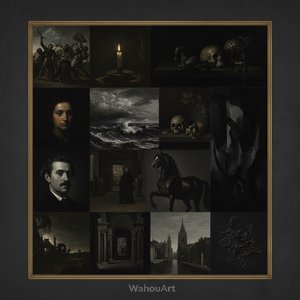
Oplev 10 ikoniske malerier domineret af 'Ivory Black' nuancer – fra Rembrandts drama til Munchs melankoli. Lær historierne bag disse mesterværker og find inspiration til din indretning med BuyPopArt.dk. Udforsk samlingen online!
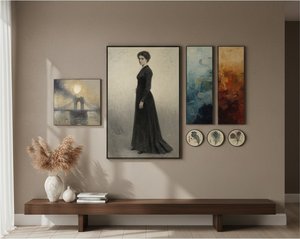
Oplev James Abbott McNeill Whistlers 25 mest ikoniske kunstværker. Fordyb dig i æstetismens verden, tonale malerier & harmoniske kompositioner. Find reproduktioner af højeste kvalitet og inspiration til din indretning på BuyPopArt.com.

Transform cherished photos into timeless oil paintings with skilled artists. Trusted for bespoke portraits & heirloom art. Discover the process, styles & lasting value – a legacy preserved.


Hold dig opdateret med de seneste kunstnyheder, eksklusive tilbud og indretningsideer.
Fortæl os om dit projekt, og vores kunsteksperter vil give dig 3 personlige kunstforslag.
Vi kuraterer 3 valgmuligheder kun til dig – Gratis!


 Se i fuld skala
 Del
Del Del
Del
 Detaljer

 Download
 Lignende værker
 Røntgenundersøgelse
 Diasshow


 Se mere







 Glasmulighed er kun tilgængelig i størrelser under 110 cm


