

Erwerben Sie ein hochauflösendes, optimiertes digitales Bild, das der Online-Vorschau weit überlegen ist.
Jede Datei wird von unseren hauseigenen Spezialisten mit modernsten Werkzeugen und fachmännischer manueller Retusche sorgfältig vorbereitet. Wir stellen sicher, dass jedes Bild eine außergewöhnliche Klarheit, präzise Farbgenauigkeit und feinste Details aufweist.
Die endgültige Datei wird innerhalb von 72 Stunden per E-Mail zugestellt und ist für den sofortigen Einsatz in professionellen, redaktionellen und Druckumgebungen optimiert. Es handelt sich um dieselbe Qualität, der führende Designstudios, Verlage und Galerien vertrauen.
Laden Sie eine hochauflösende Datei für die persönliche Präsentation, den Druck und kreative Projekte herunter. ( Druck bestellen Handgemalte Reproduktion bestellen)
Wenn Sie sich für BuyPopArt.com entscheiden, erhalten Sie nicht nur ein Bild – Sie erhalten ein professionell aufbereitetes digitales Kunstwerk, das mit höchster Präzision erstellt und durch eine Zufriedenheitsgarantie abgesichert wird. Hier ist alles, was automatisch mit Ihrer Bestellung geliefert wird:

Ihre hochauflösende digitale Bilddatei wird Ihnen innerhalb von 72 Stunden nach der Bestellung per E-Mail zugestellt – bereit zur sofortigen Verwendung.

Ihre Kunstwerke werden professionell mithilfe fortschrittlicher KI-Tools und manueller Bearbeitung optimiert, um maximale Detailtreue, Klarheit und Farbgenauigkeit zu gewährleisten.

Datei versehentlich gelöscht oder verloren? Keine Sorge – wir senden sie Ihnen jederzeit kostenlos erneut zu.

Genießen Sie Ihr Kunstwerk sofort ohne Zollgebühren, Einfuhrabgaben oder Versandkosten – digitale Downloads sind immer steuerfrei.

Wir garantieren, dass Ihr digitales Bild mithilfe professioneller Werkzeuge und Farbmanagement die Originalfarben so präzise wie möglich wiedergibt.

Sollten Sie mit Ihrem digitalen Bild nicht zufrieden sein, werden wir es überarbeiten oder Ihnen innerhalb von 60 Tagen 100% erstatten – ohne Wenn und Aber.

Nicht zufrieden? Erhalten Sie innerhalb von 60 Tagen nach Erhalt Ihrer digitalen Datei eine vollständige Rückerstattung – ohne Angabe von Gründen.

3 Bilder kaufen, 10% sparen – 5 Bilder kaufen, 15% sparen – Ab 10 Bildern 20% sparen. Ideal für kreative Projekte, Galerien und Agenturen.
Egon Schiele's portrayal of his sister, Gerti Schiele, is more than just a likeness; it’s a hauntingly beautiful exploration of youth, vulnerability, and the burgeoning anxieties of a rapidly changing era. Painted around 1909, during a pivotal moment in both Schiele’s artistic development and the broader cultural landscape of Vienna, this work embodies the transition from Art Nouveau's decorative elegance to the raw emotional intensity that would define Expressionism. The painting captures Gerti with her back partially turned, an elegant black dress clinging to her form, hinting at a nascent maturity while simultaneously preserving a sense of youthful mystery. The subtle suggestion of a corset beneath the fabric speaks to societal constraints and expectations placed upon women during this period, adding layers of symbolic weight to the composition.
To understand “Gerti Schiele” is to understand the artistic ferment of early 20th-century Vienna. The city was a crucible of ideas, grappling with the decline of the Austro-Hungarian Empire and the rise of modern psychology. Gustav Klimt, a dominant figure in the Viennese art scene, served as an early mentor to Schiele, influencing his use of decorative elements and flowing lines. However, Schiele quickly diverged from Klimt’s opulent style, stripping away ornamentation to reveal the underlying emotional core of his subjects. This painting demonstrates that transitional phase beautifully – the elegant curves and refined color palette echo Art Nouveau sensibilities, but a nascent psychological depth begins to emerge in Gerti’s posture and the overall mood of introspection. Schiele wasn’t merely interested in *how* something looked; he was obsessed with conveying *what it felt like* to exist within its form.
Schiele’s technique in this portrait is masterful, even at this early stage in his career. The delicate rendering of Gerti’s hair, styled in an updo and adorned with a pearl necklace, contrasts sharply with the more angular lines defining her back and shoulders. This interplay between softness and sharpness creates a visual tension that mirrors the emotional complexity of the subject. The limited color palette—dominated by blacks, grays, and subtle flesh tones—further enhances the painting’s somber mood. Schiele’s use of line is particularly striking; it isn’t simply used to define form but to convey emotion, with each stroke imbued with a sense of nervous energy and psychological insight. The way Gerti glances over her shoulder adds an element of unease, as if she is both inviting and withdrawing from the viewer’s gaze. This ambiguity invites us to project our own emotions onto the figure, forging a deeply personal connection with the artwork.
Beyond its aesthetic qualities, “Gerti Schiele” resonates profoundly with biographical context. The portrait reflects Schiele’s preoccupation with themes of vulnerability and repression—mirroring anxieties prevalent in Viennese society at the time. The corset symbolizes societal pressures on women to conform to idealized standards of beauty and femininity, highlighting Schiele's awareness of social constraints. Furthermore, Gerti’s averted gaze speaks to a sense of inner turmoil and unspoken emotions, suggesting that Schiele sought to capture not just her appearance but also her psychological state—a hallmark of Expressionist art.
“Gerti Schiele” stands as an emblem of Schiele’s artistic breakthrough. It exemplifies the shift from Art Nouveau's decorative formalism to Expressionism's unflinching exploration of emotion and psychological depth—a pivotal moment in Viennese art history. Its enduring power lies in its ability to evoke a visceral response, prompting viewers to contemplate themes of intimacy, melancholy, and the complexities of human experience. Reproductions of this masterpiece offer an opportunity to appreciate Schiele’s genius and immerse oneself in the atmosphere of Vienna at the dawn of the 20th century.
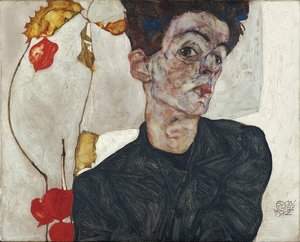
1890 - 1918 , kroatien


Bleiben Sie über die neuesten Kunstnachrichten, exklusive Angebote und Dekorationsideen auf dem Laufenden.
Erzählen Sie uns von Ihrem Projekt, und unsere Kunstexperten erstellen für Sie drei personalisierte Kunstvorschläge.
Wir kuratieren 3 Optionen exklusiv für Sie – kostenlos!


 Vorschau anzeigen
 Versenden
 Teilen
 Details anzeigen

 Herunterladen
 Ähnliche Objekte
 Röntgenaufnahme
 Diashow

 Weiterlesen