

 Contemporary Realism
 1933
1933 102.0 x 66.0 cm
Museum-quality giclée or canvas print with fast production and flexible finish options. ( Buy Hand Made Painting Buy Image)
Pick from our preset sizes that match the artwork's original proportions.

You may enter your own dimensions to fit a specific frame or space. If your selected size does not match the original image's proportions, we will either crop the artwork or extend the image with a mirrored or solid-fill edge. A digital mockup will be sent for your approval before production begins.
Please note that the on-screen preview does not reflect the actual cropping or extension. Only the mockup will accurately show the final composition.
While custom sizes are available, we recommend selecting a dimension from the predefined list to preserve the original proportions.
Worldwide Delivery () in 2 weeks instead of standard 4/5 weeks. (14 August)


Summer Wind
Reproduction Size
Alexander Brook (July 14, 1898 – February 26, 1980) stands as a prominent figure in the landscape of American Realist painting during the 1930s and beyond. Born in Brooklyn, New York, to Russian immigrants Eudoxia Gelescu and Onufri Brook, his early life was profoundly shaped by polio at age twelve—a debilitating illness that sidelined him from formal schooling but ignited a lifelong passion for artistic exploration.
Brook’s formative years were marked by diligent study at the Art Students League of New York (1915), where he honed his skills under luminaries like Kenneth Hayes Miller and John Christen Johansen. This period cemented his commitment to mastering traditional techniques—a dedication that would define his artistic trajectory for decades.
His fascination with painting began during his convalescence, fueled by visits to the Metropolitan Museum of Art and a burgeoning interest in the work of Jules Pascin. Brook’s artistic sensibilities were further nurtured at Pratt Institute, where he gained invaluable experience alongside fellow artists like Peggy Bacon—whom he married in 1920—establishing a partnership that would endure until their divorce in 1940.
The couple relocated to London briefly before returning to New York and establishing a home in Woodstock and Greenwich Village. Brook’s artistic output flourished during this era, characterized by intimate portraits, genre scenes imbued with quiet observation, and explorations of the human figure—often rendered with remarkable sensitivity and detail.
Brook achieved considerable acclaim for his paintings and prints throughout his career, earning prestigious awards including the Carnegie Prize in 1939—shared with Pablo Picasso—the Frank G. Logan Medal at the Art Institute of Chicago in 1929, and the Temple Gold Medal at Pennsylvania Academy of Fine Arts in 1931. His canvases captured the essence of everyday life during the Great Depression, reflecting a profound engagement with social realities.
He taught at the Art Students League from 1933 to 1936 and again from 1942 to 1943, imparting his knowledge and fostering the artistic development of aspiring artists. Brook’s legacy extends beyond his own creations—he championed American Realism during a period of significant artistic upheaval.
Around 1938 Brook embarked on a transformative journey to Savannah, Georgia, establishing residence in a studio overlooking the Savannah River. During this time he produced a series of evocative landscapes and portraits—capturing the spirit of the city’s historic Black neighborhoods and reflecting his unwavering adherence to artistic principles.
His work garnered recognition from institutions like the Whitney Museum and Albright-Knox Gallery, securing its place within the canon of American Realist art. Alexander Brook's enduring influence can be seen in the continuing appreciation for meticulous observation and expressive technique—a testament to his unwavering commitment to artistic excellence.

1898 - 1980
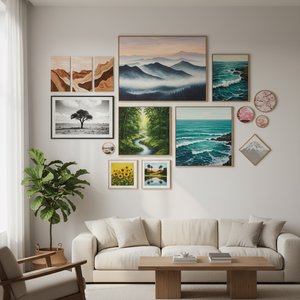
Journey through 10 breathtaking landscape paintings by Monet, Van Gogh & more! Explore iconic artworks, artistic techniques & find inspiration for your home decor. Museum-quality reproductions at BuyPopArt.com. Discover all masterpieces on BuyPopArt.com

Explore the rich history of landscape art with BuyPopArt. Discover renowned artists, movements like Impressionism & Romanticism, and expert guidance for collecting timeless pieces. Find your perfect serene escape today!

Journey through 10 Romantic landscape masterpieces by Friedrich, Turner & Cole. Explore emotional art, sublime nature scenes & iconic 19th-century paintings. Find museum-quality reproductions for your home at BuyPopArt.com – discover the full collection online!

Explore the rich history of landscape art with BuyPopArt. Discover renowned artists, movements like Impressionism & tonalism, and expert guidance for collecting timeless pieces. Find your perfect serene escape today!

Explore the captivating world of 19th-century landscape painting! Discover renowned artists like Friedrich & Monet, key movements, and find the perfect artwork to bring nature's serenity into your home. Expert insights at BuyPopArt.


Stay updated with the latest art news, exclusive offers, and decoration ideas.
Tell us about your project and our art experts will provide you with 3 personalized art suggestions.
Let Us Curate 3 Options Just for You - Free!


 Preview
 Send
Send Share
Share
 Details

 Download
 Similars
 X-Ray
X-Ray Diaporama
 Read More




































 Glass option is only available in size under 110 CM


