x


 Tempera On PanelOtherAmerican Regionalism
 1948Modern
 82.0 x 121.0 cm
Hand-painted oil on canvas in your size and frame, made to order by our artists.
Pick from our preset sizes that match the artwork's original proportions.

You may enter your own dimensions to fit a specific frame or space. If your selected size does not match the original image's proportions, we will either crop the artwork or extend the painting with additional hand-painted elements. A digital mockup will be sent for your approval before production begins.
Please note that the on-screen preview does not reflect the actual cropping or extension. Only the mockup will accurately show the final composition.
While custom sizes are available, we recommend selecting a dimension from the predefined list to preserve the original proportions.
Worldwide Delivery () in 3/4 weeks instead of standard 5 weeks. (16 July). No compromise on quality.


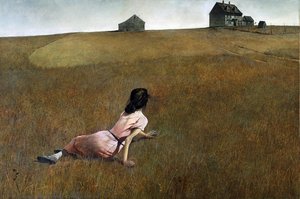
Christina's World
Reproduction Size
Painted in 1948, this iconic work by Andrew Wyeth transcends mere representation, becoming a poignant meditation on longing, isolation, and the human condition. It depicts a young woman, identified as Anna Christina Olson, lying in a field, her gaze fixed upon a distant farmhouse – a scene imbued with both serenity and melancholic yearning.
Wyeth’s connection to his subject was deeply personal. He observed Olson, who suffered from a degenerative muscular disorder, navigating her world by crawling across the fields surrounding her family home in Cushing, Maine. Rather than portraying hardship, Wyeth sought to capture Olson's indomitable spirit and her unwavering connection to the land she loved. The painting isn’t simply *of* Christina; it is an exploration of her inner world.
Executed in egg tempera on panel, the artwork showcases Wyeth’s meticulous technique and mastery of detail. Tempera allows for precise layering and a luminous quality, evident in the subtle gradations of color within the golden-brown grasses and weathered structures. The style firmly resides within American Realism, leaning towards Regionalism with its focus on rural life and landscapes. However, it also carries echoes of Social Realism through its empathetic portrayal of everyday people.
The composition is rich in symbolic meaning. The vastness of the field emphasizes Olson’s vulnerability yet simultaneously suggests a sense of freedom. Her prone position can be interpreted as surrender, resilience, or simply a quiet contemplation of life. The distant farmhouse represents home, community, and perhaps an unattainable ideal. Wyeth deliberately avoids depicting Olson's face, inviting viewers to project their own emotions and experiences onto the figure, fostering a deeply personal connection with the artwork.
Initially met with mixed reactions, this painting quickly ascended to become one of the most recognizable images in 20th-century American art. Now housed in the Museum of Modern Art (MoMA) in New York City, it continues to captivate audiences worldwide. Its enduring appeal lies in its universal themes and Wyeth’s ability to evoke profound emotion through a deceptively simple scene.
A reproduction of this artwork offers more than just aesthetic beauty; it introduces a powerful narrative into any space. Its muted color palette complements a variety of interior styles, from farmhouse chic to modern minimalism. Whether displayed in a living room, study, or bedroom, it serves as a constant reminder of the strength of the human spirit and the enduring power of art.

1917 - 2009 , United States of America

Explore the captivating world of Abbott Handerson Thayer, a pioneer of American realism & Symbolism. Discover his ethereal angel paintings, innovative techniques, and lasting influence on art history. Learn about his scientific pursuits & Transcendentalist spirit.

Explore the captivating maritime paintings of Robert W. Salmon, a pioneer of American Luminism. Discover his Boston Harbor scenes, legacy, and collecting guide at BuyPopArt.

Explore the profound world of Edward Hopper's American realism. Discover the symbolism, themes & enduring legacy of this iconic artist – from 'Nighthawks' to his lesser-known masterpieces. Expert analysis and insights.

Explore the revolutionary Ashcan School! Discover how artists like Henri & Sloan challenged tradition with gritty realism, capturing urban life in early 20th-century America. Learn about their impact on American art history.

Explore the captivating world of Jamie Wyeth, heir to the Brandywine School tradition! Discover his realist paintings of portraits, animals & Maine landscapes – a legacy of American art. Learn more at BuyPopArt.


Stay updated with the latest art news, exclusive offers, and decoration ideas.
Tell us about your project and our art experts will provide you with 3 personalized art suggestions.
Let Us Curate 3 Options Just for You - Free!


 Buy print
 Send
Send Share
Share
 Details

 Download
 Similars
 X-Ray
X-Ray Diaporama
 Read More




































 Glass option is only available in size under 110 CM