Oil On CanvasWallArtRomanticism
 191319th Century
 29.0 x 39.0 cm
 Llyfrgell Genedlaethol Cymru / The National Library of Wales
Hand-painted oil on canvas in your size and frame, made to order by our artists. ( Buy Print Buy Image)





























Pick from our preset sizes that match the artwork's original proportions.

You may enter your own dimensions to fit a specific frame or space. If your selected size does not match the original image's proportions, we will either crop the artwork or extend the painting with additional hand-painted elements. A digital mockup will be sent for your approval before production begins.
Please note that the on-screen preview does not reflect the actual cropping or extension. Only the mockup will accurately show the final composition.
While custom sizes are available, we recommend selecting a dimension from the predefined list to preserve the original proportions.
Worldwide Delivery () in 3/4 weeks instead of standard 5 weeks. (16 August). No compromise on quality.


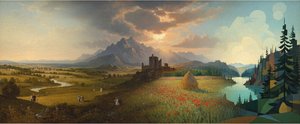
Cader Idris
Reproduction Size
To gaze upon this depiction of Cader Idris is to be transported to a realm where the grandeur of nature meets an almost palpable sense of peace. Christopher Williams, in this evocative landscape from 1913, has captured more than just mountains; he has bottled the very spirit of the Welsh uplands. The composition immediately draws the eye into a breathtaking panorama dominated by majestic peaks piercing a cerulean sky. These are not merely geological formations; they feel imbued with history and myth. Williams masterfully balances the solidity of the rock faces against the ephemeral dance of the clouds, creating a visual dialogue between permanence and transience that speaks directly to the human soul.
Williams’s handling of light and atmosphere is nothing short of masterful. Observe how the blue of the sky deepens into softer hues near the horizon, suggesting either dawn's gentle awakening or the quietude of a late afternoon. The clouds are rendered with such delicate touch that they seem ready to drift down and settle upon the viewer. Complementing this vast expanse are the scattered trees, placed thoughtfully across the foreground and mid-ground. These elements serve not only to anchor the composition but also to provide scale, allowing the viewer to truly appreciate the towering immensity of the mountains behind them. The technique employed suggests a deep understanding of tonal variation, giving the entire scene a rich, almost velvety depth that invites prolonged contemplation.
For those familiar with Williams’s oeuvre, this piece resonates deeply with his commitment to celebrating Welsh identity through art. While he is celebrated for his portraits and allegories, his landscapes often served as conduits for a national spirit—a sense of enduring resilience rooted in the dramatic beauty of his homeland. The inclusion of Cader Idris, such an iconic landmark, grounds the painting in a specific cultural geography. It suggests that this landscape was more than just scenery to him; it was part of a narrative, a visual testament to the enduring character of Wales itself.
Bringing this piece into your home or design space is an act of curating tranquility. The emotional impact of this artwork is one of profound calm. It acts as a natural focal point, capable of softening the sharp edges of modern life. For collectors and designers alike, it offers unparalleled depth without overwhelming a room. Whether placed in a study to inspire contemplation or in a living area to evoke weekend wanderings, its serene palette and monumental subject matter promise an immediate sense of upliftment and connection to something timeless and wild.
Christopher David Williams (1873-1934) was a celebrated Welsh artist whose career spanned the late Victorian and early 20th centuries. He is particularly remembered for his evocative portraits, allegorical scenes, and landscapes that often reflected a strong sense of Welsh identity and the spirit of the Celtic Revival.
Born in Maesygwrath, Wales, Williams initially faced opposition from his father, Evan Williams, who envisioned a medical career for him. However, a transformative visit to the Walker Art Gallery in Liverpool in 1892, where he was deeply moved by Frederick Leighton’s *Perseus and Andromeda*, ignited his passion for art. This experience solidified his determination to pursue a life as an artist.
Williams’s work is characterized by:
Christopher Williams played a significant role in promoting Welsh art and culture during his lifetime. He actively participated in the National Eisteddfod as an adjudicator and served on committees for the National Museum of Wales and the Honourable Society of Cymmrodorion. His work reflects a strong sense of national identity and contributed to the artistic flourishing of Wales in the early 20th century.
His paintings are held in numerous public collections, including the National Museum of Wales, the Royal Collection, and the Glynn Vivian Art Gallery, ensuring his legacy continues to inspire and captivate audiences today. He was a brother-in-law to fellow artist Fred Appleyard, and father to astronomer Evan Gwyn Williams and artist Ivor Williams.

1873 - 1934 , United States of America
Journey through 10 breathtaking landscape paintings by Monet, Van Gogh & more! Explore iconic artworks, artistic techniques & find inspiration for your home decor. Museum-quality reproductions at BuyPopArt.com. Discover all masterpieces on BuyPopArt.com

Journey through 10 Romantic landscape masterpieces by Friedrich, Turner & Cole. Explore emotional art, sublime nature scenes & iconic 19th-century paintings. Find museum-quality reproductions for your home at BuyPopArt.com – discover the full collection online!
Explore the rich history of landscape art with BuyPopArt. Discover renowned artists, movements like Impressionism & Romanticism, and expert guidance for collecting timeless pieces. Find your perfect serene escape today!
Journey through John Constable's 25 most celebrated landscapes. Explore Romanticism, Dedham Vale & his masterful use of light in iconic paintings like 'Hay Wain'. Find museum-quality art reproductions and elevate your home decor on BuyPopArt.com.

Explore the rich history of landscape painting! Discover renowned artists, movements like Romanticism, & techniques such as atmospheric perspective. Find inspiration and quality reproductions at BuyPopArt.


Stay updated with the latest art news, exclusive offers, and decoration ideas.
Tell us about your project and our art experts will provide you with 3 personalized art suggestions.
Let Us Curate 3 Options Just for You - Free!


 Preview
 Send
Send Share
Share
 Details

 Download
 Similars
 X-Ray
X-Ray Diaporama
 Read More







 Glass option is only available in size under 110 CM