

Museum-quality giclée or canvas print with fast production and flexible finish options. ( Buy Hand Made Painting Buy Image)





























Pick from our preset sizes that match the artwork's original proportions.

You may enter your own dimensions to fit a specific frame or space. If your selected size does not match the original image's proportions, we will either crop the artwork or extend the image with a mirrored or solid-fill edge. A digital mockup will be sent for your approval before production begins.
Please note that the on-screen preview does not reflect the actual cropping or extension. Only the mockup will accurately show the final composition.
While custom sizes are available, we recommend selecting a dimension from the predefined list to preserve the original proportions.
Worldwide Delivery () in 2 weeks instead of standard 4/5 weeks. (16 August)


A Comanche
Reproduction Size
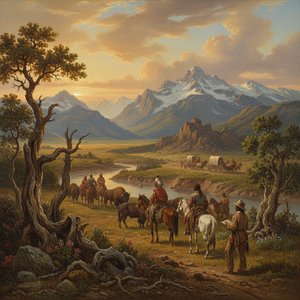
Frederic Remington’s “A Comanche” (1888) is more than just a depiction of a Native American warrior and his horse; it's a poignant snapshot of a rapidly disappearing world. Painted during a period of intense fascination with the American West, this work captures the essence of the frontier – its rugged beauty, its inherent danger, and the complex relationship between European settlers and the indigenous populations who called it home. The painting’s immediate impact lies in its powerful composition: the imposing presence of the horse dominates the foreground, anchoring the scene while simultaneously conveying a sense of raw power and untamed spirit. The Comanche warrior, rendered with meticulous detail, embodies both strength and vulnerability, his gaze fixed on an unseen horizon.
Remington's artistic style is firmly rooted in the Realist movement, yet infused with a distinctly Romantic sensibility. He wasn’t interested in idealized representations of the West; instead, he sought to portray it as he *saw* it – often through the lens of his own observations and the accounts of cowboys and frontiersmen. His technique involved rapid brushwork and bold color choices, creating a sense of immediacy and movement. The thick impasto application of paint, particularly evident in the horse’s musculature and the rider's clothing, adds to the painting’s tactile quality and reinforces its dramatic impact. Remington’s use of light and shadow is masterful, sculpting the figures and enhancing their three-dimensionality. This approach was revolutionary for its time, moving away from academic precision towards a more direct and emotionally charged representation of the subject.
"A Comanche" was created during a crucial period in American history – the late 19th century – a time when westward expansion was accelerating, leading to increasing conflict between settlers and Native Americans. Remington’s work reflects this tension, often romanticizing the frontier while simultaneously documenting its brutal realities. The painting speaks to a broader cultural fascination with the “Wild West,” fueled by dime novels, sensationalized newspaper accounts, and the growing popularity of Buffalo Bill's Wild West Show. Remington himself played a significant role in shaping this perception, becoming one of the most commercially successful artists of his era, largely due to his ability to capture the public’s imagination with scenes of cowboys, Indians, and the vast American landscape.
Beyond its literal depiction, “A Comanche” carries significant symbolic weight. The horse represents freedom, power, and connection to the land – values deeply ingrained in Native American culture. The warrior’s solitary figure embodies resilience, independence, and a profound connection to his heritage. The painting evokes a sense of both awe and melancholy, reminding us of a way of life that was rapidly disappearing. It's a powerful testament to a vanishing world, prompting reflection on themes of cultural displacement, the clash of civilizations, and the enduring allure of the American West. This artwork’s emotional resonance continues to captivate viewers today, solidifying Remington’s legacy as one of the most important chroniclers of this transformative era.

1861 - 1909 , United States of America

Explore the captivating world of Charles Marion Russell, 'the cowboy artist.' Discover his life, iconic paintings, advocacy for Native Americans, and investment potential. A guide for discerning art collectors.

Explore the life & legacy of Benjamin West, pioneering American artist and Royal Academy president. Discover his Neoclassical masterpieces, transatlantic influence, and lasting impact on art history. Learn more at BuyPopArt.
Explore the captivating art of Alfred Jacob Miller, chronicler of the American West. Discover his iconic paintings, techniques & lasting legacy – a valuable addition to any serious collection. Learn more at BuyPopArt.

Explore the evocative paintings of Henry Farny, renowned for his romantic realism & depictions of Native American life in the 19th-century West. Discover his legacy and key artworks at BuyPopArt.

Explore the world of Grant Wood & American Regionalism with BuyPopArt. Discover the symbolism behind 'American Gothic', recurring themes, and the movement's lasting impact on art history. High-quality reproductions available.


Stay updated with the latest art news, exclusive offers, and decoration ideas.
Tell us about your project and our art experts will provide you with 3 personalized art suggestions.
Let Us Curate 3 Options Just for You - Free!


 Preview
 Send
Send Share
Share
 Details

 Download
 Similars
 X-Ray
X-Ray Diaporama


 Read More







 Glass option is only available in size under 110 CM


