Buy print Buy printBuy Painting Buy Painting SendSend
DetailsDetails Add to favorites Add to favorites DownloadDownload SimilarsSimilars X-RayX-Ray DiaporamaDiaporama

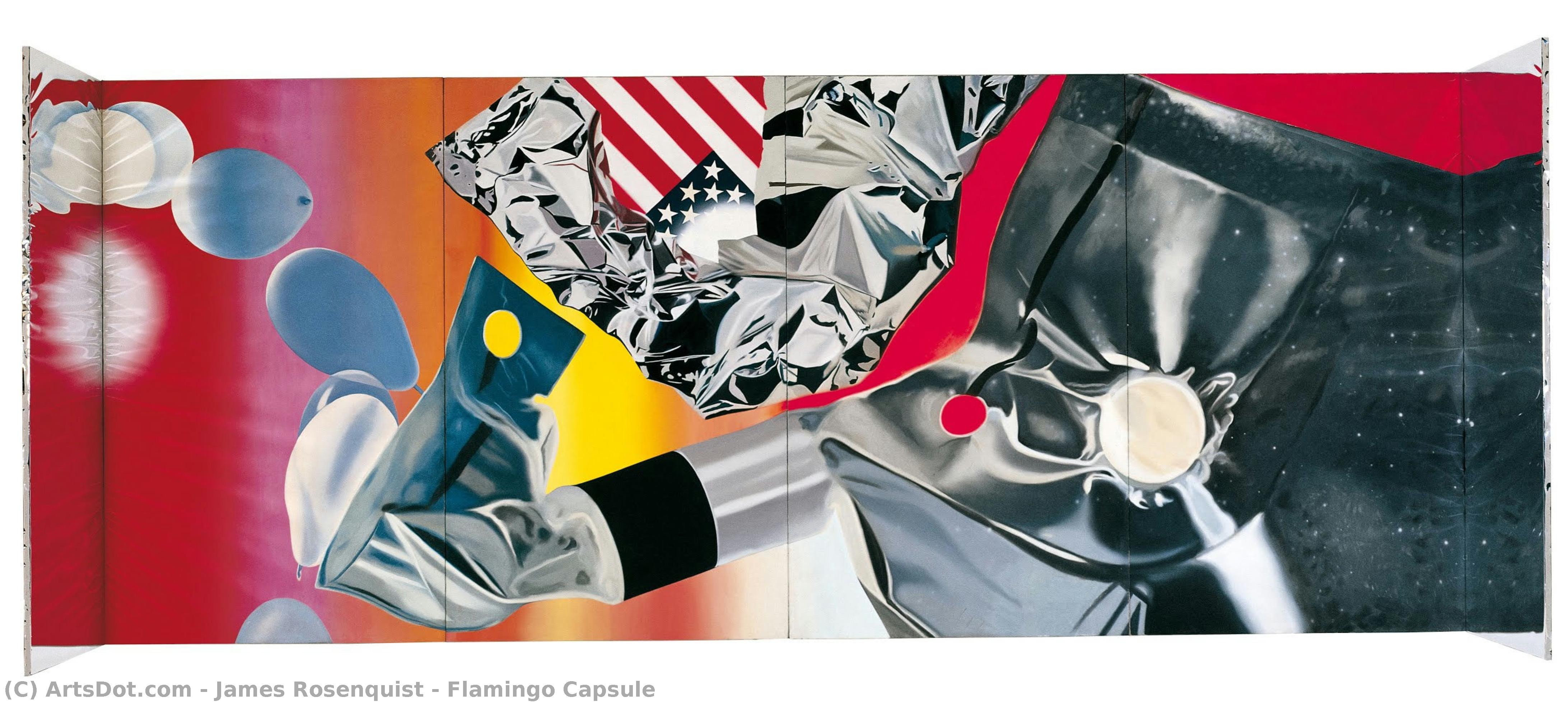
Flamingo Capsule

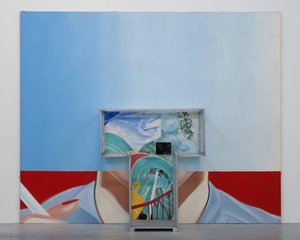
James Rosenquist’s *Flamingo Capsule* (1970) is a striking canvas featuring a flamingo encased in aluminum foil, alongside balloons, a food bag, and a flag uniform. Measuring over 26 meters long, this artwork embodies Pop Art's fascination with technology and space exploration while presenting an enigmatic composition.

Discover James Rosenquist (1933-2017), a Pop Art innovator! Explore his monumental paintings that blend advertising, surrealism, and American culture into captivating visual narratives.

Purchase a high-resolution, enhanced digital image, far superior to the online preview.

Each file is meticulously prepared by our in-house specialists using advanced tools and expert manual retouching. We ensure every image has exceptional clarity, precise color accuracy, and fine detail.

The final file is delivered via email within 72 hours, optimized for immediate use in professional, editorial, and print environments. This is the same quality trusted by top-tier design studios, publishers, and galleries.

Digital Image

Download a high-resolution file for personal display, printing, and creative projects.

Total Price

$9.99

Included in Every Digital Image Order

Expert Digital Delivery, Guaranteed

When you choose BuyPopArt.com, you're not just getting an image - you're receiving a professionally enhanced digital artwork, crafted with precision and backed by a satisfaction guarantee. Here's everything that comes with your order, automatically:

shipping_icon
Fast Email Delivery

Your high-resolution digital image file will be emailed to you within 72 hours of ordering - ready for immediate use.

canvas_icon
AI-Enhanced Digital File

Your artwork is professionally optimized using advanced AI tools and manual editing, ensuring maximum detail, clarity, and color accuracy.

insurance_icon
Free Lifetime Re-Delivery

Accidentally deleted or lost your file? No worries - we'll resend it to you anytime, free of charge.

tax_icon
No Import Fees - Ever

Enjoy your artwork instantly with zero customs, duties, or delivery fees - digital downloads are always tax-free.

color_icon
Color Accuracy Guarantee

We ensure your digital image reflects the original colors as closely as possible using professional tools and color management.

return_icon
60-Day Satisfaction Guarantee

If you're not satisfied with your digital image, we'll revise it or refund 100% within 60 days - no questions asked.

guarantee_icon
100% Money-Back Guarantee

Not satisfied? Get a full refund within 60 days of receiving your digital file - no questions asked.

discount_icon
Bulk Order Discounts

Buy 3 images, save 10% - Buy 5, save 15% - Buy 10+, save 20%. Great for creative projects, galleries, and agencies.

Art Quiz

There is only one correct answer for each question.

Question 1:
What artistic movement is James Rosenquist primarily associated with?
Question 2:
The painting *Flamingo Capsule* commemorates a significant event in American history.
Question 3:
What material is used to create the end panels of *Flamingo Capsule*, enhancing its visual impact?
Question 4:
The composition of *Flamingo Capsule* reflects Rosenquist's fascination with:
Question 5:
What is the overall stylistic approach of James Rosenquist?

Collectible Description

Flamingo Capsule: A Monumental Reflection on Tragedy and Technological Ambition

James Rosenquist’s *Flamingo Capsule*, completed in 1970, stands as a striking testament to the artist's fascination with both the mundane realities of American culture—specifically advertising—and the profound implications of space exploration. Measuring an impressive 290 x 701 x 98.5 cm, this monumental canvas commands attention and invites contemplation on themes of loss, resilience, and the relentless march of progress. Rosenquist’s approach to artmaking was deliberately antithetical to the prevailing Abstract Expressionist movement; he eschewed spontaneity for meticulous planning, employing techniques borrowed from sign painting—a craft rooted in precision and repetition—to create a visual language that simultaneously celebrates and critiques the dominant aesthetic sensibilities of his time.
  • Style: Rosenquist’s work embodies New Realism, rejecting illusionistic representation in favor of fragmented imagery and collage-like compositions. This stylistic choice aligns with his broader interest in blurring the boundaries between art and everyday life, mirroring the pervasive influence of commercial culture on the visual landscape.
  • Technique: The painting utilizes oil paint on canvas combined with aluminized Mylar panels—a material commonly employed in aerospace applications—to achieve a remarkable textural effect. Rosenquist meticulously applied pigment to create layered surfaces that capture subtle variations in color and tone, while the aluminized Mylar adds reflectivity, extending the visual scope of the artwork beyond its physical dimensions.
  • Historical Context: *Flamingo Capsule* emerged during a period marked by intense optimism regarding space exploration following Sputnik’s launch in 1957. Rosenquist deliberately referenced this pivotal moment in history—the tragic Apollo 1 fire—incorporating imagery associated with NASA and the American flag into his composition.
The artwork's visual narrative is characterized by a deliberate juxtaposition of disparate elements: crumpled foil bearing the emblem of the United States Air Force, a distorted food bag, and a balloon drifting upwards against a fiery red and yellow backdrop. These objects are not merely decorative additions; they serve as symbolic representations of various facets of American society—military might, consumerism, and aspiration—all rendered in monumental scale. Rosenquist’s masterful manipulation of perspective and color contributes to the painting's unsettling yet captivating atmosphere, prompting viewers to confront questions about mortality, ambition, and the precariousness of human endeavor. Symbolism: The flamingo itself is a recurring motif in Rosenquist’s oeuvre, representing both beauty and vulnerability—a paradoxical emblem that encapsulates his artistic preoccupation with confronting uncomfortable truths amidst dazzling visual spectacle. The aluminized Mylar panels amplify this duality, reflecting not only the painted surface but also mirroring the viewer's gaze, thereby inviting an active engagement with the artwork’s emotional core. Emotional Impact: *Flamingo Capsule* transcends mere aesthetic appreciation; it compels viewers to contemplate the complexities of human experience—the collision between dreams of grandeur and the inevitability of loss. Rosenquist’s deliberate fragmentation of imagery forces us to confront unsettling realities while simultaneously celebrating the enduring power of artistic innovation. It remains a poignant reminder that even amidst technological advancement, we are fundamentally tethered to our own mortality and burdened by the responsibility to grapple with profound existential questions.
  • Recommended Reproduction Size: For optimal visual impact, consider reproducing *Flamingo Capsule* in a large format—approximately 30 x 60 inches—to capture the painting’s monumental scale and textural richness.
  • Interior Design Considerations: The artwork's bold color palette and dynamic composition lend themselves particularly well to contemporary interior spaces characterized by minimalist aesthetics and geometric forms.
Ultimately, James Rosenquist’s *Flamingo Capsule* stands as a timeless masterpiece—a compelling fusion of artistic vision, technical prowess, and intellectual engagement that continues to resonate with audiences today.

Artist Biography

Early Life and the Seeds of a Vision

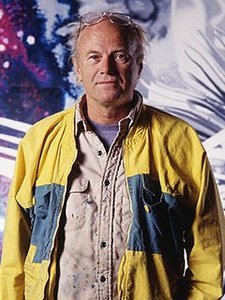
James Rosenquist emerged as a pivotal figure in American art, though he often resisted easy categorization, born in 1933 in Grand Forks, North Dakota. His upbringing was marked by constant movement; his parents, Louis and Ruth Rosenquist—both amateur pilots with Swedish heritage—followed work wherever it led, eventually settling in Minneapolis, Minnesota. This nomadic existence perhaps instilled in young James a unique perspective, an awareness of the transient nature of imagery and experience that would later permeate his art. His mother, herself a painter, nurtured his early artistic inclinations, recognizing and fostering a talent that would blossom into a groundbreaking career. A scholarship to the Minneapolis School of Art during junior high provided initial formal training, followed by studies at the University of Minnesota from 1952 to 1954. However, it was a 1955 move to New York City on an Art Students League scholarship that truly set his artistic trajectory in motion. There, under the tutelage of Edwin Dickinson and George Grosz, he initially explored abstract expressionism, laying a foundation in technique even as he would ultimately forge a radically different path. Early struggles led him to work as a chauffeur before joining the International Brotherhood of Painters and Allied Trades—a seemingly pragmatic turn that proved unexpectedly crucial to his artistic development.

From Billboards to Monumental Visions

The years Rosenquist spent painting billboards in Times Square, from 1957 to 1960, were transformative. He rose quickly through the ranks at Artkraft-Strauss, becoming their lead painter and mastering the techniques of large-scale commercial art—techniques he would later brilliantly subvert and elevate within the realm of fine art. This wasn’t merely a job; it was an immersion in the visual language of advertising, a world of bold colors, fragmented imagery, and persuasive power. He learned to manipulate scale, composition, and color to grab attention, skills that became hallmarks of his mature style. A tragic event—the death of a friend in a scaffolding accident—prompted Rosenquist to abandon commercial work and dedicate himself fully to personal artistic projects. But he didn’t leave the billboard world behind; instead, he carried its essence into his paintings, retaining its techniques, imagery, and monumental scale. He recalled painting Phillips 66 signs across North Dakota and Wisconsin even as a teenager, demonstrating an early connection with the power of commercial art. This background distinguished him from other Pop artists who often approached advertising with irony or critique; Rosenquist’s relationship was more complex—a fascination born of intimate knowledge.

A Pioneer of Pop: Fragmentation and Cultural Commentary

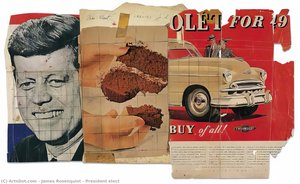
Rosenquist is rightfully recognized as a key figure in the Pop Art movement, though he consistently resisted being pigeonholed. His work shared affinities with artists like Andy Warhol and Roy Lichtenstein in its appropriation of popular imagery, but his approach was distinctly his own. He didn’t simply reproduce images; he fragmented them, juxtaposed them in unexpected ways, and scaled them to create large-scale montages that possessed a surreal, dreamlike quality. His paintings weren't merely representations of consumer culture; they were explorations of its pervasive influence on the psyche, its ability to overwhelm and disorient. F-111 (1964-65), perhaps his most iconic work, exemplifies this approach—a sprawling canvas that combines images of a military aircraft with consumer products, creating a jarring commentary on war, technology, and the American dream. Similarly, Target II (1965) dissects the imagery of advertising, revealing its underlying structures and manipulative power. His canvases became arenas for exploring themes of consumerism, media saturation, and the fragmented nature of modern experience. He wasn’t simply reflecting culture; he was deconstructing it, forcing viewers to confront its complexities and contradictions.

Recognition and Lasting Legacy

Rosenquist's artistic breakthrough came with a series of exhibitions in the early 1960s, including solo shows at the Green Gallery in 1962 and 1963. However, it was his exhibition at Leo Castelli Gallery in 1965, featuring F-111, that catapulted him to international acclaim. This success led to further opportunities, including a long-standing collaboration with the graphicstudio collaborative art initiative at the University of South Florida starting in 1971 and the establishment of his Aripeka studio in 1976. He also undertook several commissioned works for the state of Florida, demonstrating his versatility and ability to work across different scales and media. His commitment to the arts extended beyond his own practice; he served on the board of trustees for the Tampa Museum of Art and was inducted into the Florida Artists Hall of Fame in 2001. Rosenquist’s legacy lies not only in his striking visual style but also in his ability to challenge conventional notions of art. He blurred the boundaries between high and low culture, demonstrating that advertising imagery could be a legitimate subject for artistic exploration. His work continues to resonate today as a powerful commentary on consumerism, media manipulation, and the ever-increasing complexity of modern life—a testament to his enduring vision and innovative spirit. He influenced subsequent generations of artists interested in exploring the intersection of art, commerce, and popular culture.

James Rosenquist

James Rosenquist

1933 - 2017 , United States of America

Quick Facts

  • Artistic Movement Or Style: Pop Art
  • Artists Or Movements Influenced By This Artist: ['Pop Art artists']
  • Artists Who Influenced This Artist:
    • Edwin Dickinson
    • George Grosz
  • Date Of Birth: November 29, 1933
  • Date Of Death: March 31, 2017
  • Full Name: James Rosenquist
  • Nationality: American
  • Notable Artworks:
    • F-111
    • Target II
    • Paper clip
    • Waves
  • Place Of Birth: Grand Forks, USA