

Museum-quality giclée or canvas print with fast production and flexible finish options. ( Switch to hand made Painting Switch to Image)
Pick from our preset sizes that match the artwork's original proportions.

You may enter your own dimensions to fit a specific frame or space. If your selected size does not match the original image's proportions, we will either crop the artwork or extend the image with a mirrored or solid-fill edge. A digital mockup will be sent for your approval before production begins.
Please note that the on-screen preview does not reflect the actual cropping or extension. Only the mockup will accurately show the final composition.
While custom sizes are available, we recommend selecting a dimension from the predefined list to preserve the original proportions.
Worldwide Delivery () in 2 weeks instead of standard 4/5 weeks. (9 August)


Sunset
Reproduction Size
Karl Heffner (1849–1925) remains a figure of profound sensitivity, an artist whose work serves as a bridge between the meticulous realism of the German tradition and the emotive, light-drenched possibilities of plein-air painting. Born in Würzburg, Bavaria, Heffner’s early life was shaped by the quiet tensions of a family facing financial hardship, a reality that initially led him toward music studies in Munich. However, the call of the visual world proved irresistible. Guided by the landscape specialists of the Munich school, he began to develop a language not of mere depiction, but of atmosphere. His early training under masters such as Adolf Stademann and Adolf Heinrich Lier instilled in him a rigorous command of composition and an acute awareness of how light interacts with the physical world—a foundation that would allow him to capture the fleeting, ephemeral moments of nature with unparalleled grace.
Heffner’s artistic journey was defined by a restless, wandering spirit that sought out the specific character of different geographies. While his roots were firmly planted in the German landscape, his eyes were often turned toward the dramatic skies of England and the luminous warmth of Italy. In the early 1870s, his travels through the English countryside introduced him to a palette of moody, melancholic tonalities. Unlike many of his contemporaries who sought the idealized brightness of the Mediterranean, Heffner found a deep, resonant beauty in the turbulent British weather—the damp chill of an October morning, the sudden, electric shifts of light during a passing shower, and the heavy, grey textures of the northern moors. This fascination with the "unpredictable" became a hallmark of his style, as he utilized low-key, earthy tones punctuated by sudden, glistening strips of gold to represent a breaking sun.
As his career progressed, Heffner’s palette underwent a transformative evolution, most notably during his time in Southern Europe. His winters in Rome and travels through Tuscany allowed him to absorb the radiant, warm hues of the Mediterranean. The influence of this light is evident in his later works, where the heavy, misty atmospheres of his German and English landscapes began to mingle with the sun-drenched olive groves and cypress trees of Italy. This synthesis created a unique body of work that could transition seamlessly from the somber, moss-covered rocks of a Bavarian moor to the brilliant, high-contrast clarity of a Tuscan afternoon. His technique, whether in oil or watercolor, was characterized by an ability to render texture—the dampness of earth, the translucency of water, and the weight of clouds—with a precision that felt both realistic and deeply poetic.
The significance of Heffner’s contribution to late 19th-century art lies in his refusal to impose an idealized vision upon the natural world. Instead, he acted as a witness to its true, often rugged, character. His works are notable for several key artistic elements:
Though Heffner lived through eras of immense political upheaval—from the unification of Germany to the devastation of World War I—his oeuvre remained steadfastly focused on the enduring solitude of nature. His work did not seek to comment on the political tumult of his time, but rather offered a sanctuary of quiet observation. By documenting the shifting moods of the landscape, he provided a timeless record of the European environment. Today, his works are preserved in prestigious collections, including the Victoria and Albert Museum in London, serving as a testament to his skill as a painter of light. Heffner’s legacy is that of a true luminist, an artist who understood that the true soul of a landscape lies not in its permanent features, but in the transient, beautiful way the light touches them before vanishing forever.

1849 - 1925 , Germany

Discover Johan Hendrik Weissenbruch (1824-1903), a leading Dutch Hague School painter renowned for his atmospheric watercolours & oil landscapes. Explore his beautiful depictions of the Dutch countryside and skies – a master of light & detail.

Explore the emotional depth of Romantic landscape painting (18th-19th century). Discover key artists like Friedrich & Cole, and the concepts of the sublime. Expert insights for art lovers & collectors.

Explore the captivating history of sunset motifs in Western art! Discover iconic paintings by Monet, Van Gogh & Kuindzhi. Learn about Romanticism, Impressionism & collecting these timeless masterpieces. Expert insights at BuyPopArt.

Explore the life & critical work of Alan Clutton-Brock, a leading British art critic renowned for his insights into landscape painting and atmospheric realism. Discover his influence on post-war artistic discourse.
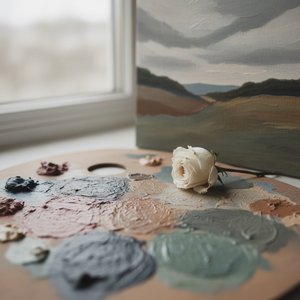
Explore the captivating world of muted colors in art & design! Discover historical context, psychological effects, techniques, and inspiration for creating serene spaces. Elevate your aesthetic with BuyPopArt.


Stay updated with the latest art news, exclusive offers, and decoration ideas.
Tell us about your project and our art experts will provide you with 3 personalized art suggestions.
Let Us Curate 3 Options Just for You - Free!


 Preview
 Send
Send Share
Share
 Details

 Download
 Similars
 X-Ray
X-Ray Diaporama
 Read More




































 Glass option is only available in size under 110 CM


