PreviewPreview AR previewAR preview Switch to hand made Painting Switch to hand made PaintingSwitch to Image Switch to Image SendSend
DetailsDetails Add to favorites Add to favorites DownloadDownload SimilarsSimilars X-RayX-Ray DiaporamaDiaporama

Façade

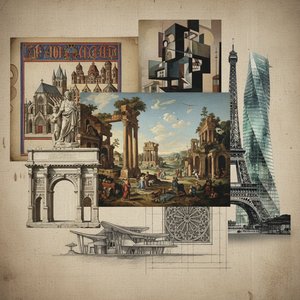
Leon Battista Alberti’s ‘Façade’ (1472) of Sant'Andrea, Mantua showcases Renaissance architectural brilliance. Admire its symmetrical design, classical details & light-filled grandeur – a masterpiece reflecting humanist ideals.

Leon Battista Alberti (1404-1472): Renaissance polymath! Architect, writer, mathematician & humanist. Explore his groundbreaking designs like Palazzo Rucellai & Tempio Malatestiano and theories on perspective.

Giclée / Art Print

Museum-quality giclée or canvas print with fast production and flexible finish options. (Switch to hand made Painting Switch to hand made PaintingSwitch to Image Switch to Image)

P118B $10
P118H $10
P118W $10
P438Z $10
P508JH $12
P508YH $12
P805H $10
P805Z $10
P919BZ $10
P919G $10
P919XJ $10
P959ZH $10
P968JZ $12
W106C $8
W218G $10
W218JH $8
W218Y $10
W307PJ $10
W316G $10
W316PJ $8
W316Y $10
W398PJ $8
W4111J $10
W500HY $15
W500JH $15
W692G $12
W849H $8
W940BG $15
W953PJ $8

Standard
custom
CM
INCH

Pick from our preset sizes that match the artwork's original proportions.

width
height

You may enter your own dimensions to fit a specific frame or space. If your selected size does not match the original image's proportions, we will either crop the artwork or extend the image with a mirrored or solid-fill edge. A digital mockup will be sent for your approval before production begins.
Please note that the on-screen preview does not reflect the actual cropping or extension. Only the mockup will accurately show the final composition.
While custom sizes are available, we recommend selecting a dimension from the predefined list to preserve the original proportions.

Worldwide Delivery () in 2 weeks instead of standard 4/5 weeks. (4 August)

why_choose_icon
Free Worldwide Express Shipping
why_choose_icon
High-Quality Linen Canvas
why_choose_icon
Full Shipping Insurance
why_choose_icon
Customs Tax Refund Guarantee
why_choose_icon
True Color Matching Guarantee
why_choose_icon
60-Day Return Policy (Defects Only)
why_choose_icon
100% Money-Back Guarantee
why_choose_icon
Bulk Discount Offer

Total Price

$ 76

reproduction

Façade

Giclée / Art Print

Reproduction Size

-

Total Price

$ 76

Quick Facts

  • Influences: Roman architecture
  • Artist: Leon Battista Alberti
  • Medium: Painting
  • Year: 1472
  • Title: Façade
  • Notable elements: Symmetry, arches, windows

Art Quiz

There is only one correct answer for each question.

Question 1:
What architectural style is most prominently displayed in the ‘Façade’ painting?
Question 2:
The large semi-circular window in the façade is primarily intended to:
Question 3:
According to the description, what is the dominant color palette of the painting?
Question 4:
The image suggests that the light source for the shadows is located:
Question 5:
Leon Battista Alberti, the artist, is best described as a:

Collectible Description

The Genesis of a Vision: Sant’Andrea’s Façade

Leon Battista Alberti's “Façade,” conceived around 1472 and meticulously realized in the Basilica of Sant’Andrea in Mantua, Italy, represents far more than just a building exterior. It embodies a pivotal moment in Renaissance architectural thought – a conscious return to classical ideals interwoven with innovative humanist principles. Born into an unconventional family in Genoa, Alberti's early life instilled within him a spirit of independence and a relentless pursuit of knowledge across diverse fields, shaping his approach to art, architecture, and beyond. This wasn’t merely the creation of a façade; it was the articulation of a new philosophy of design, one deeply rooted in proportion, harmony, and the celebration of human intellect.

The commission itself held significant weight: Alberti was tasked with transforming an existing bell tower into a monumental entrance to the Basilica. This seemingly simple assignment became a profound exercise in architectural synthesis, demanding he reconcile ancient Roman forms – particularly the iconic Arch of Trajan at Ancona – with the burgeoning spirit of the Renaissance. The result is a structure that simultaneously echoes the grandeur of antiquity and anticipates the stylistic innovations of the era.

A Symphony of Classical Elements

The façade’s design is immediately striking for its symmetrical balance, a cornerstone of classical architecture. A central archway, flanked by two smaller arches on either side, establishes a clear visual hierarchy. Above these openings, decorative elements – subtly carved niches and what appear to be windows – add layers of complexity and interest. However, it’s the semi-circular window dominating the center that truly commands attention. Framed within an elaborate structure of columns and intricate carvings, this vast opening isn't just a functional element; it’s a deliberate gesture, inviting light into the heart of the Basilica and symbolizing the divine illumination accessible through faith.

The roofline is punctuated by a series of smaller domes or cupolas, contributing to the overall sense of verticality and grandeur. Alberti masterfully employed perspective – a concept he himself developed – to create an illusion of depth and scale, drawing the eye upwards towards the heavens. The muted color palette—earth tones that suggest age and history—further enhances the façade’s timeless quality, lending it an aura of dignified permanence.

Technique and Symbolism: A Renaissance Dialogue

Alberti's meticulous attention to detail is evident in every aspect of the façade. The realistic rendering of architectural elements – from the fluted columns to the precisely carved capitals – demonstrates his deep understanding of classical techniques. The subtle use of shadow, cast by the left side of the image, adds a remarkable sense of depth and dimension, as if capturing a fleeting moment of light and atmosphere. Beyond mere technical skill, however, lies a profound symbolic intent.

The façade’s design is not simply decorative; it's a carefully constructed dialogue between past and present. By referencing the Roman arch, Alberti asserts the enduring relevance of classical principles while simultaneously forging a new architectural language for the Renaissance. The Basilica itself, dedicated to Saint Andrew, embodies a synthesis of Christian faith and classical ideals – a testament to the humanist belief in the harmonious integration of all aspects of human experience.

A Legacy Enduring: Reproduction Possibilities

BuyPopArt offers meticulously crafted hand-painted reproductions that capture the essence of Alberti’s “Façade.” Each reproduction is created by skilled artists who have studied the original with painstaking detail, ensuring an unparalleled level of accuracy and authenticity. Whether you're a discerning collector, an interior designer seeking to evoke the grandeur of the Renaissance, or simply an admirer of timeless beauty, our reproductions provide a stunning way to experience this iconic masterpiece. Explore the available sizes and options on our website to bring this extraordinary work of art into your home or office.


Artist Biography

A Renaissance Universal: The Life and Legacy of Leon Battista Alberti

Born in Genoa in 1404, a city brimming with mercantile energy and intellectual ferment, Leon Battista Alberti emerged as one of the most remarkable figures of the Italian Renaissance. His life was a testament to the humanist ideal – a striving for excellence across a breathtaking spectrum of disciplines. Unlike artists solely dedicated to brush or chisel, Alberti embodied the “universal man,” seamlessly blending artistic creation with scholarly inquiry, architectural innovation, and even cryptographic pursuits. The circumstances of his birth were somewhat unconventional; he was born out of wedlock to Lorenzo di Benedetto Alberti, a Florentine exiled from his home city, and a Bolognese widow. This early experience perhaps fostered in him a sense of independence and a drive to prove himself through intellectual achievement. His formative years unfolded amidst the rigorous academic environments of Padua and Bologna, where he initially pursued legal studies at his father’s behest. However, it was mathematics that truly captured his imagination, offering a welcome sanctuary from the demands of law and laying the groundwork for his later architectural theories. Even in these early days, Alberti demonstrated literary talent, composing his first comedy, *Philodoxius*, around 1424 – a foreshadowing of his future contributions to humanist thought.

The Architect of Humanism: Shaping Renaissance Space

Alberti’s relocation to Rome in 1431 marked a pivotal moment in his career. Entering the service of the papal court and taking holy orders provided him with access to the magnificent ruins of antiquity, igniting a lifelong passion for classical architecture. He didn't merely admire these remnants; he meticulously studied them, seeking to understand the principles that underpinned their enduring beauty and structural integrity. This dedication culminated in his magnum opus, *De re aedificatoria* (On the Art of Building), completed around 1452 but published posthumously in 1485. This treatise wasn’t simply a technical manual; it was a philosophical exploration of architecture as an art form deeply intertwined with human values. Drawing heavily from the writings of Vitruvius, Alberti infused classical principles with his own observations and innovations, emphasizing proportion, symmetry, and harmony as essential elements of design. His architectural projects brought these theories to life. The facade of the Palazzo Rucellai in Florence, begun in 1446, stands as a prime example of his ability to translate classical ideals into a contemporary urban context. Similarly, the Tempio Malatestiano in Rimini and his designs for churches in Mantua – San Sebastiano and the Basilica of Sant'Andrea – showcase his mastery of spatial organization and decorative detail. His work on Santa Maria Novella in Florence demonstrated a remarkable sensitivity to existing structures, seamlessly integrating classical elements into an already established architectural framework.

Beyond Buildings: A Polymath’s Diverse Pursuits

To define Alberti solely as an architect would be a profound disservice to the breadth of his intellectual curiosity. He was a true polymath, excelling in fields far removed from the realm of building design. His contributions to art theory were revolutionary, particularly his treatise *De pittura* (On Painting), written around 1435 and later published. This work codified the principles of linear perspective, providing artists with a mathematical framework for creating realistic depictions of space – a technique that fundamentally altered the course of Western painting. Alberti wasn’t merely theorizing; he understood the practical implications of his ideas, offering guidance on composition, color theory, and the representation of human anatomy. His intellectual prowess extended to mathematics and cryptography, where he pioneered frequency analysis—a groundbreaking method for deciphering codes. He even delved into linguistics, philosophy, and cosmology, authoring *De componendis cifris* (On Composing Ciphers) and collaborating with Paolo Toscanelli on astronomical studies. Furthermore, his treatise *De statua* (On Sculpture) explored the principles of sculptural form, demonstrating a holistic understanding of the visual arts.

A Lasting Influence: Alberti’s Enduring Legacy

Leon Battista Alberti died in Rome in 1472, leaving behind a legacy that continues to resonate today. His synthesis of classical knowledge with Renaissance humanism profoundly shaped the intellectual and artistic landscape of his era and beyond. *De re aedificatoria* became a cornerstone of architectural education for centuries, influencing generations of architects across Europe. As both a theorist and practitioner, Alberti championed reason, proportion, and harmony in art and architecture, embodying the ideals of the Renaissance “universal man.” His work on perspective fundamentally changed artistic practice, enabling artists to create more realistic and convincing depictions of space. Giorgio Vasari, in his *Lives of the Most Excellent Painters, Sculptors, and Architects*, recognized Alberti’s immense importance, solidifying his place as a pivotal figure in art history. Alberti's influence isn’t confined to specific buildings or treatises; it lies in his holistic approach to knowledge and his unwavering belief in the power of human reason to understand and shape the world around us. He remains an inspiration, reminding us that true creativity flourishes at the intersection of diverse disciplines. His work continues to be studied, admired, and emulated by artists, architects, and scholars alike—a testament to his enduring genius.
  • Notable Works: Palazzo Rucellai, Tempio Malatestiano, Basilica di Sant'Andrea
  • Key Treatises: *De re aedificatoria*, *De pittura*, *De statua*
  • Influences: Classical architecture (Vitruvius), Renaissance Humanism
  • Legacy: Foundation of Renaissance architectural theory, revolutionizing perspective in art.
Leon Battista Alberti

Leon Battista Alberti

1404 - 1472 , Italy

Quick Facts

  • Artistic Movement Or Style: Renaissance architecture
  • Artists Or Movements Influenced By This Artist: ['Renaissance architects']
  • Artists Who Influenced This Artist: ['Vitruvius']
  • Date Of Birth: February 14, 1404
  • Date Of Death: April 25, 1472
  • Full Name: Leon Battista Alberti
  • Nationality: Italian
  • Notable Artworks:
    • Palazzo Rucellai
    • Tempio Malatestiano
    • Sant'Andrea Interior
    • Exterior view
    • Apse of the Tempietto
  • Place Of Birth: Genoa, Italy
Explore artworks organized by themes, styles, and characteristics.