Buy print Buy printBuy Image Buy Image SendSend
DetailsDetails Add to favorites Add to favorites DownloadDownload SimilarsSimilars X-RayX-Ray DiaporamaDiaporama

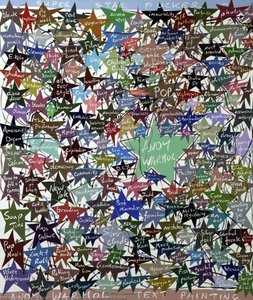
Super Star Fucker, Andy Warhol Text Painting

Peter Maxwell Davies’ *Super Star Fucker* is a striking acrylic on canvas artwork exploring connections between Andy Warhol and Alfred Barr’s seminal poster ‘Cubism and Abstract Art.’ Combining formal beauty with conceptual humor, it references celebrity culture and gay underground art, mirroring Davies' own artistic ethos.

Sir Peter Maxwell Davies (1934-2016): Explore the innovative world of this celebrated British composer & conductor, famed for his operas, symphonies, and pioneering spirit in music!

Hand Made Oil Reproduction

Hand-painted oil on canvas in your size and frame, made to order by our artists.

P118B $10
P118H $10
P118W $10
P438Z $10
P508JH $12
P508YH $12
P805H $10
P805Z $10
P919BZ $10
P919G $10
P919XJ $10
P959ZH $10
P968JZ $12
W106C $8
W218G $10
W218JH $8
W218Y $10
W307PJ $10
W316G $10
W316PJ $8
W316Y $10
W398PJ $8
W4111J $10
W500HY $15
W500JH $15
W692G $12
W849H $8
W940BG $15
W953PJ $8

Standard
custom
CM
INCH

Pick from our preset sizes that match the artwork's original proportions.

width
height

You may enter your own dimensions to fit a specific frame or space. If your selected size does not match the original image's proportions, we will either crop the artwork or extend the painting with additional hand-painted elements. A digital mockup will be sent for your approval before production begins.
Please note that the on-screen preview does not reflect the actual cropping or extension. Only the mockup will accurately show the final composition.
While custom sizes are available, we recommend selecting a dimension from the predefined list to preserve the original proportions.

Examples of what can be changed: Replace face with customer photo; Add pet (e.g., replace cat with dog); Include hidden message in background; Change background landscape or elements.
After order, BuyPopArt.com team will email client for instructions and provide a mockup preview

Worldwide Delivery () in 3/4 weeks instead of standard 5 weeks. (16 July). No compromise on quality.

why_choose_icon
Free Worldwide Express Shipping
why_choose_icon
High-Quality Linen Canvas
why_choose_icon
Full Shipping Insurance
why_choose_icon
Customs Tax Refund Guarantee
why_choose_icon
True Color Matching Guarantee
why_choose_icon
60-Day Return Policy (Defects Only)
why_choose_icon
100% Money-Back Guarantee
why_choose_icon
Bulk Discount Offer

Total Price

-

reproduction

Super Star Fucker, Andy Warhol Text Painting

Reproduction Medium

Reproduction Size

-

Total Price

-

Quick Facts

  • Artistic style: Pop Art
  • Year: 2001
  • Subject or theme: Celebrity culture; Warhol influence
  • Influences: Alfred Barr
  • Medium: Acrylic on canvas
  • Artist: Peter Maxwell Davies
  • Title: Super Star Fucker, Andy Warhol Text Painting

Art Quiz

There is only one correct answer for each question.

Question 1:
What is the primary artistic style of *Super Star Fucker*, Andy Warhol Text Painting?
Question 2:
Who inspired Peter Maxwell Davies to create this artwork?
Question 3:
What medium was used to produce *Super Star Fucker*, Andy Warhol Text Painting?
Question 4:
The artwork references a significant cultural movement of the 20th century. What is it?
Question 5:
What does the title *Super Star Fucker* suggest about Davies' intention for this piece?

Artwork Description

Peter Maxwell Davies’ *Super Star Fucker*: A Dialogue Between Warholian Pop Art and Conceptual Thought

This painting by Peter Maxwell Davies—titled *Super Star Fucker*, and awarded first prize in the John Moores Exhibition of Contemporary Painting 22 (now the John Moores Painting Prize)—represents a fascinating intersection between visual formalism and conceptual exploration. Created in 2001, it’s more than just an aesthetically striking artwork; it's a deliberate provocation designed to engage with the legacy of Andy Warhol and the broader discourse surrounding art history and contemporary artistic practice. Davies himself articulated this intention: “For some years I have been making text paintings alongside abstract paintings. Both types feed off and inform one another. The text paintings offer a playful and humorous take on my attempts to understand art history and contemporary art.” Davies’ approach is rooted in the influential work of Alfred Barr Jr., director of MoMA, whose groundbreaking exhibition “Cubism and Abstract Art” (1936) established a framework for interpreting modern art as a continuous dialogue between movements. Davies consciously adopted Barr's method—creating a visual diagram to trace connections between artistic influences—demonstrating an awareness of the scholarly tradition surrounding modernist aesthetics. This conceptual underpinning is powerfully conveyed through the painting’s composition and execution, elevating it beyond mere decorative appeal. The artwork itself presents a densely packed canvas dominated by irregularly shaped stars in a vibrant palette of blues, reds, yellows, greens, and purples—colors deliberately eschewed for their harmonious blending, instead appearing as distinct blocks that contribute to the overall fragmented visual experience. These stars aren’t uniformly distributed; they cluster and overlap, creating areas of intense visual density, mirroring the chaotic energy characteristic of Warhol's studio environment. Superimposed upon this starry field is a profusion of handwritten or printed text—a deliberate disruption of traditional artistic conventions—that seems random at first glance but carries thematic weight related to pop culture, art history, and Davies’ own intellectual curiosity. The text utilizes various sizes and orientations, furthering the sense of complexity and inviting contemplation about its significance. Davies' technique employs acrylic paint on canvas, resulting in a textured surface that subtly reflects light—a deliberate choice designed to heighten visual impact. He skillfully combines formal considerations with conceptual references, mirroring Warhol’s embrace of both aesthetics and intellectual critique. The painting draws inspiration from Barr’s seminal exhibition, which aimed to illuminate the interconnectedness of artistic movements during the early 20th century. Davies' use of a flowchart-like structure—a visual representation of this lineage—underscores his commitment to exploring the conceptual dimensions of artmaking. The symbolic resonance of *Super Star Fucker* extends beyond its immediate aesthetic qualities. It engages with Warhol’s fascination for celebrity culture and his exploration of queer identity, referencing figures like Marilyn Monroe and Jackie Kennedy—icons whose images captivated audiences during Warhol's era. Davies utilizes Warhol’s stylistic innovations—screen printing, portraiture, and self-portraiture—to articulate a broader critique of commodification and consumerism within the art world. Furthermore, he acknowledges Warhol’s influence on gay culture, recognizing his role in normalizing LGBTQ+ visibility and challenging societal prejudices. The painting's title itself—"Super Star Fucker"—is deliberately provocative, embodying Davies’ playful defiance of artistic conventions and injecting a dose of humor into his engagement with Warholian aesthetics. It serves as a testament to Davies’ unwavering dedication to pushing boundaries and fostering dialogue within the realm of contemporary art.

Artist Biography

A Life Dedicated to Sound: The World of Peter Maxwell Davies

Sir Peter Maxwell Davies, a name synonymous with innovation and daring in 20th and 21st-century British music, was more than just a composer; he was an architect of sound, a theatrical visionary, and a dedicated champion of the arts. Born in Salford, United Kingdom, in 1934, his journey from a young boy captivated by Gilbert and Sullivan to becoming Master of the Queen’s Music is a testament to unwavering dedication and artistic courage. Even as a child, a performance of *The Gondoliers* ignited within him an ambition that would define his life – to create music. Early piano lessons quickly blossomed into composition, with youthful works like *Blue Ice* already finding their way onto the BBC’s *Children's Hour*, hinting at the prodigious talent that lay within. His formal education at the University of Manchester and the Royal Manchester College of Music provided a crucial foundation, but it was the formation of New Music Manchester alongside fellow students Harrison Birtwistle, Alexander Goehr, Elgar Howarth, and John Ogdon that truly set his creative trajectory. This collective wasn’t merely a study group; it was a crucible where contemporary music was explored, dissected, and brought to life, laying the groundwork for each member's future success. A scholarship to Rome further honed his skills under Goffredo Petrassi, exposing him to new perspectives and solidifying his commitment to pushing musical boundaries.

A Diverse Palette of Musical Expression

Davies’ compositional output was remarkably expansive, defying easy categorization. He moved with apparent ease between opera, symphonies, concertos, chamber music, choral works, and even film scores, each genre bearing the unmistakable stamp of his unique voice. However, it is perhaps in the realm of opera that he truly distinguished himself. Works like *Eight Songs for a Mad King* (1969) were deliberately provocative, challenging conventional vocal techniques and theatrical staging to create an experience that was both unsettling and profoundly moving. The use of extended vocal ranges and unconventional instrumentation wasn’t merely shock value; it was a deliberate attempt to explore the psychological depths of his subjects. Later works, such as *Kommilitonen!* (2011), continued this exploration of dramatic form, demonstrating an enduring willingness to experiment and innovate. Beyond opera, Davies embarked on a monumental symphonic journey, composing ten symphonies between 1973 and 2013. These weren’t simply numbered works; each symphony represented a distinct stylistic evolution, reflecting his ever-expanding musical horizons. *Alla Ricerca di Borromini*, the tenth symphony, stands out for its fascinating interplay between music and architecture, revealing Davies's broader intellectual curiosity. His commitment to orchestral writing also manifested in the series of ten *Strathclyde Concertos* composed for the Scottish Chamber Orchestra, showcasing his ability to tailor his compositions to specific ensembles and instrumental forces.

Influences and a Unique Aesthetic

The seeds of Davies’ musical language were sown by early influences like Goffredo Petrassi, but his artistic development was far from linear. He absorbed inspiration from diverse sources – the intricate counterpoint of Renaissance music, the structural clarity of Baroque forms, and the radical experimentation of the avant-garde. However, a pivotal moment in shaping his aesthetic came with his extended sojourn on the Orkney Islands. The stark beauty of the landscape, the raw power of the natural world, and the rich cultural heritage of the region profoundly impacted his compositions. He didn’t simply depict Orkney; he *absorbed* it, allowing its spirit to permeate his music. This connection is evident in many of his works, which often evoke a sense of isolation, mystery, and ancient ritual. Davies wasn't afraid to embrace contradictions – blending traditional forms with experimental approaches, juxtaposing dissonance with lyricism, and creating a cohesive whole from seemingly disparate elements. This willingness to challenge conventions was the hallmark of his artistic integrity. He embraced both intellectual rigor and emotional depth, crafting music that was intellectually stimulating yet deeply affecting.

Legacy and Lasting Impact

Peter Maxwell Davies left an indelible mark on British music, expanding the boundaries of operatic form, orchestral writing, and musical expression itself. His appointment as Master of the Queen’s Music from 2004 to 2014 was a fitting recognition of his significant contribution to the nation's cultural landscape. He didn’t simply fulfill the role; he used it as a platform to promote classical music to a wider audience, advocating for its importance in education and public life. His founding of the St Magnus Festival in Orkney wasn’t just about showcasing new works; it was about fostering a vibrant artistic community and providing opportunities for emerging musicians. He understood that nurturing creativity required more than just financial support – it demanded a supportive environment where artists could take risks and explore their potential. Davies was also remarkably forward-thinking, recognizing the power of technology to connect with audiences. As one of the first classical composers to launch a music download website, MaxOpus, he demonstrated his commitment to innovation and accessibility. His legacy continues to inspire composers and performers around the world, solidifying his place as one of the most important musical figures of our time. He was a true original, a fearless innovator, and a passionate advocate for the power of music to transform lives.

A Final Note

  • Early Recognition: Davies’s talent was evident from a young age, with early compositions broadcast on BBC radio.
  • Collaborative Spirit: The New Music Manchester collective played a vital role in shaping his artistic development and fostering a community of like-minded musicians.
  • Orkney’s Influence: His time spent on the Orkney Islands profoundly impacted his musical aesthetic, imbuing his compositions with a unique sense of place and atmosphere.
  • Master of Innovation: Davies consistently challenged conventions, pushing boundaries in opera, symphonic writing, and beyond.
  • A Lasting Legacy: His music continues to inspire and captivate audiences worldwide, ensuring his place as a towering figure in British musical history.
Sir Peter Maxwell Davies’s contribution extends far beyond the notes he wrote; it lies in the spirit of innovation, courage, and artistic integrity that defined his life and work.
Peter Maxwell Davies

Peter Maxwell Davies

1934 - 2016 , United Kingdom

Quick Facts

  • Artistic Movement Or Style: Contemporary music
  • Artists Or Movements Influenced By This Artist: ['British music']
  • Artists Who Influenced This Artist: ['Goffredo Petrassi']
  • Date Of Birth: 1934
  • Date Of Death: 2016
  • Full Name: Peter Maxwell Davies
  • Nationality: English
  • Notable Artworks:
    • Eight Songs for a Mad King
    • Kommilitonen!
    • Ten Symphonies
  • Place Of Birth (City And Country): Salford, UK
Explore artworks organized by themes, styles, and characteristics.