Buy print Buy printBuy Image Buy Image SendSend
DetailsDetails Add to favorites Add to favorites DownloadDownload SimilarsSimilars X-RayX-Ray DiaporamaDiaporama

Modern painting with wedge

Roy Lichtenstein (1923-1997): Pioneering Pop Artist famed for Ben-Day dots, comic strip inspiration & bold commentary on consumer culture. Explore 'Whaam!' & more.

Hand Made Oil Reproduction

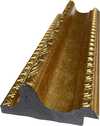
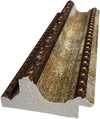
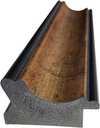
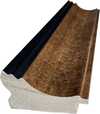
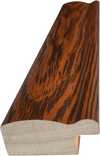
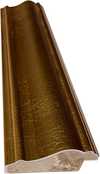
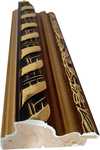
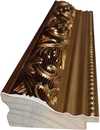
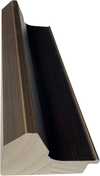
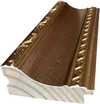
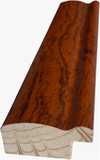
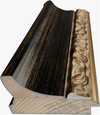
Hand-painted oil on canvas in your size and frame, made to order by our artists.
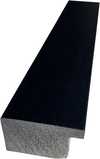
P118B $10
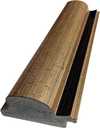
P118H $10
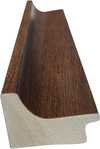
P118W $10
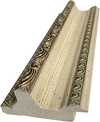
P438Z $10
P508JH $12
P508YH $12
P805H $10
P805Z $10
P919BZ $10
P919G $10
P919XJ $10
P959ZH $10
P968JZ $12
W106C $8
W218G $10
W218JH $8
W218Y $10
W307PJ $10
W316G $10
W316PJ $8
W316Y $10
W398PJ $8
W4111J $10
W500HY $15
W500JH $15
W692G $12
W849H $8
W940BG $15
W953PJ $8

Standard
custom
CM
INCH

Pick from our preset sizes that match the artwork's original proportions.

width
height

You may enter your own dimensions to fit a specific frame or space. If your selected size does not match the original image's proportions, we will either crop the artwork or extend the painting with additional hand-painted elements. A digital mockup will be sent for your approval before production begins.
Please note that the on-screen preview does not reflect the actual cropping or extension. Only the mockup will accurately show the final composition.
While custom sizes are available, we recommend selecting a dimension from the predefined list to preserve the original proportions.

Examples of what can be changed: Replace face with customer photo; Add pet (e.g., replace cat with dog); Include hidden message in background; Change background landscape or elements.
After order, BuyPopArt.com team will email client for instructions and provide a mockup preview

Worldwide Delivery () in 3/4 weeks instead of standard 5 weeks. (16 July). No compromise on quality.

why_choose_icon
Free Worldwide Express Shipping
why_choose_icon
High-Quality Linen Canvas
why_choose_icon
Full Shipping Insurance
why_choose_icon
Customs Tax Refund Guarantee
why_choose_icon
True Color Matching Guarantee
why_choose_icon
60-Day Return Policy (Defects Only)
why_choose_icon
100% Money-Back Guarantee
why_choose_icon
Bulk Discount Offer

Total Price

-

reproduction

Modern painting with wedge

Reproduction Medium

Reproduction Size

-

Total Price

-

Quick Facts

  • Artist: Roy Lichtenstein
  • Artistic style: Abstract Expressionism
  • Notable elements or techniques: Ben-Day dots, Color halftone printing
  • Location: Private Collection
  • Dimensions: 73 x 86 cm
  • Title: Modern painting with wedge
  • Subject or theme: Geometric abstraction

Artwork Description

Modern Painting with Wedge – A Bold Echo of Lichtenstein’s Vision

Roy Fox Lichtenstein, born in Manhattan on October 27, 1923, irrevocably transformed the trajectory of twentieth-century art. His journey began with a fascination for realism and drawing, nurtured by formative experiences at the Art Students League and Ohio State University – briefly interrupted by wartime service. However, it was his encounter with Reginald Marsh’s teachings that truly ignited his artistic spirit, propelling him toward a revolutionary approach to visual expression. Lichtenstein's early influences foreshadowed the seismic shifts he would orchestrate within the burgeoning Pop Art movement, rejecting traditional academic conventions in favor of embracing the vernacular language of advertising and comic books. This deliberate stylistic choice wasn’t merely aesthetic; it was a profound critique of societal values and a reimagining of art’s role in confronting contemporary concerns.
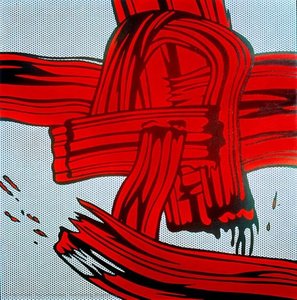
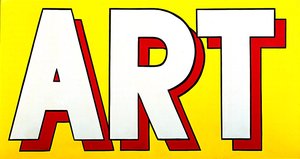
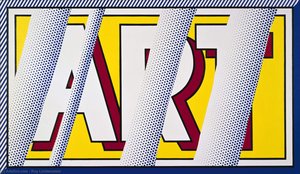
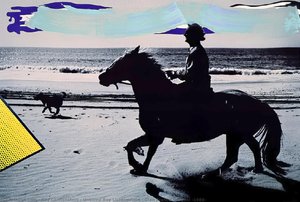
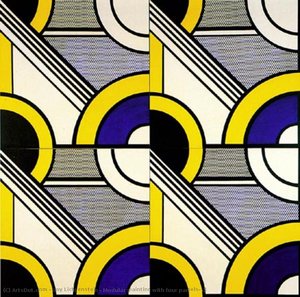
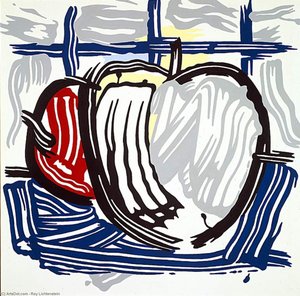
  • Subject Matter: The artwork presents a deceptively simple geometric form – a wedge – overlaid against a vibrant yellow background. Its starkness is punctuated by strategically placed blue circles and countless white dots, creating an arresting visual contrast.
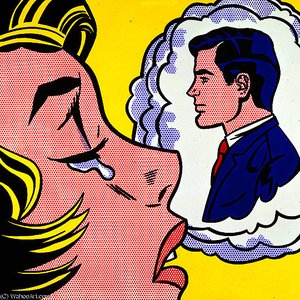
  • Style & Inspiration: Immediately recognizable as Pop Art, the piece draws heavily from the distinctive style pioneered by Roy Lichtenstein himself. The use of Ben-Day dots – a printing technique popularized in comic strips – lends the painting a characteristic halftone effect, mimicking the illusionistic quality of printed images.

Technique & Material Considerations

The execution of this artwork demonstrates Lichtenstein’s mastery of meticulous craftsmanship. The wedge shape is rendered with precise lines and shading, emphasizing geometric accuracy while simultaneously conveying a sense of dynamism. The yellow background provides a luminous canvas for the contrasting blue circles and white dots, highlighting their placement and contributing to the overall visual impact. Careful attention was paid to color palettes and textural variations—elements crucial to Lichtenstein’s signature aesthetic.
  • Printing Method: Lithography – a technique known for its ability to reproduce images with exceptional clarity and tonal range – was employed, ensuring the faithful reproduction of the original artwork's colors and details.
  • Surface Texture: The white dots are applied with painstaking precision, creating a subtle surface texture that adds depth and dimensionality to the composition. This textural element reinforces Lichtenstein’s commitment to capturing visual nuances beyond mere representation.

Historical Context & Symbolic Resonance

Created in 1967, “Modern Painting with Wedge” emerged during a period of significant artistic experimentation and cultural upheaval—the height of the Pop Art movement. Lichtenstein’s work served as a counterpoint to Abstract Expressionism's emotionally charged canvases, advocating for a more detached and intellectually stimulating engagement with art. The wedge itself can be interpreted symbolically as representing progress, division, or perhaps even disruption – themes prevalent in discussions surrounding societal transformation during the era. Furthermore, referencing “Beat the Whites with the Red Wedge,” a powerful Bolshevik propaganda poster from 1919—created by El Lissitzky—underscores Lichtenstein’s engagement with political discourse and his willingness to utilize visual imagery as a tool for conveying ideological messages.

Emotional Impact & Artistic Legacy

Despite its apparent simplicity, “Modern Painting with Wedge” possesses an undeniable emotional resonance. The bold color combinations and geometric forms provoke contemplation about perception and representation—questions central to Lichtenstein’s artistic philosophy. More broadly, the artwork embodies the spirit of Pop Art's challenge to traditional art conventions and its celebration of popular culture as a source of inspiration. Its enduring appeal testifies to Lichtenstein’s ability to distill complex ideas into visually arresting compositions that continue to captivate audiences today.

Artist Biography

The Genesis of a Pop Visionary

Roy Fox Lichtenstein, born in the vibrant metropolis of New York City on October 27, 1923, indelibly altered the landscape of twentieth-century art. Emerging as a pivotal figure within the Pop Art movement, Lichtenstein didn’t simply reflect his era; he actively interrogated it, transforming commonplace imagery into compelling artistic statements. His upbringing in an upper-middle-class Jewish family fostered both a cultural awareness and an early artistic inclination. Childhood exposure to museums and concerts, coupled with a deep appreciation for jazz music, laid the groundwork for a creative spirit that would challenge conventional notions of fine art. Though initially drawn to realistic drawing and painting during his formative years, Lichtenstein’s formal training commenced at the Art Students League in 1939 under Reginald Marsh, followed by studies at Ohio State University – interrupted briefly by wartime service in the Army. These experiences provided a robust technical foundation that would later be brilliantly re-contextualized through the lens of mass culture and commercial aesthetics. The seeds of his signature style weren’t sown within the hallowed halls of artistic tradition but rather in the often-overlooked world of everyday imagery, particularly comic books and advertising.

From Abstraction to Appropriation: A Pivotal Shift

Lichtenstein's early work demonstrated a clear engagement with Abstract Expressionism, mirroring the dominant aesthetic trends of the post-war period. However, this phase proved transitional, a stepping stone towards his revolutionary style. A crucial moment arrived during his tenure at Rutgers University where he encountered Allan Kaprow, whose influence reignited Lichtenstein’s interest in proto-pop imagery. This encounter sparked a critical shift in his artistic trajectory, leading him to question the established boundaries between “high” and “low” art. He began looking beyond the subjective expression of Abstract Expressionism towards the objective language of popular culture – specifically, comic books and advertising. The year 1961 marked a turning point with *Look Mickey*, a work that boldly appropriated characters from Disney comics, signaling the beginning of his signature style. This wasn’t mere imitation; it was an act of artistic re-evaluation, elevating commonplace imagery to the status of fine art. He didn't simply copy comic strips; he meticulously recreated them using techniques mimicking commercial printing processes, a deliberate blurring of the lines between original artwork and mass production. This appropriation wasn’t about celebrating consumerism uncritically but rather examining its pervasive influence on American society and challenging traditional artistic hierarchies.

The Language of Ben-Day Dots and Bold Lines

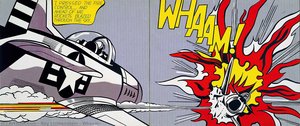
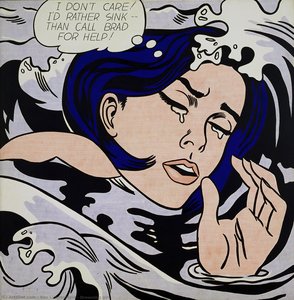
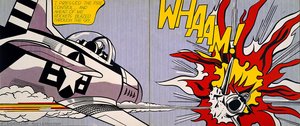
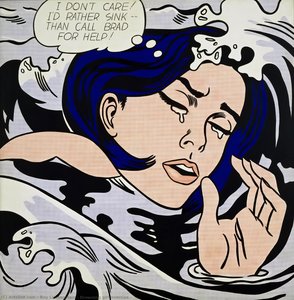
Lichtenstein's artistic vocabulary is instantly recognizable: bold, primary colors, thick black outlines, and most famously, Ben-Day dots – a technique borrowed directly from the mechanical reproduction of comic books. These dots weren’t merely decorative; they were integral to his conceptual framework, representing the very process of mass production and challenging the traditional emphasis on the artist's hand. His paintings often enlarged details from comic strips to monumental scale, forcing viewers to confront the aesthetic qualities of an art form typically dismissed as trivial. Works like *Whaam!* (1963), *Drowning Girl* (1963), and *Oh, Jeff…I Love You, Too…But…* (1964) became iconic representations of Pop Art, capturing the anxieties and desires of a rapidly changing consumer culture. These weren’t simply depictions of comic book scenes; they were commentaries on themes of war, romance, and societal expectations, filtered through the visual language of mass media. He aimed to strip away any pretense of artistic subjectivity, presenting his work as objective reflections of American society – a mirror held up to its own manufactured reality. The deliberate flatness and lack of painterly gesture further emphasized this detachment, mimicking the impersonal nature of commercial printing.

Legacy and Lasting Impact

Roy Lichtenstein’s influence extends far beyond the realm of painting. His innovative use of commercial techniques and appropriation paved the way for new generations of artists exploring themes of consumerism, media saturation, and cultural identity. The sale of *Masterpiece* in 2017 for $165 million solidified his position as one of the most commercially successful American artists of all time, but his legacy is not solely defined by monetary value. He challenged traditional notions of artistic authorship and originality, forcing a re-evaluation of what constitutes “art” itself. His work continues to inspire graphic designers, illustrators, and visual artists across various disciplines.
  • Major Achievements: Pioneered Pop Art style; achieved international recognition with groundbreaking exhibitions.
  • Notable Works: *Whaam!*, *Drowning Girl*, *Oh, Jeff…I Love You, Too…But…*, *Masterpiece*.
  • Teaching Career: Influenced aspiring artists at SUNY Oswego and Rutgers University.
Lichtenstein passed away on September 29, 1997, leaving behind a body of work that remains as relevant and provocative today as it was during the height of the Pop Art movement. His art serves as a powerful reminder of the pervasive influence of mass media and its ability to shape our perceptions of reality. He didn’t just reflect his time; he actively interrogated it, leaving an indelible mark on the history of 20th-century art and continuing to inspire critical dialogue about the relationship between art, culture, and commerce. His legacy is a testament to the power of appropriation, the beauty of the commonplace, and the enduring impact of a truly visionary artist.
Roy Lichtenstein

Roy Lichtenstein

1923 - 1997 , United States of America
Quick Facts

  • Artistic Movement Or Style: Pop Art
  • Artists Or Movements Influenced By This Artist:
    • Graphic designers
    • Illustrators
  • Artists Who Influenced This Artist:
    • Reginald Marsh
    • Allan Kaprow
  • Date Of Birth: October 27, 1923
  • Date Of Death: September 29, 1997
  • Full Name: Roy Fox Lichtenstein
  • Nationality: American
  • Notable Artworks:
    • Whaam!
    • Drowning Girl
    • Masterpiece
    • Oh, Jeff...
  • Place Of Birth: New York City, USA
Explore artworks organized by themes, styles, and characteristics.