x


 OilWallArtHudson River School
 1833
1833 49.0 x 41.0 cm
 Metropolitan Museum of Art
Hand-painted oil on canvas in your size and frame, made to order by our artists.





























Pick from our preset sizes that match the artwork's original proportions.

You may enter your own dimensions to fit a specific frame or space. If your selected size does not match the original image's proportions, we will either crop the artwork or extend the painting with additional hand-painted elements. A digital mockup will be sent for your approval before production begins.
Please note that the on-screen preview does not reflect the actual cropping or extension. Only the mockup will accurately show the final composition.
While custom sizes are available, we recommend selecting a dimension from the predefined list to preserve the original proportions.
Worldwide Delivery () in 3/4 weeks instead of standard 5 weeks. (16 July). No compromise on quality.


The Titan's Goblet
Reproduction Size
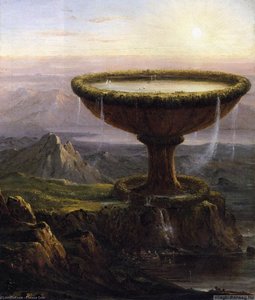
Thomas Cole's "The Titan’s Goblet," painted in 1833, is not merely a landscape; it’s an immersive allegory, a visual poem steeped in the Romantic tradition yet profoundly rooted in American identity. This monumental oil painting, now housed at the Metropolitan Museum of Art, immediately captivates with its sheer scale and dramatic composition – a vast bowl or vase dominating a rugged mountainscape. Yet, beyond the immediate spectacle lies a complex layering of meaning, inviting viewers to contemplate themes of creation, time, civilization, and the relationship between humanity and nature.
Cole’s artistic journey is crucial to understanding this enigmatic work. Born in England but deeply influenced by European Romanticism, he arrived in America with a desire to forge a distinctly American art—one that moved beyond the historical narratives favored in Europe and instead focused on the sublime beauty of the American wilderness. “The Titan’s Goblet” exemplifies this shift; it's not a depiction of a specific place but rather an imagined realm, a constructed landscape brimming with symbolic weight. The painting’s genesis is intertwined with Cole’s own artistic struggles and his relationship with his patron, Luman Reed, who initially requested a series of paintings depicting the course of empire. The difficulties he encountered in completing this ambitious project—and his subsequent decision to paint a single, self-contained landscape—contributed significantly to the painting's open-ended interpretation.
The immediate visual impact is striking: a colossal golden bowl, seemingly carved from stone, rests precariously on a mountain’s edge. Water cascades dramatically over its rim, feeding a lush, verdant landscape below – a miniature world teeming with tiny buildings reminiscent of Greek temples and Italian palaces. Scattered throughout this idyllic scene are figures engaged in leisurely activities—boating, strolling, and seemingly oblivious to the grandeur surrounding them. This internal world is juxtaposed against the stark, rocky terrain of the mountain itself, creating a powerful visual dichotomy.
However, Cole doesn’t simply present a picturesque vista. The water flowing from the goblet acts as a transformative agent. It nourishes the land below, fostering a civilization that appears both idyllic and somewhat fragile. The contrast between the cultivated world within the bowl and the desolate mountainside suggests a commentary on the impact of human activity upon nature—a subtle critique of unchecked expansion and the potential for environmental degradation. The placement of the two small buildings is particularly significant; they represent the ambition of civilization, attempting to impose order onto the untamed wilderness.
The painting’s enduring mystery stems from Cole's deliberate refusal to offer a definitive explanation. He famously refrained from providing any accompanying text, leaving the interpretation entirely open to the viewer. Over time, various theories have emerged, ranging from interpretations rooted in Norse mythology—linking the goblet to Yggdrasil, the world tree—to comparisons with Bosch’s *Garden of Earthly Delights*, suggesting a parallel creation narrative. Cole himself alluded to the idea of a “picture within a picture,” and some scholars believe he drew inspiration from J.M.W. Turner's *Ulysses Deriding Polyphemus*, reflecting his own complex relationship with the British painter’s dynamic style.
Interestingly, Cole’s initial sketches for the painting reveal a deeper engagement with the concept of time and its passage. The presence of a setting sun evokes a sense of twilight and the inevitable decline of empires—a theme that resonates throughout his “Course of Empire” series. The small figure in the foreground, often interpreted as Cole himself, gazing out over the scene, adds another layer of introspection, inviting us to contemplate our own place within this vast and timeless landscape.
BuyPopArt offers meticulously crafted hand-painted reproductions of Thomas Cole’s “The Titan’s Goblet,” capturing the painting's rich detail, atmospheric depth, and evocative symbolism. Each reproduction is created by skilled artists using traditional oil painting techniques, ensuring a faithful representation of Cole’s original vision. Whether you seek to add a touch of Romantic grandeur to your living room, study, or gallery space, our reproductions provide an authentic and captivating way to experience this iconic American masterpiece. The scale of the original is faithfully replicated, allowing you to fully appreciate the painting's monumental scope and immersive quality. Bring the mystery and beauty of “The Titan’s Goblet” into your home – a timeless testament to Cole’s artistic genius.

1801 - 1848 , United Kingdom

Explore the emotional depth of Romantic landscape painting (18th-19th century). Discover key artists like Friedrich & Cole, and the concepts of the sublime. Expert insights for art lovers & collectors.

Explore the emotional power of Romantic landscape painting! Discover the sublime & picturesque aesthetics, key artists like Friedrich & Cole, and lasting influence on art history. Find your perfect piece at BuyPopArt.

Explore the rich history of rivers in painting! Discover masterpieces from ancient times to Impressionism & beyond. Learn about symbolism, artists like Monet & Daubigny, and find your perfect serene artwork at BuyPopArt.

Explore the captivating genre scenes of Thomas George Webster, a Victorian painter bridging British traditions with American themes. Discover his style, influences & legacy in 19th-century art history.

Explore the captivating world of the Hudson River School! Discover the history, artists, and defining characteristics of this iconic American art movement. Learn about Romanticism's influence & find inspiration for your collection.


Stay updated with the latest art news, exclusive offers, and decoration ideas.
Tell us about your project and our art experts will provide you with 3 personalized art suggestions.
Let Us Curate 3 Options Just for You - Free!


 Buy print
 Send
Send Share
Share
 Details

 Download
 Similars
 X-Ray
X-Ray Diaporama
 Read More







 Glass option is only available in size under 110 CM