Early Life & Influences: From Realism to Expressionist Roots
Abstract expressionism in the United States emerged as a distinct art movement in the aftermath of World War II and gained mainstream acceptance in the 1950s, a shift from the American social realism of the 1930s influenced by the Great Depression an...
Jacob Kainen’s artistic trajectory was not one of immediate revelation, but a gradual unfolding shaped by a keen intellect and an insatiable curiosity. Born in Waterbury, Connecticut, in 1909 to Russian immigrant parents, he inherited a household that valued both cultural enrichment and practical skill. His father's inventive spirit and his mother’s love for music and literature laid the foundation for Kainen’s lifelong engagement with art, even manifesting early in meticulously curated scrapbooks filled with reproductions gleaned from publications like The Jewish Daily Forward. This formative period wasn’t simply about admiring masterpieces; it was a deliberate act of study, a nascent artist absorbing the language of form and composition. A move to New York City in 1918 amplified these influences, providing access to institutions like The Metropolitan Museum of Art and the New York Public Library – spaces that would become crucial to his developing aesthetic sensibility.
However, Kainen’s early artistic explorations weren't immediately abstract. His initial training at the Pratt Institute, though ultimately frustrating, revealed a preference for portraiture and a warm tonal palette reminiscent of Cézanne. It was a period marked by technical proficiency but also a growing dissatisfaction with what he perceived as the school’s rigid adherence to traditional methods. This discontent would prove pivotal, setting him on a path toward more radical experimentation and an embrace of the emotive power found in European modernism.
Kainen’s Engagement with Social Realism and the WPA Era
Expelled from Pratt just weeks before graduation for his rebellious spirit, Kainen plunged into the vibrant artistic milieu of 1930s New York. This was an era defined by economic hardship and social unrest, powerfully reflected in the rise of Social Realism – a movement that sought to depict the struggles of everyday people with unflinching honesty. Kainen became deeply involved, joining groups like the New York Group and “The Ten,” collectives dedicated to representing “the rawest human emotions” and prioritizing expressive paint handling over mere descriptive accuracy. Works such as Tenement Fire (1934) and The Flood (1936) exemplify this period, showcasing a commitment to portraying the realities of poverty and hardship with both technical skill and emotional urgency.
Crucially, Kainen’s involvement wasn't merely stylistic; it was rooted in a genuine concern for social justice. His participation in the WPA Graphic Arts Division further solidified his connection to this artistic ethos, providing opportunities to create works that directly addressed contemporary issues. Yet, even within this framework, a desire for greater expressive freedom began to emerge, hinting at the abstract explorations that would define his later career.
The Transition to Abstraction: Color Field Painting Emerges
Color field painting (Colour field painting in Commonwealth English) is a style of abstract painting that emerged in New York City during the 1940s and 1950s. It was inspired by European modernism and closely related to abstract expressionism, while ...
Kainen’s artistic evolution wasn't an abrupt departure but a gradual refinement of his core concerns. While deeply engaged with Social Realism, he recognized its limitations in fully conveying the complexities of human experience. A pivotal friendship with Arshile Gorky – forged during lively debates in New York cafeterias – proved transformative. Their shared belief in the importance of studying master works and their willingness to challenge conventional norms fostered a spirit of experimentation that would ultimately lead Kainen toward abstraction.
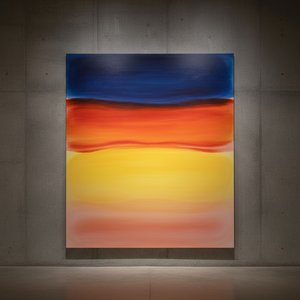
The late 1940s witnessed a significant shift in his work, marked by a growing emphasis on color and form over narrative representation. Inspired by European modernism and the burgeoning Abstract Expressionist movement, Kainen began to explore the possibilities of large fields of flat, solid color spread across the canvas. This wasn’t simply about aesthetic innovation; it was an attempt to liberate color from “objective context” and allow it to become the subject itself – a pursuit central to the emerging Color Field painting style. His work increasingly prioritized consistency of form and process, minimizing gesture and brushstrokes in favor of an overall visual harmony.
A Unique Voice in Abstract Expressionism: Style and Symbolic Depth
While often associated with Abstract Expressionism, Kainen’s work occupies a unique space within the movement. Unlike the gestural intensity of Jackson Pollock or the somber contemplation of Mark Rothko, Kainen's abstractions possess a dynamic energy and symbolic depth that sets them apart. Consider Advance Man (1974), a vibrant watercolor piece characterized by flowing lines and a striking interplay of red and blue hues. The composition isn’t merely decorative; it evokes a sense of movement, progress, and perhaps even conflict – qualities rooted in his earlier engagement with social themes.
Kainen never fully abandoned the humanistic concerns that informed his Social Realist period. Even as he embraced abstraction, his work retained an “aura of human experience,” suggesting underlying narratives and emotional resonances. This is evident in his meticulous layering of color and form, creating areas of unbroken surface that invite contemplation and interpretation. His approach was less about spontaneous action and more about deliberate construction – a testament to his intellectual rigor and artistic control.
Legacy & Influence: Kainen's Place in American Art History
Jacob Kainen’s contribution to American art extends beyond his paintings and prints. He was also a respected art historian, authoring influential books on John Baptist Jackson and the etchings of Canaletto – demonstrating a lifelong commitment to scholarship and preservation. Furthermore, his extensive collection of German Expressionist art, generously donated to the National Gallery of Art in 1985 with his wife Ruth, continues to enrich public understanding of this pivotal movement.
Kainen’s legacy lies not only in his individual achievements but also in his ability to bridge seemingly disparate artistic traditions. He seamlessly integrated the social awareness of Realism with the expressive freedom of Abstract Expressionism and Color Field painting, creating a body of work that is both intellectually stimulating and emotionally resonant. Artists like Alma Thomas, who similarly explored the power of color and abstraction, stand as testament to his enduring influence on subsequent generations. His story serves as a powerful reminder that artistic evolution is rarely linear – often it’s through embracing change and challenging convention that true innovation emerges.
- Explore more works by Jacob Kainen at WahooArt.com.
- Discover the vibrant world of Abstract Expressionism and Color Field painting with our curated collection.