


The Subway Canvas: Haring’s Emergence from the New York Underground
 Wikipedia: Keith Haring
Keith Allen Haring (May 4, 1958 – February 16, 1990) was an American artist whose pop art emerged from the New York City graffiti subculture of the 1980s. His animated imagery has "become a widely recognized visual language". Much of his work include...
Keith Haring didn't emerge from a traditional art school pedigree; his canvas was the pulsating heart of 1980s New York City – specifically, the subway system. While artists like Andy Warhol were elevating consumer culture to high art within gallery walls, Haring brought art directly *to* the people, bypassing institutional gatekeepers and embracing the raw energy of urban life. This wasn’t mere vandalism; it was a deliberate act of democratization, filling empty black spaces on advertising panels with chalk outlines that quickly evolved into his signature lexicon of radiant babies, barking dogs, and abstract figures. The subway became an impromptu exhibition space, a constantly shifting gallery accessible to all, and Haring, its most prolific contributor. These early works weren’t conceived as preparatory sketches for larger pieces; they were immediate responses to the city's rhythm, anxieties, and vibrant pulse. Arrests followed, of course – charges of vandalism – but even these encounters served to amplify his presence, turning him into a local celebrity and solidifying his reputation as an artist who dared to challenge conventional boundaries.
Pop Art Deconstructed: Influences, Techniques & Haring’s Unique Visual Language
 Pop Art 2.0: Recontextualizing Appropriation & Consumerism for a Digital Native Generation
Explore the evolution of Pop Art for today's digital world! Discover how appropriation & consumerism are reimagined by a new generation of artists. Expert insights & collecting tips.
To understand Haring is to understand the lineage of Pop Art, yet also recognize his distinct departure from it. While Warhol appropriated imagery *from* mass culture, Haring synthesized a visual language that felt intrinsically personal and expressive. The bold lines and flat planes of color owe a clear debt to artists like Roy Lichtenstein, but Haring’s work possessed an immediacy and kinetic energy absent in the cool detachment of earlier Pop aesthetics. He wasn't simply replicating images; he was creating a new form of communication – a visual shorthand for complex emotions and ideas. His fascination with cartooning, evident from childhood sketches, is crucial here. The simplified forms weren’t about naiveté but rather about accessibility and universal recognition. This deliberate simplification allowed his messages to transcend language barriers and cultural differences. Furthermore, Haring's technique was remarkably direct: chalk on subway walls, then markers on paper and canvas, eventually scaling up to large murals executed with acrylic paints. The visible energy of the line – often described as ‘dancing’ – became a hallmark of his style.
Activism in Radiant Color: Addressing Social Issues Through Bold Imagery
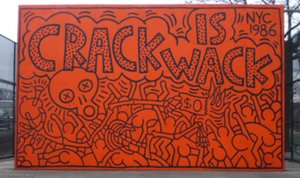 Crack is wack
Discover Keith Haring’s iconic pop art! Explore vibrant murals & drawings tackling social issues like crack cocaine & AIDS. A powerful legacy of art & activism.
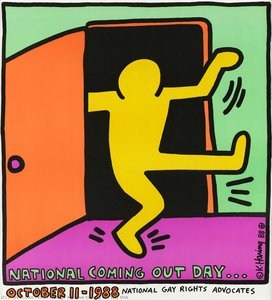
Haring wasn't content to simply create visually arresting art; he felt compelled to use his platform to address pressing social issues. The 1980s were a period of immense upheaval – the AIDS epidemic, the crack cocaine crisis, political unrest – and Haring’s work became a powerful voice for marginalized communities and urgent calls for change. “Crack is Wack,” perhaps his most famous public mural, wasn't merely an anti-drug slogan; it was a visceral response to the devastation wrought by the epidemic in New York City. Similarly, his series of works addressing AIDS awareness – often featuring faceless figures surrounded by radiating lines symbolizing both life and vulnerability – were groundbreaking in their directness and emotional impact. He didn’t shy away from sexual allusions, using them instead as a means of challenging societal taboos and advocating for safe sex practices. This commitment to activism wasn't limited to specific artworks; it permeated his entire practice, influencing the subjects he chose, the colors he employed, and the spaces where he exhibited his work.
Beyond Aesthetics: The Blueprint Drawings and Haring’s Conceptual Depth
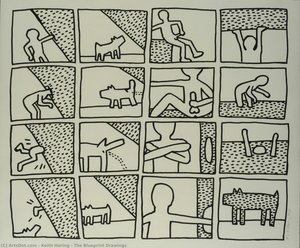 The Blueprint Drawings
Explore Keith Haring’s ‘The Blueprint Drawings,’ a dynamic 1990 grid of simplified figures in bold black lines. Pop Art-influenced & socially conscious, this iconic piece captures urban life.
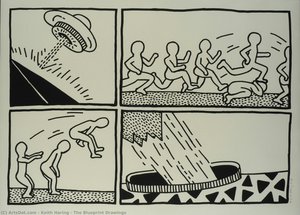
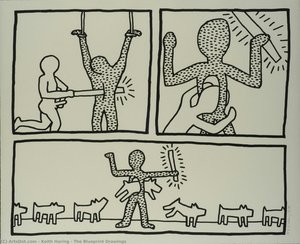
Often overshadowed by his more vibrant and immediately accessible works, The Blueprint Drawings (1990) reveal a fascinating layer of conceptual depth. Created in the final year of his life, this grid of simplified figures – rendered in stark black lines on paper – functions as both an inventory of his iconic motifs and a meditation on the nature of representation itself. The drawings resemble architectural blueprints, suggesting a systematic approach to image-making and a desire to deconstruct his own visual language. They are not simply studies for future works but rather self-contained compositions that explore the fundamental elements of Haring’s aesthetic – line, form, space, and repetition. This work demonstrates a level of artistic self-awareness rarely seen in artists known primarily for their spontaneous energy. It's a testament to his intellectual curiosity and his willingness to push beyond the boundaries of established artistic conventions.
Haring’s Legacy: Impact on Contemporary Art and Continued Relevance
Keith Haring’s untimely death in 1990, at the age of 31 from complications related to AIDS, tragically cut short a brilliant career. However, his impact on contemporary art continues to resonate profoundly. He blurred the lines between high art and street culture, paving the way for generations of artists who embrace public space as a canvas. His commitment to social activism remains deeply relevant in today’s world, inspiring artists to use their work as a tool for change. Haring's influence can be seen in everything from graffiti art to graphic design to fashion. His iconic imagery has been appropriated and reinterpreted countless times, demonstrating its enduring power and universal appeal. He proved that art could be both aesthetically pleasing *and* politically charged, accessible *and* intellectually stimulating.
Collecting Keith Haring: Navigating the Market & Identifying Key Works
For collectors, acquiring a work by Keith Haring represents not only an investment in a significant artistic legacy but also a commitment to his values. While original paintings command substantial prices, a range of options exists for those entering the market. Signed posters from his early career are relatively accessible, offering a tangible connection to his subway origins. Limited-edition prints and sculptures provide another avenue for acquisition. “The Blueprint Drawings”, while highly sought after, represent a more significant investment. Authenticity is paramount; careful research and consultation with reputable galleries or appraisers are essential. Key works to consider include early subway drawings (often documented in publications), the “Crack is Wack” series, and his AIDS awareness pieces. At BuyPopArt.com, we offer a curated selection of high-quality reproductions of Haring’s iconic works, allowing collectors to experience his art firsthand and appreciate its enduring power. We also provide expert consultation services to help you navigate the market and identify pieces that align with your collecting goals.





