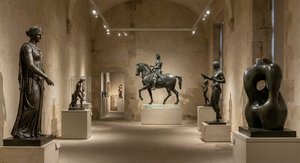
The Ancient Roots: Marble's Rise to Prominence in Greek & Roman Sculpture
Ancient Greek art is the visual and applied arts, as well as the architecture, produced by the Hellenes or Greek peoples from the start of the Iron Age to the Hellenistic period, ending with Roman conquest of Greece at the Battle of Corinth in 146 BC...
From the earliest Cycladic figurines to the monumental statues of antiquity, marble has held a unique position in the artistic imagination. While earlier civilizations utilized stone for sculpture, it was the ancient Greeks who truly unlocked its potential, recognizing not merely its durability but its capacity to embody ideal forms and capture the very essence of human beauty. Before the widespread adoption of marble, limestone and wood were common materials, yet they lacked the luminosity and fine-grained texture that allowed for the nuanced detail Greek sculptors sought. The quarries of Paros, famed for its exceptionally pure white marble – Parian marble – became a source of artistic inspiration, providing the medium for masterpieces like Praxiteles’ Aphrodite and countless depictions of gods, heroes, and athletes. This preference wasn't accidental; marble possesses an inherent quality to absorb light just beneath its surface, creating a soft, almost ethereal glow that mimics the appearance of skin, lending a lifelike quality unmatched by other stones. The development of sophisticated carving techniques – from percussive methods to refine abrasion with bronze tools and ultimately, the use of rasps and polishing compounds – allowed sculptors to achieve an unprecedented level of realism and anatomical accuracy.
The Romans, inheriting Greek artistic traditions, continued this reverence for marble, though often employing it on a grander scale. Imperial portraiture flourished, utilizing marble to project power, authority, and the idealized image of the emperor. Augustus’s claim to have restored Rome to its former glory was visually reinforced through public art—statues that echoed classical forms but served a distinctly political purpose. The use of colored marbles also became prevalent, adding richness and complexity to their compositions. However, it wasn't simply about replication; Roman sculptors developed innovative techniques in drilling and undercutting, allowing for more dynamic poses and intricate drapery.
Technical Mastery: Carving Light and Form from Stone – A Sculptor’s Process
The creation of a marble sculpture is a testament to human skill and patience. The process begins with the selection of the block itself—a crucial step, as the stone's quality dictates the final outcome. Ancient sculptors meticulously examined quarries for veins, fissures, or imperfections that might compromise the integrity of the work. Once chosen, the initial shaping involved removing large portions of material using percussive tools – chisels and hammers – gradually revealing the rough form within. This was followed by a series of increasingly refined abrasives, moving from coarser to finer grades to smooth the surface and define details. The Egyptians pioneered many of these techniques, which were then adopted and adapted by the Greeks and Romans.
The true artistry lay in understanding how light interacts with the stone. Sculptors didn’t simply carve a form; they sculpted *light* itself, manipulating surfaces to create shadows, highlights, and a sense of volume. This required an intimate knowledge of anatomy, proportion, and the subtle nuances of human expression. The final stages involved polishing – often using pumice or even linen cloths – to achieve a lustrous sheen that enhanced the stone’s natural beauty. The ability to work “in the round,” creating sculptures intended to be viewed from all angles, demanded exceptional skill and foresight. It was a process that could take months, even years, for a single masterpiece.
Renaissance Revival: Rediscovering Classical Ideals in Marble Art
Following centuries of relative decline during the Medieval period, the Renaissance witnessed a fervent rediscovery of classical art and philosophy. This revival profoundly impacted sculpture, with artists turning to ancient models for inspiration. The Italian Renaissance sculptors, particularly those working in Florence, embraced marble as the ideal medium for expressing humanist ideals – celebrating the beauty and dignity of the human form. Artists like Donatello and Michelangelo sought to emulate the realism and anatomical accuracy of Greek and Roman sculptures, but infused their work with a new sense of emotion and dynamism.
Michelangelo’s *David*, carved from a single block of Carrara marble, stands as perhaps the most iconic example of this Renaissance revival. The sheer scale of the sculpture, combined with its breathtaking detail and emotional intensity, captivated audiences and established Michelangelo as one of the greatest sculptors of all time. The rediscovery of ancient texts on art theory also played a crucial role, providing artists with insights into classical techniques and aesthetic principles. This period saw a renewed emphasis on contrapposto – the naturalistic shifting of weight in the human body – and a meticulous study of anatomy, resulting in sculptures that were both technically brilliant and emotionally resonant.
Neoclassicism and Beyond: The Enduring Influence of Antiquity on 18th- & 19th-Century Sculpture
Neoclassicism, also spelled Neo-classicism, emerged as a Western cultural movement in the decorative and visual arts, literature, theatre, music, and architecture that drew inspiration from the art and culture of classical antiquity. Neoclassicism wa...
The 18th century witnessed the rise of Neoclassicism, a movement that explicitly sought to emulate the art and culture of classical antiquity. Fueled by archaeological discoveries at Pompeii and Herculaneum, artists and architects embraced classical forms as symbols of order, reason, and civic virtue. Marble sculpture became central to this aesthetic, with sculptors like Antonio Canova achieving international renown for their elegant and refined works. Canova’s sculptures – often depicting mythological figures or portraits of prominent individuals – were characterized by a smooth, polished surface, idealized forms, and a sense of restrained emotion.
The influence of Neoclassicism extended into the 19th century, with artists like Jean-Baptiste Carpeaux pushing the boundaries of the style while still drawing inspiration from classical models. While adhering to classical principles of form and composition, Carpeaux introduced a new level of realism and emotional intensity, often depicting dramatic scenes and dynamic poses. Even as artistic movements shifted towards Romanticism and Realism, marble continued to be valued for its ability to convey beauty, permanence, and the enduring legacy of the past.
Modern Abstraction and the Continued Appeal of Marble
While modern sculpture embraced a wider range of materials – bronze, steel, wood – marble has never entirely lost its appeal. Artists like Constantin Brancusi explored the abstract qualities of form, utilizing marble to create simplified, elegant sculptures that evoked a sense of timelessness and spirituality. The inherent weight and texture of marble lent itself well to these minimalist forms, emphasizing the stone’s natural beauty rather than representational accuracy.
Today, contemporary sculptors continue to experiment with marble, pushing the boundaries of technique and form. From large-scale installations to intimate portraits, marble remains a powerful medium for expressing artistic vision. Its enduring appeal lies not only in its aesthetic qualities but also in its historical significance – a connection to centuries of artistic tradition. The soft glow, the tactile smoothness, and the sense of permanence all contribute to its unique allure.
Collecting Marble: Investing in a Timeless Legacy
Acquiring a marble sculpture is not merely purchasing an artwork; it’s investing in a piece of history—a tangible connection to centuries of artistic innovation. Whether you are drawn to the classical masterpieces of antiquity, the refined elegance of Neoclassical works, or the abstract forms of modern sculpture, there is a marble sculpture to suit every taste and budget. When considering a purchase, it’s important to assess the quality of the stone, the skill of the carving, and the provenance of the work.
At BuyPopArt, we offer a curated selection of handmade oil paintings and museum-quality prints inspired by renowned marble sculptures. Our skilled artists meticulously recreate these masterpieces on 100% cotton canvas, ensuring authentic brushstrokes and lasting beauty. We also provide custom reproduction services, allowing you to transform your favorite artworks into stunning pieces for your home or collection. Explore our extensive library today and discover the enduring allure of marble sculpture – a timeless legacy that will be cherished for generations.