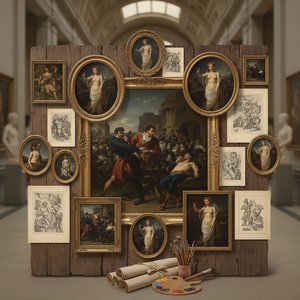
Alexandre Denis Abel de Pujol: A Neoclassical Visionary
Alexandre Denis Abel de Pujol (1785-1861) stands as a prominent figure in French Neoclassical art, remembered primarily for his monumental commissions that graced the halls of Parisian institutions – notably the Louvre and Fontainebleau. Though overshadowed by contemporaries like Jacques-Louis David, Pujol’s distinctive style and unwavering dedication to classical ideals cemented his place within the artistic landscape of the early 19th century.
Born into a noble family with connections to the Bourbon monarchy, Pujol received an aristocratic education that instilled in him a profound appreciation for humanist values and artistic tradition. He studied under David at the École Royale Supérieure des Beaux-Arts in Paris, absorbing the master’s meticulous attention to detail and his commitment to portraying historical narratives with dramatic grandeur. This formative influence profoundly shaped Pujol's artistic sensibilities, guiding him toward a stylistic approach characterized by clarity of form, balanced compositions, and idealized figures imbued with moral significance.
Pujol’s prolific output spanned across various genres, including portraits, landscapes, and mythological scenes. However, he achieved lasting fame through his ambitious decorative projects undertaken for the French state. The ceiling of the Grand Staircase at the Louvre depicts a scene from Virgil's Aeneas—a powerful allegory exploring themes of Roman virtue and destiny—demonstrating Pujol’s masterful command of color and perspective. Similarly, the Galerie de Diane at Fontainebleau showcases a monumental fresco portraying Julius Caesar returning to Rome after defeating Pompey, capturing the pivotal moment with breathtaking realism and conveying a palpable sense of triumph. Perhaps his most celebrated achievement was the ceiling of the Bourse de Paris, which portrays Hercules battling Hydra—a symbolic representation of courage and perseverance against overwhelming adversity.
Beyond his technical prowess, Pujol’s artistic vision reflected the intellectual currents of his time – specifically the revival of classical learning championed by Jean-Jacques Rousseau and Voltaire. He embraced the humanist ideals inherent in Greco-Roman culture, prioritizing moral contemplation alongside aesthetic beauty. His works serve as tangible embodiments of this philosophical stance, inviting viewers to engage with narratives that grapple with fundamental questions about human nature and societal responsibility.
Despite facing challenges during his lifetime—including financial difficulties and personal tragedies—Pujol persevered in his artistic pursuits until his untimely death in 1861. Today, Pujol’s paintings continue to inspire admiration for their elegance, ambition, and unwavering fidelity to classical principles. His legacy resides not only in the grandeur of his commissions but also in his contribution to shaping the visual culture of France during a transformative era—a testament to the enduring power of artistic idealism.