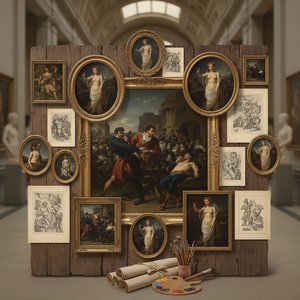
The Legacy of a Sicilian Master: Antonio de Saliba
In the golden twilight of the Quattrocento, amidst the salt-misted air of Messina, a painter emerged whose brush would bridge the gap between the rugged traditions of Sicily and the luminous innovations of Venice. Antonio de Saliba, known variously as Antonello de Salibá or Resaliba, was not merely a peripheral figure in the Italian Renaissance; he was a vital conduit of style and technique. Born around 1466 into a family of skilled artisans—his father, Giovanni Resaliba, was a woodcarver of Maltese descent—Antonio’s very lineage was woven into the fabric of Mediterranean craftsmanship. While history often casts a long shadow through his illustrious uncle, the titan Antonello da Messina, Saliba’s own journey reveals a master who navigated the complex currents of artistic evolution with profound grace and technical precision.
The formative years of Saliba’s life were defined by an apprenticeship that would forever alter the trajectory of his art. In 1480, at the tender age of fourteen, he entered the workshop of his cousin, Jacobello da Messina. This period of rigorous training provided him with a foundational mastery of form and narrative, but it was his subsequent sojourn to the Venetian Lagoon that truly ignited his creative spirit. Moving through the cosmopolitan atmosphere of Venice during the mid-1490s, Saliba found himself immersed in one of the most transformative artistic environments in Europe. It is widely believed by scholars that he served as an assistant in the prestigious workshop of Giovanni Bellini, a connection that would infuse his work with the soft light and atmospheric depth characteristic of the Venetian school.
A Synthesis of Light and Devotion
The true brilliance of Saliba’s oeuvre lies in his ability to synthesize the sharp, sculptural clarity inherited from the Messina tradition with the ethereal, painterly qualities of Bellini. His works are a testament to this delicate balance, where the heavy presence of religious iconography meets a newfound sensitivity to chiaroscuro and perspective. Upon returning to Sicily, Saliba established a prolific workshop that became a cornerstone of religious life across Calabria, Malta, and Eastern Sicily. He did not merely paint; he crafted spiritual experiences through a diverse array of formats:
- Altarpieces: Grand, structured compositions that served as the focal points for ecclesiastical devotion, often featuring saints rendered with a palpable, human dignity.
- Gonfaloni: Magnificent religious banners designed to grace the streets during festive processions, blending movement with sacred storytelling.
- Painted Crucifixes: Intimate and profoundly emotive works that captured the raw, spiritual resonance of the Passion, deeply rooted in the Sicilian tradition of devotional art.
This period of intense productivity, which lasted from approximately 1497 until the mid-1530s, saw Saliba becoming a preferred artist for a wide range of patrons. His ability to adapt the sophisticated Venetian aesthetic to the specific liturgical needs of Mediterranean institutions allowed his influence to ripple far beyond the borders of his native Messina.
Historical Significance and Enduring Presence
The historical importance of Antonio de Saliba extends beyond the mere cataloging of his paintings; he represents the interconnectedness of the Renaissance world. His career illustrates how artistic ideas traveled along trade routes, from the workshops of Venice to the churches of Malta and the rugged coasts of Calabria. While some of his works have faced challenges of attribution—occasionally being misidentified as those of his uncle due to shared stylistic signatures—modern scholarship has worked tirelessly to reclaim his unique identity. His mastery is recognized today in some of the world's most esteemed institutions, including the Metropolitan Museum of Art in New York, the Gallerie dell'Accademia in Venice, and the Victoria and Albert Museum in London.
Ultimately, Saliba stands as a symbol of the Renaissance spirit: an artist capable of honoring his heritage while fearlessly embracing the future. Through his hands, the solemnity of the Sicilian tradition was elevated by the light of the Venetian Renaissance, leaving behind a legacy of beauty that continues to resonate with the profound spiritual and aesthetic power of a bygone era.