Gabriel de Saint-Aubin: A Parisian Observer and Master Engraver
Gabriel de Saint-Aubin (1724–1780) stands as a pivotal figure in the artistic landscape of late Baroque and Rococo France, renowned not merely for his prolific output but also for his singular approach to documenting the vibrant cultural life of Paris during its golden age. Unlike many artists preoccupied with grand narratives or idealized portraits, Saint-Aubin possessed an unwavering fascination for capturing everyday scenes—the bustling marketplaces, theatrical performances, and social gatherings that defined Parisian society—transforming these observations into exquisitely detailed engravings that continue to captivate audiences today.
- Early Life and Artistic Training:
- The Prix de Rome Trials and Departure from Académie des Beaux-Arts:
- A Distinctive Style: Observation of Parisian Society:
- Major Engravings and Artistic Achievements:
- Legacy and Influence on Subsequent Artists:
His brothers, Charles Germain de Saint Aubin and Augustin de Saint-Aubine, were equally accomplished artists, fostering a familial tradition of artistic excellence. Influenced by Étienne Jeaurat and Hyacinthe Collin de Vermont, Gabriel embarked upon his formal artistic education, honing his skills in drawing and printmaking—skills that would ultimately define his distinctive oeuvre. Despite three unsuccessful attempts to secure the prestigious Prix de Rome, a cornerstone of artistic recognition at the time, Saint-Aubin resolutely rejected the rigid conventions of academic art, choosing instead to pursue independent creative endeavors. This decision proved transformative, allowing him to cultivate a style characterized by unparalleled realism and psychological insight—a style that would distinguish him from his contemporaries.
Saint-Aubine’s artistic vision centered around meticulously documenting Parisian life, capturing fleeting moments of social interaction with remarkable precision. He eschewed grand allegorical compositions in favor of intimate scenes rendered with meticulous detail, utilizing chiaroscuro lighting to heighten dramatic effect and conveying nuanced emotions through subtle gestures and expressions. His engravings offer invaluable glimpses into the fashions, customs, and entertainments of the era—serving as a testament to his keen observational abilities and artistic virtuosity. The artist’s work is particularly notable for its portrayal of theatrical performances, capturing the energy and excitement of the Parisian stage with breathtaking accuracy. Saint Aubine's prints are considered among the finest examples of Rococo art, reflecting the aesthetic ideals of elegance, refinement, and playful illusionism prevalent during his time.
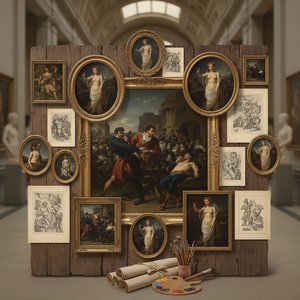
Among Saint-Aubine’s most celebrated engravings include “Le rêve ou Voltaire composant la pucelle,” a dramatic depiction of Voltaire’s theatrical production featuring an elaborate set design and captivating characters—a testament to his mastery of composition and artistic technique. Similarly, "Laban Cherchant Ses Idoles," portrays Joseph's confrontation with rich textures, chiaroscuro lighting & a powerful narrative of betrayal and reconciliation. These works exemplify Saint Aubine’s ability to transform observation into art, capturing the spirit of his time with unparalleled sensitivity and artistry. His engravings are housed in prominent museums worldwide—including the Louvre Museum and the Musée Bonnat—solidifying his place as one of France's most influential printmakers.
Saint-Aubine’s legacy extends far beyond his own lifetime, influencing generations of artists who followed him. His unwavering commitment to realism and psychological depth established a precedent for portraiture and genre scenes—inspiring subsequent artists to explore the complexities of human experience with similar boldness and conviction. Saint Aubine's meticulous attention to detail and masterful use of chiaroscuro lighting continue to inspire admiration among art historians and practitioners alike, cementing his enduring significance as a pioneer of French Baroque and Rococo art.