Impresiones giclée o en lienzo de calidad de museo con producción rápida y opciones de acabado flexibles. ( Cambiar a pintura hecha a mano Cambiar a imagen)





























Elija entre nuestros tamaños predefinidos que respetan las proporciones originales de la obra.

Puede introducir sus propias dimensiones para adaptarse a un marco o espacio específico. Si el tamaño seleccionado no coincide con las proporciones de la imagen original, recortaremos la obra de arte o extenderemos la imagen con un borde con efecto espejo o de color sólido. Se enviará una maqueta digital para su aprobación antes de que comience la producción.
Tenga en cuenta que la vista previa en pantalla no refleja el recorte o la extensión real. Solo la maqueta mostrará con precisión la composición final.
Aunque existen tamaños personalizados, recomendamos seleccionar una dimensión de la lista predefinida para preservar las proporciones originales.
Envío a todo el mundo () en 2 semanas en lugar de las 4/5 semanas estándar. (31 julio)


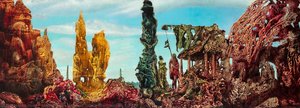
Les trompettes de lamort
Tamaño de la reproducción
Max Ernst’s “Les trompettes de l’enfer” – translating roughly to “Trumpets of Hell” – is a striking monochrome collage that encapsulates the spirit of Surrealism and the anxieties of its time. Executed in 1959, this artwork represents a culmination of Ernst's lifelong exploration into subconscious imagery and experimental artistic methods.
Subject Matter & Composition: The painting depicts two large vases brimming with flowers—purple and scarlet blooms—arranged at varying heights. These vases aren’t merely decorative; they serve as conduits for an unsettling presence – the trumpets of death. Ernst deliberately juxtaposes organic forms (the flowers) with geometric shapes, creating a visual tension that reflects the artist's preoccupation with confronting mortality.
Style & Technique: Ernst pioneered techniques like frottage and grattage, methods he developed during his formative years in Berlin’s Dada movement. Frottage involves rubbing pencil or crayon over textured surfaces – in this case, paper – to transfer impressions onto the canvas. This process deliberately disrupts traditional artistic conventions, prioritizing chance and spontaneity. The watercolor wash adds a subtle luminosity that contrasts with the starkness of the black and white palette.
Historical Context: Dada emerged in Zurich during World War I as a reaction against rationalism and bourgeois values. Artists like Ernst sought to dismantle accepted notions of beauty and truth, embracing absurdity and irrationality as tools for artistic expression. “Les trompettes de l’enfer” embodies this rebellious ethos, mirroring the pervasive fear of impending doom that gripped Europe in the aftermath of the conflict.
Symbolism & Emotional Impact: The trumpets symbolize death, but also herald a transformative moment – the acceptance of mortality. Ernst's masterful use of monochrome amplifies the painting’s emotional resonance, conveying a sense of solemn contemplation and confronting the viewer with the inevitability of decay. The flowers, despite their beauty, are presented within this framework of darkness, suggesting that even amidst life’s splendor, death remains an inescapable reality.
Provenance & Reproduction: This artwork was originally exhibited at Fundación Pedro Barrié de la Maza in La Coruña and subsequently acquired by Paolo Marinotti. Today, BuyPopArt offers high-quality reproductions of “Les trompettes de l’enfer,” allowing art enthusiasts to experience Ernst's visionary aesthetic firsthand.

1891 - 1976 , Alemania

Transforma tus recuerdos en obras de arte únicas con BuyPopArt. Reproducciones personalizadas hechas por artistas expertos y materiales de calidad museística. Crea un legado visual atemporal.

Descubra el dadaísmo: su origen radical, artistas clave como Arp y Richter, y su impacto en el arte moderno. Análisis experto de este movimiento revolucionario y su legado estético.
Descubre las 25 obras maestras de Max Ernst, el rey del surrealismo. Explora su arte onírico, técnicas innovadoras y simbolismo profundo. Reproducciones de alta calidad para decorar tu hogar con estilo en BuyPopArt.com
Descubre los fundamentos filosóficos del Surrealismo. Explora su contexto histórico, la influencia de Freud y las técnicas clave con análisis experto. Un viaje al corazón de este revolucionario movimiento artístico.

Descubre la fascinante evolución del Surrealismo en la pintura. Explora sus orígenes, técnicas innovadoras y las obras maestras de Dalí, Magritte y Miró. Un análisis profundo para amantes del arte.


Manténgase al día con las últimas noticias de arte, ofertas exclusivas e ideas de decoración.
Cuéntanos sobre tu proyecto y nuestros expertos en arte te ofrecerán 3 sugerencias de obras personalizadas.
Permítenos seleccionar 3 opciones solo para ti – ¡Gratis!


 Vista previa
 Compartir
 Compartir
 Ver detalles

 Descargar
 Ver similares
 Radiografía
 Presentación automática
 Leer más







 La opción de vidrio solo está disponible en tamaños inferiores a 110 cm.