Impresiones giclée o en lienzo de calidad de museo con producción rápida y opciones de acabado flexibles. ( Encargar reproducción pintada a mano Comprar descarga)





























Elija entre nuestros tamaños predefinidos que respetan las proporciones originales de la obra.

Puede introducir sus propias dimensiones para adaptarse a un marco o espacio específico. Si el tamaño seleccionado no coincide con las proporciones de la imagen original, recortaremos la obra de arte o extenderemos la imagen con un borde con efecto espejo o de color sólido. Se enviará una maqueta digital para su aprobación antes de que comience la producción.
Tenga en cuenta que la vista previa en pantalla no refleja el recorte o la extensión real. Solo la maqueta mostrará con precisión la composición final.
Aunque existen tamaños personalizados, recomendamos seleccionar una dimensión de la lista predefinida para preservar las proporciones originales.
Envío a todo el mundo () en 2 semanas en lugar de las 4/5 semanas estándar. (15 agosto)


Newspaper:
Tamaño de la reproducción
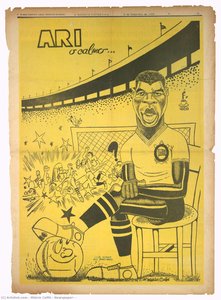
In the vibrant tapestry of mid-century Brazilian visual culture, few voices resonate with as much playful charm and satirical bite as that of Miécio Caffé. His work, specifically this captivating newspaper clipping from 1959, serves as a window into a bygone era of graphic humor that once animated the daily lives of Brazilians. The piece presents a lively comic strip composition, where characters move through a choreographed scene of everyday motion. At its heart, we find a trio of figures: one hurrying with hands tucked behind him, another observing the unfolding drama with a relaxed gaze, and a third poised with an umbrella, adding a touch of whimsical preparation to the narrative. This rhythmic arrangement of bodies, set against the backdrop of a bustling street life complete with bicycles and passing pedestrians, captures the kinetic energy of urban Brazil during a period of profound social transition.
The technique employed by Caffé is a masterclass in the art of the caricature, utilizing bold, decisive lines that command attention even within the small format of a newsprint publication. His style is characterized by an economy of line—where a single stroke can convey a character's entire temperament or the frantic pace of a runner. This graphic simplicity does not diminish the complexity of the emotion; rather, it amplifies it. The interplay between the heavy ink work and the negative space creates a sense of depth and movement that draws the eye across the frame, making the static image feel as though it is caught in a moment of mid-motion. For the collector of vintage graphic arts, this piece offers a profound appreciation for the precision required to translate human character into minimalist, high-impact illustration.
To understand this work is to understand the cultural landscape of 20th-century Brazil. Miécio Caffé was not merely an illustrator; he was a chronicler of his time, deeply embedded in the musical and social fabric of his nation. His ability to blend humor with sharp social observation allowed him to bridge the gap between high art and popular media. This specific piece, emerging from the late 1950s, reflects a period when the newspaper was the primary vessel for shared cultural experience. The inclusion of such caricatures in daily publications helped shape the national identity, providing a mirror in which the public could see their own joys, struggles, and eccentricities reflected through a lens of satire.
Beyond its immediate visual appeal, the artwork carries a deep emotional resonance, evoking a sense of nostalgia for the golden age of print media. For interior designers and art enthusiasts looking to curate a space with character, a reproduction of this work offers more than just decoration; it provides a conversation piece that speaks to the history of Brazilian graphic humor. It brings an element of storytelling into a room, inviting viewers to linger on the details of the characters' expressions and the nostalgic charm of the composition. Whether placed in a modern gallery setting or a classic study, Caffé’s work remains a timeless testament to the power of wit and the enduring allure of the hand-drawn line.

1920 - 2003 , Brasil

Level up your space with high-impact lithography and graphic art. From Warhol-inspired pop prints to bold street art aesthetics, discover how to curate a visually powerful collection that defines your personal brand and urban style.

Explore the Digital Art Revolution. Discover how high-impact graphics, pop art energy, and cutting-edge design are shaping the future of contemporary aesthetics and urban decor.

Explore the seismic shift in modern aesthetics. Discover how Glitch Pop, high-impact graphics, and digital photography are dismantling minimalism to create a new, electric visual language of saturated chaos and urban energy.

Explore the high-impact future of modern art with our trend forecast on Digital Illustration and Glitch Pop. Discover how saturated graphics and digital entropy are redefining contemporary aesthetics for the urban collector.


Manténgase al día con las últimas noticias de arte, ofertas exclusivas e ideas de decoración.
Cuéntanos sobre tu proyecto y nuestros expertos en arte te ofrecerán 3 sugerencias de obras personalizadas.
Dejamos que nosotros seleccionemos 3 opciones exclusivas para ti – ¡Gratis!


 Vista previa
 Compartir
 Compartir
 Ver detalles

 Descargar
 Ver similares
 Radiografía
 Presentación de diapositivas


 Leer más







 La opción de vidrio solo está disponible en tamaños inferiores a 110 cm.