Adquiera una imagen digital de alta resolución y optimizada, muy superior a la vista previa en línea.
Cada archivo es preparado meticulosamente por nuestros especialistas internos mediante el uso de herramientas avanzadas y un experto retoque manual. Nos aseguramos de que cada imagen posea una claridad excepcional, una precisión cromática impecable y un detalle minucioso.
El archivo final se entrega por correo electrónico en un plazo de 72 horas, optimizado para su uso inmediato en entornos profesionales, editoriales y de impresión. Esta es la misma calidad en la que confían los estudios de diseño, las editoriales y las galerías de primer nivel.
Descarga un archivo de alta resolución para exhibición personal, impresión y proyectos creativos. ( Switch to Print Switch to hand made Painting)
Al elegir BuyPopArt.com, no solo está adquiriendo una imagen; está recibiendo una obra de arte digital mejorada profesionalmente, elaborada con precisión y respaldada por una garantía de satisfacción. Esto es todo lo que incluye su pedido, automáticamente:

Recibirá su archivo de imagen digital en alta resolución por correo electrónico en un plazo de 72 horas tras realizar su pedido, listo para su uso inmediato.

Su obra de arte se optimiza profesionalmente mediante herramientas avanzadas de IA y edición manual, garantizando el máximo detalle, claridad y precisión cromática.

¿Has borrado o perdido tu archivo por error? No te preocupes: te lo volveremos a enviar en cualquier momento, sin coste adicional.

Disfrute de su obra de arte al instante sin aduanas, aranceles ni gastos de envío; las descargas digitales siempre están libres de impuestos.

Garantizamos que su imagen digital refleje los colores originales con la mayor fidelidad posible, mediante el uso de herramientas profesionales y gestión del color.

Si no está satisfecho con su imagen digital, la revisaremos o le reembolsaremos el 100% en un plazo de 60 días, sin preguntas.

¿No está satisfecho? Obtenga un reembolso completo dentro de los 60 días posteriores a la recepción de su archivo digital, sin preguntas.

Compra 3 imágenes, ahorra 10% - Compra 5, ahorra 15% - Compra 10+, ahorra 20%. Ideal para proyectos creativos, galerías y agencias.
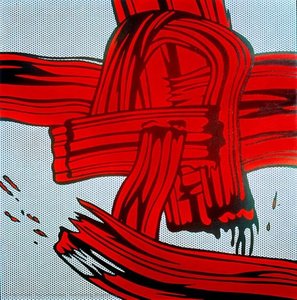
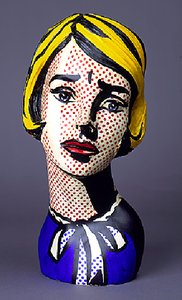
Roy Lichtenstein's "Head Red Shadow," painted in 1964, isn’t merely a portrait; it’s a carefully constructed visual dialogue with the burgeoning world of mass media and consumer culture. This striking image, dominated by a vibrant yellow background punctuated by stark black polka dots and a subtly rendered woman’s head, encapsulates the core tenets of Lichtenstein's groundbreaking Pop Art style. The painting immediately draws the viewer in, demanding attention through its bold contrasts and simplified forms – a deliberate strategy designed to mimic the aesthetic language of comic books and advertising, both increasingly prevalent in American society at the time.
The composition itself is deceptively simple. The woman’s head, rendered with an almost clinical precision, isn't intended as a romanticized depiction; rather, it feels like a fragment, a captured moment divorced from context. Her hat adds a touch of enigmatic detail, hinting at personality without revealing much. Crucially, Lichtenstein employs the technique of Ben-Day dots – tiny, colored squares that simulate the printing process used in commercial illustrations. These dots aren’t just decorative; they are integral to the painting's meaning, representing the mechanical reproduction inherent in mass media and challenging traditional notions of artistic skill and originality. The red shadow enveloping the head creates a sense of mystery and perhaps even unease, subtly disrupting the otherwise assertive visual language.
Understanding “Head Red Shadow” requires placing it within the broader context of Roy Lichtenstein’s artistic development. Born in 1923, Lichtenstein initially trained as a realist painter, absorbing influences from Reginald Marsh, his early instructor at the Art Students League. However, he quickly became disillusioned with traditional fine art and sought inspiration in the visual culture surrounding him – specifically, the world of advertising and comic books. These sources provided a vocabulary of imagery ripe for appropriation and reinterpretation. His wartime service further shaped his perspective, exposing him to the realities of industrial production and mass communication.
The painting’s creation coincided with a period of intense social and cultural change in America. Post-war prosperity fueled consumerism, while television and comic books became dominant forms of entertainment. Lichtenstein wasn't simply reacting to these trends; he was actively engaging with them, using his art to critique the values and aesthetics of this new era. His work can be seen as a commentary on the blurring lines between high art and popular culture – a theme that would continue to resonate throughout his career.
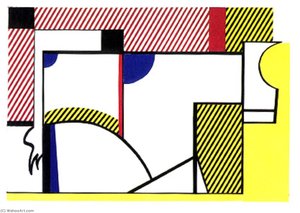
Lichtenstein’s meticulous approach to technique is central to the painting's impact. He employed a limited color palette—primarily yellow, black, and red—to create a striking visual effect. The use of hard edges and flat planes of color, reminiscent of commercial printing techniques, further emphasizes the mechanical nature of the image. The polka dots themselves are not arbitrary; they represent the process of reproduction, highlighting the artificiality of the artwork and drawing attention to its origins in mass-produced imagery.
Beyond the technical aspects, “Head Red Shadow” is laden with symbolism. The woman’s head, presented in isolation, can be interpreted as a representation of the female figure within a consumerist society – reduced to an object of desire and subject to constant reproduction through advertising and media. The red shadow could symbolize danger, uncertainty, or even the subconscious, adding layers of complexity to the image. The painting invites viewers to contemplate the relationship between art, commerce, and identity in a rapidly changing world.
“Head Red Shadow” remains a powerful example of Roy Lichtenstein’s innovative approach to Pop Art. Its bold colors, simplified forms, and deliberate references to mass media continue to captivate audiences today. BuyPopArt offers meticulously crafted hand-painted reproductions that faithfully capture the essence of this iconic work, allowing you to experience its visual impact and intellectual depth in your own space. More than just a beautiful image, “Head Red Shadow” is a testament to Lichtenstein’s ability to transform everyday imagery into profound artistic statements – a reflection on our relationship with culture, commerce, and the very nature of representation.


1923 - 1997 , Estados Unidos de América


Manténgase al día con las últimas noticias de arte, ofertas exclusivas e ideas de decoración.
Cuéntanos sobre tu proyecto y nuestros expertos en arte te ofrecerán 3 sugerencias de obras personalizadas.
Permítenos seleccionar 3 opciones solo para ti – ¡Gratis!


 Preview
 Enviar
 Compartir
 Detalles

 Descargar
 Similares
 Radiografía
 Presentación de diapositivas

 Ver más