Oil On CanvasWallArtExpressionism
 1913Modern
 91.0 x 131.0 cm
 Staatsgalerie Moderner Kunst
Meie kunstnike poolt tellimusel valmistatud käsitsi maalitud õli-kainaste teos teie soovitud suuruses ja raamis. ( Osta print Osta pilt)





























Vali meie eelmääratud suurused, mis vastavad teose algupärastele proportsioonidele.

Sa võite sisestada oma mõõtmed konkreetse raami või ruumi sobivuse tagamiseks. Kui teie valitud suurus ei vasta originaalpildi proportsioonidele, siis kärvime kunstiteost või laiendame maali täiendavate käsitsi maalitud elementidega. Enne tootmise algust saadetakse teile heakskiitmiseks digitaalne eelvaade.
Palun pidage meeles, et ekraanil kuvatav eelvaade ei kajasta tegelikku kärpimist või laiendamist. Ainult eelvaade näitab täpselt lõplikku kompositsiooni.
Kuigi on saadaval kohandatud suurused, soovitame originaalproportsioonide säilimiseks valida mõõdud eelmääratletud nimekirjast.
Maailmline tarne 3–4 nädala jooksul tavalise 5 nädala asemel. (15 august). Kvaliteedis kompromisse ei tehta.


The Mandrill
Reproduktsiooni suurus
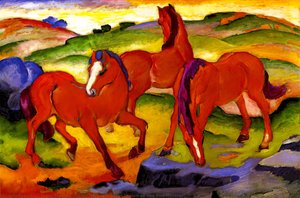
In the pantheon of German Expressionism, few works capture the raw, spiritual pulse of the natural world as vibrantly as “The Mandrill.” Painted in 1913, this masterpiece by Franz Marc serves as a profound meditation on the interconnectedness of all living things. At its heart, the painting is not merely a depiction of a primate; it is an exploration of essence over appearance. Marc, a founding member of the influential Der Blaue Reiter movement, sought to transcend the superficiality of reality to reveal a deeper, more spiritual truth. Through his lens, the mandrill becomes a vessel for cosmic energy, rendered in a palette that vibrates with life and tension.
The technique employed in “The Mandrill” is a masterful collision of organic fluidity and geometric structure. Marc utilizes a striking expanse of ochre—a hue that grounds the composition with its earthy, stable presence—which stands in dynamic contrast to splashes of emerald green. These greens symbolize vitality and the regenerative forces of nature, creating a visual dialogue between stability and growth. The artist’s brushwork avoids soft, academic blending; instead, colors collide energetically, conveying a palpable sense of urgency. By integrating elements of Cubist-inspired fragmentation, Marc breaks down the subject into angular lines and bold shapes, disrupting traditional perspective to offer a multifaceted view of the creature's power.
To gaze upon this work is to enter a world where color functions as emotion itself. For Marc, colors were not merely aesthetic choices but symbolic languages: blue represented masculinity and spirituality, while yellow evoked feminine gentleness and joy. In “The Mandrill,” the interplay of warm ochres and cool emeralds creates a rhythmic tension that mirrors the complexities of the wild. The central, curving structure of the mandrill’s form commands the canvas with a monumental grandeur, drawing the viewer into its primal orbit. This central focus is surrounded by a delicate balance of trees, foliage, and birds, suggesting a harmonious yet turbulent ecosystem where every element plays a role in a larger, divine symphony.
For the discerning collector or interior designer, “The Mandrill” offers more than just visual splendor; it provides an emotional anchor for a space. The painting’s ability to evoke both stability and dynamism makes it a versatile centerpiece for sophisticated environments. Whether placed in a contemporary gallery setting or a curated residential study, the work invites contemplation and conversation. It stands as a testament to a brief but brilliant era of art history—a time when artists like Marc dared to paint the soul of the world, leaving behind a legacy of color that continues to inspire awe and a deep, spiritual resonance in all who encounter it.

1880 - 1916 , Saksa

Explore the visceral world of German Expressionism. Discover how masters like Ernst Ludwig Kirchner used bold colors and distortion to convey raw emotion, through our expert-led deep dive into this transformative era of art history.

Unleash raw emotion in your space. Explore the high-impact world of Expressionism through BuyPopArt.com’s premium hand-painted oil reproductions and custom photo transformations. Bold, confident, and curated for those who live for visual impact. Shop the revolution today!


Püsige kursis viimaste kunstiuudistega, eksklusiivsete pakkumistega ja sisustamisideetega.
Kirjeldage meile oma projekti ja meie kunstieksperdid pakuvad teile 3 isikupärast kunstiettepanekut.
Laske meil koostada just teile mõeldud 3 valikut – tasuta!


 Eelvaade
 Saada
Saada Jaga
Jaga
 Teave teose kohta

 Laadi alla
 Sarnased teosed
 Röntgenuuring
 Slaidietendus
 Loe lähemalt







 Klaasivalik on saadaval ainult suuruses kuni 110 cm