
x

Muuseumikvaliteediga giclée- või kangasprint kiire tootmisega ja paindlikud viimistlusvõimalused. ( Osta käsitsi maalitud maal Osta pilt)
Vali meie eelmääratud suurused, mis vastavad teose algupärastele proportsioonidele.

Saate sisestada oma mõõdud, et need sobiks konkreetse raami või ruumi sisse. Kui valitud suurus ei vasta originaalteose proportsioonidele, lõigame teose ära või laiendame pilti peegeldatud või ühtlase servaga. Enne tootmisprotsessi algust saadetakse Teie kinnitamiseks digitaalne näidis.
Palun märka, et ekraanil kuvatav eelvaade ei kajasta tegelikku lõigamist või laiendamist. Ainult näidis kujutab täpselt lõplikku kompositsiooni.
Kuigi erimõõdu on saadaval, soovitame originaaproportsioonide säilitamiseks valida mõõt ette määratud nimekirjast.
Ülemaailmne tarne () 2 nädala jooksul, tavalise 4/5 nädala asemel. (25 august)


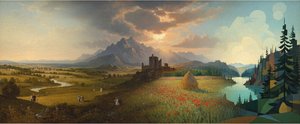
Backyards
Reproduktsiooni suurus
In the grand tapestry of twentieth-century American art, few figures possess the quiet, transformative power of Hugo Robus. Born in Cleveland, Ohio, in 1885, Robus embarked on a creative odyssey that would see him traverse the boundaries between the two-dimensional world of painting and the tactile, three-dimensional realm of sculpture. His journey was not merely one of changing mediums, but an evolution of spirit—a movement from the structured, fragmented perspectives of Cubism toward a deeply personal, lyrical abstraction that sought to capture the very essence of human emotion through form.
Robus’s artistic foundation was built upon rigorous classical training. His early years at the Cleveland School of Art and the National Academy of Design in New York City provided him with a disciplined command of technique, yet it was his time in Paris that truly ignited his avant-garde sensibilities. Immersed in the vibrant atmosphere of the Académie de la Grande Chaumière under the guidance of Emile Carlsen, Robus breathed in the revolutionary air of European modernism. This exposure to the radical shifts of the era allowed him to experiment with the geometric complexities of Picasso and Braque, yet he possessed an innate drive to move beyond purely intellectual exercises toward something more visceral and emotive.
The 1920s marked a profound metamorphosis in Robus’s career. While he began his professional life as a painter, the limitations of the flat surface eventually gave way to a fascination with volume, weight, and the interplay of light upon physical form. This transition was not an abandonment of his earlier explorations but a refinement of them. The fragmented logic of Cubism found a new, more fluid expression in his sculptural work, where he began to masterfully balance positive and negative space—a technique that would later echo the profound influence of Surrealist masters like Henry Moore.
As a sculptor, Robus developed a signature style characterized by serene elegance and sinuous contours. His works often feature stylized figures with polished surfaces that invite the eye to dance along their curves. He possessed a unique ability to render the human form not as a rigid anatomical study, but as a vessel for movement and feeling. Whether through the rhythmic lines of a bronze figure or the delicate tension in a pencil drawing, his work consistently sought to embody fundamental themes of domesticity, grace, and the quiet rhythms of life.
Beyond his individual masterpieces, Robus played a vital role in the communal fabric of American modernism. In 1918, alongside contemporaries such as Henry Varnum Poor and Martha Kantor, he co-founded an influential art colony in New City, New York. This enclave became a sanctuary for creative experimentation, fostering a community where the boundaries between different artistic disciplines could blur and evolve.
The enduring significance of Hugo Robus is etched into the permanent collections of the world's most prestigious institutions. His ability to bridge the gap between the structural rigor of early modernism and the expressive freedom of lyrical abstraction ensures his place in art history. Today, his works serve as poignant reminders of a period when American art was finding its unique voice—a voice that Robus helped shape through bronze, stone, and an unwavering commitment to the beauty of the human spirit.

1885 - 1964

Explore the revolutionary world of Cubist landscapes. Discover how masters like Picasso and Braque redefined nature through geometric beauty, and learn expert tips for curating these transformative masterpieces in your modern home collection.

Embark on a cultural journey through the soul of Cubist landscapes. Discover how masters like Braque and Rivera redefined nature through geometric beauty, fragmented forms, and profound abstraction in this expert art-history exploration.

Explore the profound beauty of village scene art. From Impressionist light to pastoral realism, discover how timeless landscapes capture nostalgia through expert artistry and historical depth. Perfect for collectors seeking evocative, museum-quality landscape inspirations.

Avastage 10 romantilise maastikukunsti meistriteost! Tutvuge Caspar David Friedrichi, J.M.W. Turneri ja teiste suurte kunstnike loominguga BuyPopArt.com-is. Leidke täiuslik õlimaal või reproduktsioon koduks – inspireeriv kollektsioon ootab!
Explore the rich history of landscape art with BuyPopArt. Discover renowned artists, movements like Impressionism & Romanticism, and expert guidance for collecting timeless pieces. Find your perfect serene escape today!


Püsige kursis viimaste kunstiuudistega, eksklusiivsete pakkumistega ja sisustamisideetega.
Kirjeldage meile oma projekti ja meie kunstieksperdid pakuvad teile 3 isikupärast kunstiettepanekut.
Laske meil koostada just teile mõeldud 3 valikut – tasuta!


 Eelvaade
 Saada
Saada Jaga
Jaga
 Teave teose kohta

 Laadi alla
 Sarnased teosed
 Röntgenuuring
 Slaidietendus


 Loe lähemalt




































 Klaasivalik on saadaval ainult suuruses kuni 110 cm


