Museolaatuisia giclée- tai kankaitaulun tulosteita nopealla tuotannolla ja joustavilla viimeistelyvaihtoehdoilla. ( Osta käsintehty maalaus Osta kuva)





























Valitse valmiista mitoistamme sellaiset, jotka vastaavat teoksen alkuperäisiä mittasuhteita.

Voit syöttää omat mitat sopiaksesi tiettyyn kehykseen tai tilaan. Jos valittu koko ei vastaa alkuperäisen kuvan mittasuhteita, rajaamme teosta tai laajennamme kuvaa peilatulla tai yhtenäisellä reunalla. Digitaalinen mallikuva lähetetään hyväksyttäväksi ennen tuotannon aloittamista.
Huomaathan, että näytöllä näkyvä esikatselu ei vastaa lopullista rajausta tai laajennusta. Vain mallikuva näyttää lopullisen sommittelun tarkasti.
Vaikka räätälöityjä kokoja on saatavilla, suosittelemme valitsemaan mitat valmiista listasta alkuperäisten mittasuhteiden säilyttämiseksi.
Toimitus maailmanlaajuisesti () kahdessa viikossa tavallisen 4–5 viikon sijaan. (17 elokuu)


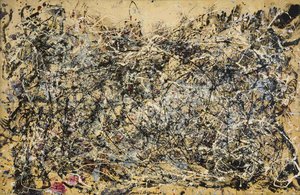
Number 8
Replikaatin koko
Jackson Pollock's "Number 8," created in 1949, stands as a pivotal work within the Abstract Expressionist movement. This piece exemplifies Pollock’s revolutionary “drip technique,” where paint was poured and flung onto a canvas laid horizontally on the floor. This method allowed for a complete immersion of the artist into the creative process, moving beyond traditional easel painting to embrace a dynamic, almost performative act. The absence of recognizable imagery forces viewers to engage directly with the raw energy and materiality of the paint itself. "Number 8" isn't about depicting something; it’s about *doing* – capturing a moment of spontaneous creation.
The composition of "Number 8" is a complex web of interwoven lines, drips, and splatters. Pollock utilized a variety of tools—sticks, knives, even hardened brushes—to manipulate the paint's flow, creating layers of texture and depth. The dominant color palette features greens, blacks, yellows, and rust tones, all blended in an intricate dance across the canvas. Notice how the lines don’t simply stop at the edges; they seem to extend beyond the frame, suggesting a boundless energy contained within the work's boundaries. This "all-over" composition, where every inch of the canvas is treated with equal importance, was a hallmark of Pollock’s style and challenged traditional notions of pictorial space.
"Number 8" emerged during a period of significant cultural change in post-World War II America. Abstract Expressionism reflected a desire to break from European artistic traditions and establish a uniquely American voice in the art world. The movement was also influenced by psychological theories, particularly Jungian psychology, which explored the power of the unconscious mind. While Pollock’s work is largely non-representational, some critics have interpreted his drip paintings as symbolic representations of primal forces, emotional turmoil, or even cosmic energies. The act of creation itself became a form of self-expression and exploration.
Viewing "Number 8" can be an intensely visceral experience. The chaotic yet controlled arrangement of paint evokes feelings of energy, movement, and perhaps even anxiety. It’s a work that demands active engagement from the viewer – there's no passive observation here. Pollock’s innovative technique and his commitment to pure abstraction profoundly influenced subsequent generations of artists, solidifying his place as one of the most important figures in modern art history. The painting continues to inspire awe and debate, prompting viewers to reconsider the very nature of artistic creation and the power of abstract expression.

1912 - 1956 , Yhdysvallat

Dive into the high-voltage world of Abstract Expressionism. Explore the raw energy of Action Painting and the legendary masters of the New York School through a visual journey of pure chaos and color. Discover how to bring bold, high-impact abstract art into your modern space.

Dive into the raw power of Abstract Expressionism. Explore the high-octane energy of action painting and color field mastery. Discover how these bold, visceral movements redefine modern interiors with high-impact, premium abstract art for the contemporary collector.

Master the high-impact world of contemporary abstraction. Discover how bold colors, textures, and modern movements like Abstract Expressionism can transform your space with premium, high-energy art curated for the design-conscious professional.

Discover the power of Neo-Abstract art. Explore how bold geometric forms and high-impact visual energy are redefining modern design. Learn to curate sophisticated, high-energy spaces with the latest trends in contemporary abstraction and structural color.


Pysy ajan tasalla uusimmista taideuutisista, eksklusiivisista tarjouksista ja sisustusideoista.
Kerro meille projektistasi, niin taideasiantuntijamme tarjoavat sinulle kolme henkilökohtaista taidesuositusta.
Anna meidän kuratoida 3 vaihtoehtoa juuri sinulle – Ilmaiseksi!


 Esikatselu
 Jaa
Jaa Jaa
Jaa
 Tarkemmat tiedot

 Lataa
Lataa
 Samanlaisia
 Röntgenkuva
 Diaesitys

 Näytä lisää







 Lasivaihtoehto on saatavilla vain alle 110 cm kokoisina teoksina