x
MegtekintésMegtekintés Műalkotás AR előnézeteMűalkotás AR előnézete Nyomat rendelése Nyomat rendeléseKézzel festett másolat rendelése Kézzel festett másolat rendelése KüldésKüldés
RészletekRészletek Kedvencekhez ad Kedvencekhez ad LetöltésLetöltés Hasonló darabokHasonló darabok X-ray felvételX-ray felvétel DiavetítésDiavetítés

Sonata

Marcel Duchamp's Sonata captures the harmonious interplay of four musicians—violinist, pianist, and two singers—in a meticulously crafted watercolor scene reflecting proto-cubism’s geometric abstraction.

Marcel Duchamp: Egy francia avant-garde művész, aki megváltoztatta az művészi alkotás értelmét és új irányokat mutatott be a modern művészet története során.

Vásároljon nagy felbontású, javított digitális képet, amely minőségében messze felülmúlja az online előnézetet.

Minden fájlt szakembereink a legmodernebb eszközök és precíz, kézi retusálás segítségével készítenek el aprólékosan. Gondoskodunk arról, hogy minden kép kivételes tisztasággal, pontos színhelyességgel és részletgazdag finomsággal rendelkezzen.

A végleges fájl 72 órán belül e-mailben megérkezik, professzionális, szerkesztői és nyomtatási környezetbe optimalizálva az azonnali használathoz. Ez ugyanaz a minőség, amelyben a legmeghatározóbb tervezőstúdiók, kiadók és galériák is megbízhatnak.

Digitális kép

Töltsön le nagy felbontású fájlt személyes kiállításokhoz, nyomtatáshoz és kreatív projektekhez. (Nyomat rendelése Nyomat rendeléseKézzel festett másolat rendelése Kézzel festett másolat rendelése)

Összesített ár

$ 26,90

Minden digitális kép rendeléséhez tartozó extrák

Szakértői digitális kézbesítés, garantáltan

Amikor a BuyPopArt.com szolgáltatást választja, nem csupán egy képet kap – professzionálisan felmagasított digitális műalkotást kap, amely precizitással készült, és amelyet megelégsedési gwarancia tesz biztoslássá. Az alábbiakban automatikusan minden benne 】

shipping_icon
Gyors e-mail teslimítés

A nagy felbontású digitális képmásolatát a megrendelést követő 72 órán belül e-mailben elküldjük Önnek – azonnal használható formátumban.

canvas_icon
MI-alapú digitális fejlesztésű fájl

Műve professzionális módon kerül optimalizálásra fejlett mesterséges intelligencia eszközök és manuális szerkesztés segítségével, biztosítva a maximális részletességet, tisztaságot és színpontosságot.

insurance_icon
Örök életű ingyenes újradelivery

Véletlenül törölted vagy elvesztetted a fájlodat? Ne aggódj – bármikor ingyen újra megküldjük neked.

tax_icon
Nincs importköltség – soha

Élvezze műalkotásait azonnal, vám, illeték vagy szállítási költség nélkül – a digitális letöltések mindig adamentesek.

color_icon
Színpontosság garantálása

Professzionális eszközök és színkezelés segítségével garantáljuk, hogy digitális képe a lehető legpontosabban tükrözze az eredeti színeket.

return_icon
60 napos elégedettségi garancia

Ha nemມີ elégedett a digitális képpel, 60 napon belül átmunkáljuk azt, vagy 100% visszatérítjük az amountot – kérdés nélkül.

guarantee_icon
100% Pénzvisszatérítési garancia

Nem érheted el a teljes elégedettséget? 60 napon belül teljes visszatérítést kapsz a digitális fájlod megérkezése után – kérdés nélkül.

discount_icon
Tömegrendelési kedvezmények

Vásároljon 3 képet, spóroljon 10%-et - Vásároljon 5-öt, spóroljon 15%-et - Vásároljon 10+ képet, spóroljon 20%-at. Kiváló kreatív projektekhez, galériákhoz és ügynökségekhez.

Gyors információk

  • Year: 1911
  • Artistic style: Abstract
  • Notable elements or techniques: Geometric shapes; Limited color palette
  • Title: Sonata
  • Influences: Cubism
  • Subject or theme: Musical instruments; Women
  • Movement: Proto-Cubism

Művészeti kvíz

Minden kérdésre csak egy helyes válasz létezik.

Kérdés 1:
What artistic movement is Marcel Duchamp primarily associated with?
Kérdés 3:
Describe the predominant stylistic characteristic of Sonata.
Kérdés 5:
In what year was Sonata painted?
Kérdés 7:
Where is Sonata currently housed?
Kérdés 9:
What distinguishes Sonata from earlier musical forms like the fugue?

A gyűjtemény részletei

A Symphony of Fractured Light

In the quiet evolution of modernism, few moments capture the tension between tradition and revolution as poignantly as Marcel Duchamp’s 1911 watercolor, Sonata. At first glance, the viewer is invited into an intimate domestic scene—a musical gathering where four women are immersed in the rhythmic beauty of performance. Yet, as the eye lingers, the familiar boundaries of reality begin to dissolve. This is not merely a depiction of a concert; it is a profound exploration of proto-Cubist thought, where the artist begins to dismantle the physical world to reveal its underlying geometric soul. The composition breathes with a sense of spatial dynamism, as if the very air in the room is vibrating in harmony with the instruments being played.

Duchamp’s technique in Sonata serves as a bridge between the soft, atmospheric legacies of Impressionism and the sharp, intellectual rigor of Cubism. Using the delicate medium of watercolor, he employs a palette of muted, earthy tones—predominantly browns and whites—interspersed with strategic, luminous yellow accents that guide the viewer through the fractured landscape. The artist utilizes orthogonal lines and intersecting planes to break the figures into geometric segments, creating a visual puzzle that challenges the eye to reconstruct the scene. This deliberate fragmentation allows for a simultaneous viewpoint, where the depth of the room and the solidity of the chairs are reimagined through a lens of abstraction, offering a sense of movement that feels both structured and ethereal.

The Architecture of Sound and Spirit

Beyond its technical brilliance, Sonata carries a deep symbolic weight, representing the transition from "retinal art"—art intended only for the eye—to a more conceptual mode of expression. The musical theme is not incidental; it serves as a metaphor for the mathematical and rhythmic precision found within the Cubist movement. Just as a sonata is composed of structured movements that coalesce into a unified whole, Duchamp arranges his subjects—the violinist, the pianist, and their companions—into a carefully orchestrated arrangement of shapes and shadows. The presence of the two chairs, positioned to anchor the composition, provides a structural counterpoint to the fluid, breaking forms of the musicians, grounding the experimental abstraction in a recognizable human experience.

For the discerning collector or interior designer, this piece offers an unparalleled opportunity to introduce a sense of intellectual depth and historical significance into a space. Sonata is more than a decorative element; it is a conversation starter that evokes the avant-garde spirit of early 20th-century Paris. Its sophisticated use of neutral tones and geometric rhythm makes it a versatile masterpiece, capable of complementing both minimalist contemporary settings and richly textured classical interiors. To possess a reproduction of this work is to hold a fragment of the moment when art decided to break free from the mirror of reality and begin dreaming in geometry.
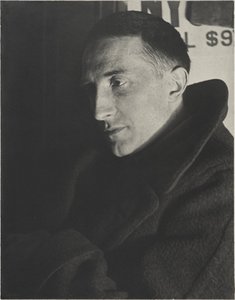

A művész életrajza

Marcel Duchamp (1887–1968): A Revolutionary Spirit

Marcel Duchamp, born Henri-Robert-Marcel Duchamp in 1887 in Blainville-Crevon, Normandy, was more than an artist; he was a philosophical provocateur who fundamentally altered the course of modern art. His early life, though seemingly conventional – nurtured within a family that appreciated artistic expression with both brothers pursuing successful careers as artists – hinted at the iconoclasm to come. Duchamp initially pursued formal training, mastering traditional techniques and experimenting with post-impressionist styles. However, this academic foundation served not as an end in itself, but as a springboard for questioning the very nature of art, its purpose, and its definition. He wasn’t content merely to depict the world; he sought to challenge how we perceive it, and what constitutes artistic value. This restless intellectual curiosity would become the defining characteristic of his prolific career.

Early Life and Artistic Beginnings

Duchamp's formative years were marked by a familial tradition of artistic inclination. His father, Eugène Duchamp, was a notary, yet four of the six Duchamp children embraced art as their vocation. Jacques Villon, Marcel’s elder brother, established himself as a painter, demonstrating an early aptitude for visual expression. Raymond Duchamp-Villon followed suit, pursuing sculpture with considerable success. Marcel himself began experimenting with painting at a young age, producing *Portrait of Marcel Lefrançois* (1904), which showcased his nascent stylistic sensibilities and technical prowess. His studies at the École des Beaux-Arts in Paris yielded mixed results—he famously failed to pass the final exam—but this setback fueled his determination to forge his own artistic path, independent from established conventions.

Cubism: A Dialogue with Tradition

Duchamp’s initial engagement with Cubism, evident in works like *Portrait of Chess Players* (1911), represented a crucial step beyond purely decorative pursuits. He absorbed the influence of Picasso and Braque, adopting their innovative techniques for dissecting visual reality into fragmented planes and multiple perspectives—a deliberate departure from traditional representation. However, Duchamp didn’t simply replicate Cubist aesthetics; he interrogated its underlying principles, questioning whether it truly captured the essence of experience. The pervasive disillusionment stemming from World War I profoundly impacted his artistic vision, propelling him toward Dadaism as a reaction against perceived intellectual and moral failings.

Dadaism: Rebellion Against Reason

The horrors of World War I galvanized Duchamp’s rebellious spirit, leading him to embrace Dadaism—a movement born out of utter despair and vehement rejection of logic, reason, and the prevailing artistic values of the time. Dadaists sought to dismantle accepted norms through absurdity, chance, and provocation, rejecting any attempt at rational explanation or aesthetic judgment. Within this anarchic framework, Duchamp unleashed his most radical innovation: the ‘readymade’. This concept—taking an ordinary manufactured object and declaring it art—challenged the very definition of artistic skill and authorship. His seminal work, *Fountain* (1917), a porcelain urinal signed “R. Mutt,” epitomized Dada’s irreverence for convention and ignited a furious debate about the role of the artist in society.

The Readymades and Conceptual Art: A Paradigm Shift

Duchamp's embrace of the readymade irrevocably altered the trajectory of art history, establishing him as a progenitor of Conceptual Art—an artistic movement that prioritizes idea over material execution. Objects like *L.H.O.O.Q.* (1919), a postcard reproduction of the Mona Lisa defaced with a mustache and goatee, served as biting critiques of cultural icons and artistic traditions. These works weren’t judged on their visual beauty; they demanded contemplation and provoked viewers to confront uncomfortable questions about art's role in shaping our perceptions of reality. Duchamp’s unwavering conviction that art should reside in the mind—not merely in the eye—continues to resonate powerfully within contemporary artistic discourse. His legacy extends far beyond his individual creations, influencing countless artists who followed him and reshaping our understanding of what constitutes artistic expression.

Later Years: Surrealism and Continued Innovation

Duchamp’s artistic explorations continued throughout his life, encompassing film, sculpture, and collaborative projects with fellow artists like Man Ray. He participated in Surrealist exhibitions organized by André Breton, demonstrating an enduring fascination with the subconscious mind and its capacity to generate unexpected imagery. His monumental *Etant donnés* (1965–6), a reconstructed version of *The Large Glass*, represents his final artistic endeavor—a complex symbolic work that embodies his lifelong preoccupation with challenging conventions and provoking intellectual engagement. Marcel Duchamp died in Neuilly-sur-Seine on October 2, 1968, leaving behind an unparalleled body of work that cemented his place as one of the most influential figures in modern art history.
Marcel Duchamp

Marcel Duchamp

1887 - 1968 , Franciaország

Érdekességek

  • Artistic Movement Or Style:
    • Kubizmus
    • Dadaizmus
    • Szürrealizmus
  • Artists Or Movements Influenced By This Artist: ['Minimalizmus']
  • Date Of Birth: 28 július 1887
  • Date Of Death: 2 október 1968
  • Full Name: Marcel Duchamp
  • Nationality: Francia-amerikai
  • Notable Artworks:
    • Fúvóka
    • L.H.O.O.Q.
    • A Nagy Üveg
  • Place Of Birth: Blainville, Franciaország