Acquista stampa Acquista stampaAcquista download Acquista download InviaInvia
Dettagli operaDettagli opera Aggiungi ai preferiti Aggiungi ai preferiti ScaricaScarica SimiliSimili RadiografiaRadiografia SlideshowSlideshow

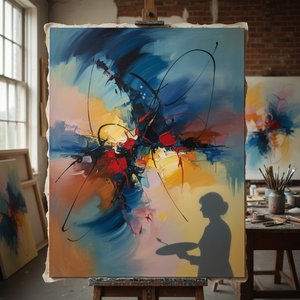
Transmutation III

Explore Basil Alkazzi’s ‘Transmutation III,’ a captivating 1991 abstract watercolor depicting cosmic themes & spiritual symbolism. A unique piece for art collectors.

Basil Alkazzi is a celebrated Abstract Expressionist known for his vibrant color palettes and dynamic compositions, creating evocative works that capture the energy of modern life—discover his captivating art today.

Riproduzione a olio fatta a mano

Olio su tela dipinto a mano nelle tue dimensioni e con la tua cornice, realizzato su ordinazione dai nostri artisti.

Standard
custom
CM
INCH

Scegli tra le nostre dimensioni predefinite, che rispettano le proporzioni originali dell'opera d'arte.

larghezza
altezza

È possibile inserire dimensioni personalizzate per adattare l'opera a una cornice o a uno spazio specifico. Se la dimensione selezionata non corrisponde alle proporzioni dell'immagine originale, provvederemo a ritagliare l'opera o a estendere il dipinto con elementi aggiuntivi dipinti a mano. Un mockup digitale ti sarà inviato per approvazione prima dell'inizio della produzione.
Si prega di notare che l'anteprima a schermo non riflette il ritaglio o l'estensione effettivi. Solo il mockup mostrerà accuratamente la composizione finale.
Sebbene siano disponibili dimensioni personalizzate, consigliamo di selezionare una dimensione dall'elenco predefinito per preservare le proporzioni originali.

Esempi di modifiche possibili: sostituire il volto con una foto del cliente; aggiungere un animale domestico (ad esempio, sostituire un gatto con un cane); inserire un messaggio nascosto sullo sfondo; modificare il paesaggio o gli elementi dello sfondo.
Dopo l'ordine, il team di BuyPopArt.com invierà un'e-mail al cliente per le istruzioni e fornirà un'anteprima del mockup

Consegna in tutto il mondo () in 3/4 settimane anziché nelle normali 5 settimane. (23 Luglio). Nessun compromesso sulla qualità.

why_choose_icon
Spedizione espressa gratuita in tutto il mondo

why_choose_icon
Tela in lino di alta qualità
why_choose_icon
Assicurazione completa sulla spedizione
why_choose_icon
Garanzia di rimborso dei dazi doganali
why_choose_icon
Garanzia di fedeltà cromatica
why_choose_icon
Politica di reso entro 60 giorni (solo per difetti)
why_choose_icon
Garanzia di rimborso al 100%
why_choose_icon
Sconto per acquisti multipli

Prezzo totale

-

reproduction

Transmutation III

Tecnica di riproduzione

Dimensioni riproduzione

-

Prezzo totale finale

-

Descrizione dell'opera

Basil Alkazzi studied at the Central School of Art in London and went on to live in multiple Western cities. Throughout, he has maintained a core sense of the spiritual and metaphysical in his work. His abstract images and symbols of nature are often inspired by a search for the sacred and the meaning of life. He paints dreamlike nightscapes, landscapes, and representations of cosmic space. The double triangle reoccurs in his later work, one denoting the body with its base on earth and reaching upward toward the heavens, the other symbolizing the soul based in the heavens and pointing earthward to support the body. In 1986, Alkazzi established the Basil H. Alkazzi Foundation Awards at the Royal College of Art London and in 1987 he founded the Basil H. Alkazzi Award for young and emerging U.S. painters.

Biografia dell'artista

A Life Immersed in Light and Form: The Journey of Basil Alkazzi

Basil Alkazzi is a British artist whose work embodies a profound connection to the landscapes and light of the Mediterranean, particularly those of his ancestral homeland, Morocco. Born in 1930 in Tetuan, Morocco, Alkazzi’s early life was steeped in the rich visual culture of North Africa – a world of vibrant colors, intricate patterns, and the dramatic interplay of sun and shadow. This formative period would become the cornerstone of his artistic vision, influencing not only *what* he painted but also *how* he approached the canvas. His family relocated to England when he was young, yet the memories and emotional resonance of Morocco remained a powerful force throughout his development as an artist. He studied at the Regent Street Polytechnic in London, receiving formal training that provided him with technical skills, but it was his innate sensitivity to color and composition that truly set him apart. Alkazzi’s artistic path wasn't immediate; he initially pursued a career in architecture before fully dedicating himself to painting in the 1960s. This architectural background subtly informs his work, evident in the strong structural elements often present within his compositions.

The Moroccan Influence and Early Development

Alkazzi’s early paintings were largely focused on capturing the essence of Morocco – bustling marketplaces, serene courtyards, and the majestic Atlas Mountains. He wasn't interested in a literal depiction of these scenes; rather, he sought to convey the *feeling* of being there, the warmth of the sun on skin, the scent of spices in the air, the energy of daily life. His style during this period can be described as expressive and semi-abstract, utilizing bold brushstrokes and a rich palette inspired by traditional Moroccan textiles and ceramics. The influence of artists like Matisse and Braque is discernible in his early work, particularly their use of flattened forms and vibrant color to create a sense of atmosphere and emotion. However, Alkazzi quickly moved beyond mere imitation, developing a unique visual language that was distinctly his own. He began experimenting with different techniques, incorporating collage elements into his paintings and exploring the possibilities of texture and layering. This experimentation led him towards a more abstract approach, where form and color became increasingly important in conveying meaning.

Abstraction and the Pursuit of Pure Color

By the 1970s, Alkazzi’s work had undergone a significant transformation. While still rooted in his Moroccan heritage, he moved away from representational imagery towards a more abstract style. His paintings became increasingly focused on the interplay of color and form, exploring the emotional power of pure pigment. He sought to create works that were not about *what* they depicted but rather about *how* they made you feel. This period saw him develop his signature technique of layering thin washes of color, creating luminous surfaces that seem to glow from within. He often worked on large-scale canvases, allowing the colors to interact and blend in complex and subtle ways. Alkazzi’s abstract works are not entirely devoid of reference; hints of architectural structures, geometric patterns, and landscape elements can still be detected beneath the layers of color. However, these references are fragmented and abstracted, serving as a starting point for his exploration of form and emotion.

Recognition and Legacy

Throughout his career, Basil Alkazzi has exhibited widely in both Europe and North America, gaining recognition for his unique artistic vision and technical mastery. His work is held in numerous public and private collections, including the Tate Gallery in London and the Museum of Modern Art in New York. He has been described as a “colorist” – an artist who possesses an exceptional understanding of color theory and its emotional impact.
  • Alkazzi’s paintings have resonated with audiences for their ability to evoke a sense of warmth, tranquility, and joy.
  • His work is often seen as a celebration of cultural diversity and the beauty of the Mediterranean world.
  • He has inspired generations of artists with his commitment to experimentation and his unwavering pursuit of artistic expression.
Alkazzi’s historical significance lies in his ability to bridge the gap between abstraction and representation, creating works that are both visually stunning and emotionally resonant. He demonstrated how abstract forms could be used to convey complex ideas and emotions, while simultaneously celebrating the rich cultural heritage of his ancestral homeland. His legacy continues to inspire artists today, reminding them of the power of color, form, and personal experience in shaping a unique artistic vision.

Dati rapidi

  • Artistic Movement Or Style: Abstract Expressionism
  • Artists Or Movements Influenced By This Artist: Contemporary Artists
  • Artists Who Influenced This Artist:
    • Mark Rothko
    • Willem de Kooning
  • Date Of Death: Living
  • Full Name: Basil Alkazzi
  • Notable Artworks:
    • Untitled (1960s)
    • Red and Black (1970s)