A Fragmented Vision: The Soul of Georges Braque’s Cabines
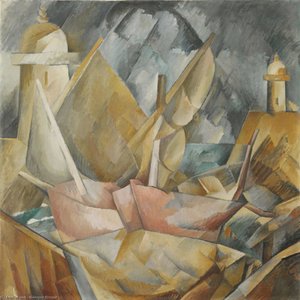
To gaze upon Georges Braque’s Cabines is to witness the very moment the foundations of Western representation began to fracture and reform. Created in 1907, this seminal work serves as a profound gateway into the Cubist revolution, a period where the artist sought not to mirror the world, but to interrogate its fundamental structure. The painting presents a deceptively quiet scene—small cabins nestled against a rugged, rocky outcrop beneath a brooding, heavy sky—yet beneath this stillness lies a radical deconstruction of reality. Braque moves away from the fleeting light of Impressionism to embrace a more permanent, intellectual exploration of form. Through his eyes, we do not see a mere landscape; we see a rhythmic arrangement of geometric planes that challenge our very perception of space and existence.
The composition is a masterclass in the early Cubist technique, where the boundaries between object and atmosphere begin to dissolve. Braque utilizes a palette of shadows, dominated by somber shades of charcoal gray, deep brown, and earthy black, which imbues the work with a haunting, melancholic resonance. There is no singular, clear light source; instead, a subtle play of tonal variations suggests a world caught in a state of transition. The texture of the canvas itself feels vital to the narrative, as thick, deliberate brushstrokes define the cliff face and the skeletal structure of the boat resting on the shore. This tactile quality creates a sense of palpable weight and solidity, grounding the abstract shapes in a physical, almost visceral reality that invites the viewer to touch the very essence of the paint.
Symbolism and the Architecture of Emotion
Beyond its formal innovations, Cabines carries a profound emotional weight that speaks to the human condition. The fragmentation of the cabins and the rocky terrain can be interpreted as a reflection of modern existentialism—a sense of isolation and vulnerability within an indifferent universe. The way the structures are broken into angular, sharp-edged forms suggests a world that is no longer stable or unified, but rather a collection of disparate perspectives. For the collector or the interior designer, this piece offers more than just aesthetic beauty; it provides a focal point of intellectual depth. It is a work that demands contemplation, offering a sophisticated atmosphere of mystery and quiet strength.
Integrating a high-quality reproduction of such a masterpiece into a curated space allows for a dialogue between history and modernity. The monochromatic elegance of Braque’s vision complements contemporary minimalist interiors, adding a layer of historical gravity and textural richness. Whether placed in a professional gallery setting or a private study, Cabines acts as an anchor of profound thought, reminding us that even within the broken fragments of our perception, there is a powerful, underlying structure waiting to be discovered. It is an invitation to look closer, to see beyond the surface, and to find beauty in the complexity of the fractured whole.


 プレビュー
プレビュー
 手描きの絵画を購入
 シェアする
シェアする シェアする
シェアする
 詳細を見る
詳細を見る

 ダウンロード
 似ている作品
 X線調査
X線調査 スライドショー

 詳細を見る
詳細を見る






































 ガラスオプションは、110cm未満のサイズでのみご利用いただけます。