作品詳細説明
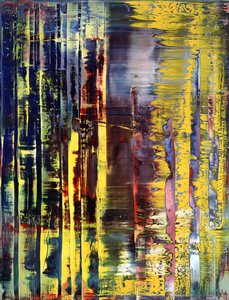
A Window into Uncertainty: Examining Gerhard Richter’s “Forest (8)”
Gerhard Richter's "Forest (8)" isn’t merely a depiction of woodland scenery; it’s an embodiment of the artist’s profound engagement with memory, perception, and the elusive nature of reality—themes that consistently underpin his oeuvre. Created in 2005, this monumental canvas – measuring 197 x 132 cm – exemplifies Richter's signature style: Photorealism overlaid with a deliberate haze of abstraction, a technique he termed “Capitalist Realism,” which reflects the anxieties and contradictions inherent within late 20th-century German culture. The image itself presents a tranquil forest scene—trees dominate the background, punctuated by architectural structures—yet this serenity is undercut by Richter’s masterful manipulation of color and texture.
The Technique of Diffusion: Richter's Methodical Approach
Richter achieved his distinctive visual effect through a process he painstakingly documented in “Gerhard Richter Painting,” a film exploring his creative methodology. He employs multiple layers of semi-transparent acrylic paint applied to the canvas, creating a mottled surface that mimics the appearance of photographic prints—a deliberate homage to the medium itself and a rejection of traditional painting conventions. This diffusion technique isn’t simply about achieving visual accuracy; it's about conveying an emotional state – uncertainty, hesitation – mirroring Richter’s own artistic philosophy. The artist himself describes this process as “like trying to capture something that is already gone,” highlighting the inherent impossibility of perfectly replicating experience and emphasizing instead the importance of suggestion and atmosphere.
Historical Context: Reflecting a Divided Nation
“Forest (8)” emerges from the context of Germany’s turbulent postwar period, specifically following reunification in 1990. Richter's artistic explorations grapple with the legacy of division—the trauma of the Second World War and the Cold War—and the difficulty of reconciling past narratives with present realities. The muted palette – predominantly greens, browns, and reds – contributes to this sense of melancholy and contemplation. Unlike Impressionists who sought to capture fleeting moments of beauty, Richter aims for a more enduring representation of emotion, mirroring the artist’s preoccupation with confronting uncomfortable truths about history and identity.
Symbolism Beyond Landscape: Layers of Meaning
While ostensibly portraying a forest landscape, “Forest (8)” transcends its surface appearance. The architectural elements—likely buildings representing urban life—serve as counterpoints to the natural world, symbolizing the encroachment of civilization upon wilderness. This juxtaposition underscores Richter’s broader concern with examining how memory shapes our understanding of the past and influences our perception of the present. Furthermore, the hazy texture of the painting symbolizes the elusive nature of recollection; it suggests that we never fully grasp what has transpired, only fragments of experience filtered through time.
Emotional Resonance: Capturing Transient Beauty
Ultimately, “Forest (8)” succeeds in evoking a powerful emotional response. The artwork’s subdued colors and textured surface invite viewers to contemplate the passage of time and the fragility of beauty. Richter's masterful blending of photorealism and abstraction compels us to question our own interpretations of visual stimuli—to recognize that what we see is never entirely objective but always shaped by subjective experience. It’s a piece that lingers in the mind long after viewing, prompting reflection on themes of loss, remembrance, and the enduring power of art to convey profound emotional truths.


 プレビュー
プレビュー
 手描きの絵画を購入
 シェアする
シェアする シェアする
シェアする
 詳細を見る
詳細を見る

 ダウンロード
 似ている作品
 X線調査
X線調査 スライドショー


 詳細を見る
詳細を見る






































 ガラスオプションは、110cm未満のサイズでのみご利用いただけます。