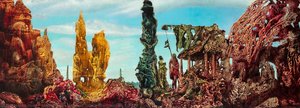
A Descent into Chromatic Discord: Unpacking Max Ernst’s “Fleur violette”
Max Ernst's "Fleur violette" presents a captivating enigma, a visual puzzle that immediately draws the viewer into its unsettling yet undeniably compelling world. This seemingly simple composition – a dominant blue circle punctuated by bursts of yellow and red – is far more than just an exercise in color; it’s a potent distillation of Dadaist principles, reflecting Ernst's profound skepticism towards reason and his exploration of the subconscious mind. The painting’s raw energy and deliberate disruption of traditional artistic conventions speak to a period of intense social and political upheaval, mirroring the anxieties and uncertainties that defined the early 20th century.
- Subject Matter: While ostensibly depicting a flower – “fleur” in French – the work transcends any literal representation. The blue circle acts as an anchor, a void perhaps, while the vibrant colors suggest a chaotic bloom, a distorted and unsettling natural form.
- Style & Technique: Executed in oil on canvas, "Fleur violette" embodies Ernst’s signature approach to painting. He employed techniques borrowed from various sources – including collage, frottage (rubbing), and decalcomania – layering textures and creating a sense of visual friction. The deliberate roughness of the paint application contributes to the work's unsettling atmosphere.
- Dadaist Roots: As a key figure in the Dada movement, Ernst rejected academic art traditions and embraced irrationality, chance, and anti-art sentiments. “Fleur violette” perfectly embodies this ethos, challenging viewers to confront their own preconceptions about beauty and representation.
Decoding the Symbolism: A Journey into the Unconscious
The specific colors employed in "Fleur violette" are laden with symbolic weight. Blue, often associated with melancholy, spirituality, and the infinite, dominates the composition, creating a sense of isolation or perhaps even dread. The jarring bursts of yellow – representing energy, intellect, and sometimes deceit – clash violently with the blue, while red evokes passion, danger, and primal instincts. These colors aren’t blended harmoniously; they are deliberately juxtaposed to create visual tension and disrupt any attempt at rational interpretation.
- The Circle: The central circle can be interpreted as a symbol of wholeness or containment, but within the context of the painting, it feels more like an empty space, a void that demands attention.
- Color Dynamics: Ernst’s use of color is not merely decorative; it's a deliberate attempt to evoke emotional responses and tap into the viewer’s subconscious. The colors seem to vibrate with an internal energy, reflecting the artist’s own psychological turmoil.
Historical Context & Max Ernst’s Vision
Created during a period of immense social and political change – marked by World War I and the rise of Dadaism – “Fleur violette” reflects Ernst's disillusionment with Western civilization. Born in 1891, Ernst witnessed firsthand the horrors of war and the breakdown of traditional values. His artistic practice became a means of expressing his anxieties and challenging the status quo. Ernst’s intellectual background, encompassing philosophy, psychology, and psychiatry, profoundly shaped his work, leading him to explore themes of dreams, memory, and the irrational.
- Early 20th Century Influences: The painting resonates with the broader artistic currents of the time, including Expressionism and Surrealism, reflecting Ernst’s ongoing experimentation with different styles.
- A Rejection of Representation: “Fleur violette” exemplifies Ernst's commitment to rejecting traditional representational art in favor of exploring subjective experience and psychological states.
Emotional Impact & Artistic Value
"Fleur violette" is a powerfully evocative work that continues to fascinate and challenge viewers today. Its unsettling composition, bold use of color, and Dadaist sensibilities create an atmosphere of unease and disorientation. This reproduction captures the essence of Ernst’s artistic vision, offering a tangible connection to one of the most important figures in 20th-century art. It's a piece that invites contemplation, prompting viewers to question their perceptions of reality and explore the depths of the human psyche.


 プレビュー
プレビュー
 プリントを購入
 シェアする
シェアする シェアする
シェアする
 詳細を見る
詳細を見る

 ダウンロード
 似ている作品
 X線調査
X線調査 スライドショー

 詳細を見る
詳細を見る






































 ガラスオプションは、110cm未満のサイズでのみご利用いただけます。