
 Contemporary Realism
 1933
1933 102.0 x 66.0 cm
작품의 원본 비율을 유지하는 미리 설정된 크기 중에서 선택하세요.

특정 프레임이나 공간에 맞도록 직접 크기를 입력할 수 있습니다. 선택하신 크기가 원본 이미지의 비율과 일치하지 않는 경우, 작품을 자르거나 추가적인 손으로 그린 요소를 사용하여 그림을 확장합니다. 제작 시작 전 승인을 위해 디지털 목업을 보내드립니다.
화면 미리 보기는 실제 자르기 또는 확장을 반영하지 않습니다. 최종 구성은 목업을 통해서만 정확하게 확인하실 수 있습니다.
맞춤 크기 제작도 가능하지만, 원본 비율을 유지하기 위해 사전 정의된 목록에서 크기를 선택하시는 것을 권장합니다.

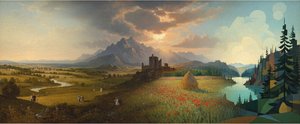
Summer Wind
복제본 크기
Alexander Brook (July 14, 1898 – February 26, 1980) stands as a prominent figure in the landscape of American Realist painting during the 1930s and beyond. Born in Brooklyn, New York, to Russian immigrants Eudoxia Gelescu and Onufri Brook, his early life was profoundly shaped by polio at age twelve—a debilitating illness that sidelined him from formal schooling but ignited a lifelong passion for artistic exploration.
Brook’s formative years were marked by diligent study at the Art Students League of New York (1915), where he honed his skills under luminaries like Kenneth Hayes Miller and John Christen Johansen. This period cemented his commitment to mastering traditional techniques—a dedication that would define his artistic trajectory for decades.
His fascination with painting began during his convalescence, fueled by visits to the Metropolitan Museum of Art and a burgeoning interest in the work of Jules Pascin. Brook’s artistic sensibilities were further nurtured at Pratt Institute, where he gained invaluable experience alongside fellow artists like Peggy Bacon—whom he married in 1920—establishing a partnership that would endure until their divorce in 1940.
The couple relocated to London briefly before returning to New York and establishing a home in Woodstock and Greenwich Village. Brook’s artistic output flourished during this era, characterized by intimate portraits, genre scenes imbued with quiet observation, and explorations of the human figure—often rendered with remarkable sensitivity and detail.
Brook achieved considerable acclaim for his paintings and prints throughout his career, earning prestigious awards including the Carnegie Prize in 1939—shared with Pablo Picasso—the Frank G. Logan Medal at the Art Institute of Chicago in 1929, and the Temple Gold Medal at Pennsylvania Academy of Fine Arts in 1931. His canvases captured the essence of everyday life during the Great Depression, reflecting a profound engagement with social realities.
He taught at the Art Students League from 1933 to 1936 and again from 1942 to 1943, imparting his knowledge and fostering the artistic development of aspiring artists. Brook’s legacy extends beyond his own creations—he championed American Realism during a period of significant artistic upheaval.
Around 1938 Brook embarked on a transformative journey to Savannah, Georgia, establishing residence in a studio overlooking the Savannah River. During this time he produced a series of evocative landscapes and portraits—capturing the spirit of the city’s historic Black neighborhoods and reflecting his unwavering adherence to artistic principles.
His work garnered recognition from institutions like the Whitney Museum and Albright-Knox Gallery, securing its place within the canon of American Realist art. Alexander Brook's enduring influence can be seen in the continuing appreciation for meticulous observation and expressive technique—a testament to his unwavering commitment to artistic excellence.

1898 - 1980
Journey through 10 breathtaking landscape paintings by Monet, Van Gogh & more! Explore iconic artworks, artistic techniques & find inspiration for your home decor. Museum-quality reproductions at BuyPopArt.com. Discover all masterpieces on BuyPopArt.com
Explore the rich history of landscape art with BuyPopArt. Discover renowned artists, movements like Impressionism & Romanticism, and expert guidance for collecting timeless pieces. Find your perfect serene escape today!

낭만주의 시대, 예술혼을 불태운 10대 풍경화 걸작! 터너부터 프리드리히까지, 시대를 초월하는 아름다움을 와후아트에서 만나보세요. 고흐의 색채와 코로의 섬세함이 당신의 공간에 영감을 더합니다. 지금 바로 와후아트에서 명품 미술 작품을 감상하고 구매하세요!

Explore the rich history of landscape art with BuyPopArt. Discover renowned artists, movements like Impressionism & tonalism, and expert guidance for collecting timeless pieces. Find your perfect serene escape today!

Explore the captivating world of 19th-century landscape painting! Discover renowned artists like Friedrich & Monet, key movements, and find the perfect artwork to bring nature's serenity into your home. Expert insights at BuyPopArt.


최신 미술 뉴스, 특별 혜택 및 인테리어 아이디어를 가장 먼저 만나보세요.
프로젝트에 대해 알려주시면 저희 미술 전문가들이 맞춤형 아트 제안 3가지를 전달해 드립니다.
당신만을 위한 맞춤형 옵션 3가지를 무료로 추천해 드립니다!


 미리보기
미리보기
 프린트 구매
 공유하기
공유하기 공유하기
공유하기
 상세 정보
상세 정보

 다운로드
다운로드
 유사 작품
유사 작품 X-레이
X-레이 슬라이드 쇼
 더 보기
더 보기






































 유리 옵션은 110cm 미만 크기에서만 선택 가능합니다.


