Franz Marc’s “Cat with Kittens”: A Symphony of Color and Spiritual Resonance
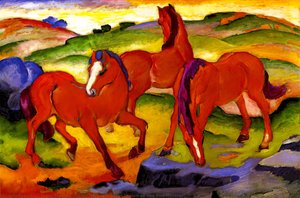
The painting "Cat with Kittens" by Franz Marc is more than just an image; it's a distillation of Expressionist philosophy into visual form. Created in 1912, during the height of Der Blaue Reiter’s artistic fervor—a movement dedicated to exploring inner emotional experience through abstraction—this oil on canvas piece transcends mere representation, aiming instead for a profound connection with the viewer’s soul. Marc's unwavering belief that art could illuminate the hidden truths of existence is palpable in every brushstroke.
Expressionism and Color: Decoding Marc’s Palette
Marc’s stylistic choices are deliberately disruptive to academic conventions. He abandons meticulous realism, opting for bold color palettes—primarily oranges, blacks, and muted blues—that prioritize emotional impact over accurate depiction. The vibrant orange dominating the cat's fur isn’t merely a pigment choice; it symbolizes warmth, vitality, and maternal instinct – qualities central to Marc’s worldview. Contrasting sharply with this fiery hue is the black, representing darkness, mystery, and perhaps even death, yet balanced by the blues that evoke tranquility and contemplation. This juxtaposition underscores the Expressionist preoccupation with confronting anxieties about mortality while simultaneously embracing beauty and harmony.
Compositional Harmony: Finding Balance Amidst Chaos
The painting’s composition contributes significantly to its emotive power. Marc employs a simplified geometric structure—circles and squares—to depict the cat and its kittens, creating an illusion of stability within a dynamic visual field. The central feline figure commands attention, radiating confidence and nurturing care. Surrounding it are three smaller figures nestled within the cat's belly, symbolizing vulnerability and dependence. Yet, despite their diminutive size, these kittens are rendered with meticulous detail, emphasizing the interconnectedness of life and highlighting Marc’s reverence for nature—a recurring theme throughout his oeuvre.
Marie Laurencin and Cubism: Influences Shaping Marc’s Vision
Franz Marc wasn't operating in isolation; he was deeply influenced by fellow artists like Marie Laurencin, a pioneer of Cubist aesthetics. Laurencin’s fragmented forms and flattened planes mirrored Marc’s desire to challenge traditional perspective, mirroring the movement's rejection of illusionistic representation. This shared interest in exploring new visual languages reflects the broader intellectual climate of early 20th-century Europe—a period marked by experimentation and a yearning for artistic innovation.
A Legacy Preserved: Museums and Reproductions
Today, Marc’s “Cat with Kittens” resides in prestigious institutions such as the Thyssen-Bornemisza Museum in Madrid and the Staedtische Galerie im Lenbachhaus in Germany, ensuring its enduring presence within the art historical canon. Furthermore, reproductions crafted by BuyPopArt.com allow enthusiasts worldwide to experience the painting's beauty and emotional depth without incurring the expense of acquiring an original masterpiece. To delve deeper into Laurencin’s contribution to Cubism, consult Wikipedia for comprehensive biographical information.