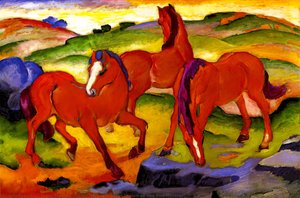
Oil On CanvasWallArtExpressionism
 1913Modern
 91.0 x 131.0 cm
 Staatsgalerie Moderner Kunst
빠른 제작과 다양한 마감 옵션을 제공하는 박물관 품질의 지클레이 또는 캔버스 프린트. ( 손으로 그린 그림 구매 이미지 구매)





























작품의 원본 비율을 유지하는 미리 설정된 크기 중에서 선택하세요.

특정 프레임이나 공간에 맞춰 직접 치수를 입력하실 수 있습니다. 선택하신 사이즈가 원본 이미지의 비율과 일치하지 않을 경우, 작품을 크롭(자르기)하거나 이미지를 대칭 또는 단색 채우기로 확장하여 제작합니다. 제작 시작 전, 최종 확인을 위해 디지털 목업이 전송됩니다.
화면상의 미리보기는 실제 크롭이나 확장 상태를 반영하지 않으므로, 최종 구도는 오직 목업을 통해서만 정확하게 확인하실 수 있습니다.
맞춤 사이즈 제작도 가능하지만, 원본 비율을 유지하기 위해서는 사전 정의된 목록에서 치수를 선택하시는 것을 권장합니다.

The Mandrill
복제본 크기
In the pantheon of German Expressionism, few works capture the raw, spiritual pulse of the natural world as vibrantly as “The Mandrill.” Painted in 1913, this masterpiece by Franz Marc serves as a profound meditation on the interconnectedness of all living things. At its heart, the painting is not merely a depiction of a primate; it is an exploration of essence over appearance. Marc, a founding member of the influential Der Blaue Reiter movement, sought to transcend the superficiality of reality to reveal a deeper, more spiritual truth. Through his lens, the mandrill becomes a vessel for cosmic energy, rendered in a palette that vibrates with life and tension.
The technique employed in “The Mandrill” is a masterful collision of organic fluidity and geometric structure. Marc utilizes a striking expanse of ochre—a hue that grounds the composition with its earthy, stable presence—which stands in dynamic contrast to splashes of emerald green. These greens symbolize vitality and the regenerative forces of nature, creating a visual dialogue between stability and growth. The artist’s brushwork avoids soft, academic blending; instead, colors collide energetically, conveying a palpable sense of urgency. By integrating elements of Cubist-inspired fragmentation, Marc breaks down the subject into angular lines and bold shapes, disrupting traditional perspective to offer a multifaceted view of the creature's power.
To gaze upon this work is to enter a world where color functions as emotion itself. For Marc, colors were not merely aesthetic choices but symbolic languages: blue represented masculinity and spirituality, while yellow evoked feminine gentleness and joy. In “The Mandrill,” the interplay of warm ochres and cool emeralds creates a rhythmic tension that mirrors the complexities of the wild. The central, curving structure of the mandrill’s form commands the canvas with a monumental grandeur, drawing the viewer into its primal orbit. This central focus is surrounded by a delicate balance of trees, foliage, and birds, suggesting a harmonious yet turbulent ecosystem where every element plays a role in a larger, divine symphony.
For the discerning collector or interior designer, “The Mandrill” offers more than just visual splendor; it provides an emotional anchor for a space. The painting’s ability to evoke both stability and dynamism makes it a versatile centerpiece for sophisticated environments. Whether placed in a contemporary gallery setting or a curated residential study, the work invites contemplation and conversation. It stands as a testament to a brief but brilliant era of art history—a time when artists like Marc dared to paint the soul of the world, leaving behind a legacy of color that continues to inspire awe and a deep, spiritual resonance in all who encounter it.

1880 - 1916 , 독일

Explore the visceral world of German Expressionism. Discover how masters like Ernst Ludwig Kirchner used bold colors and distortion to convey raw emotion, through our expert-led deep dive into this transformative era of art history.

Unleash raw emotion in your space. Explore the high-impact world of Expressionism through BuyPopArt.com’s premium hand-painted oil reproductions and custom photo transformations. Bold, confident, and curated for those who live for visual impact. Shop the revolution today!


최신 미술 뉴스, 특별 혜택 및 인테리어 아이디어를 가장 먼저 만나보세요.
프로젝트에 대해 알려주시면 저희 미술 전문가들이 맞춤형 아트 제안 3가지를 전달해 드립니다.
당신만을 위한 맞춤형 옵션 3가지를 무료로 추천해 드립니다!


 미리보기
미리보기
 공유하기
공유하기 공유하기
공유하기
 상세 정보
상세 정보

 다운로드
다운로드
 유사 작품
유사 작품 X-레이
X-레이 슬라이드 쇼
 더 보기
더 보기









 유리 옵션은 110cm 미만 크기에서만 선택 가능합니다.