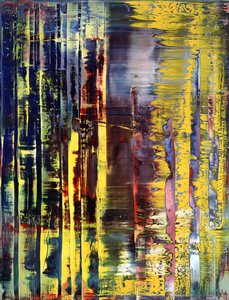
빠른 제작과 다양한 마감 옵션을 제공하는 박물관 품질의 지클레이 또는 캔버스 프린트. ( 손으로 그린 그림 구매 이미지 구매)
작품의 원본 비율을 유지하는 미리 설정된 크기 중에서 선택하세요.

특정 프레임이나 공간에 맞춰 직접 치수를 입력하실 수 있습니다. 선택하신 사이즈가 원본 이미지의 비율과 일치하지 않을 경우, 작품을 크롭(자르기)하거나 이미지를 대칭 또는 단색 채우기로 확장하여 제작합니다. 제작 시작 전, 최종 확인을 위해 디지털 목업이 전송됩니다.
화면상의 미리보기는 실제 크롭이나 확장 상태를 반영하지 않으므로, 최종 구도는 오직 목업을 통해서만 정확하게 확인하실 수 있습니다.
맞춤 사이즈 제작도 가능하지만, 원본 비율을 유지하기 위해서는 사전 정의된 목록에서 치수를 선택하시는 것을 권장합니다.

Portrait in Green
복제본 크기
Born Lena Krassner on October 27, 1908, in the vibrant streets of Brooklyn, New York, the woman who would become Lee Krasner emerged as a transformative force within the landscape of American modernism. Her journey was never merely one of following established paths, but rather of carving out new, visceral territories through paint and movement. From her early days at Washington Irving High School for Girls, where a focused course in visual arts first ignited her creative spirit, to her rigorous training at Cooper Union’s Women's Art School, Krasner possessed a foundational discipline that would later serve as the bedrock for her most radical experiments. Her education was marked by a relentless pursuit of mastery, eventually leading her to the National Academy of Design between 1928 and 1932, where she studied under the legendary Hans Hofmann. It was through Hofmann’s guidance that Krasner began to internalize the principles of spontaneity and expressive gesture, elements that would become the heartbeat of her mature style.
The trajectory of Krasner's career is inextricably linked to the seismic shifts of the mid-2ണ്ട century art world, a period defined by the rise of Abstract Expressionism. While history often attempts to frame her through the lens of her marriage to Jackson Pollock, such a narrow view obscures the profound individual brilliance she maintained throughout her life. Her relationship with Pollock placed her at the very epicenter of the New York School, yet Krasner consistently resisted being relegated to a secondary role. Instead, she utilized the era's intense energy to push the boundaries of abstraction, integrating influences from European Modernism—specifically the structural complexities of Cubism and the psychological depths of Surrealism—into a uniquely American vernacular. Her work became a dialogue between control and chaos, where the structured logic of her early training met the unbridled emotion of the post-war era.
To stand before a Krasner canvas is to witness a rhythmic dance of medium and motion. Her technique is famously characterized by a gestural approach, where rapid, energetic brushstrokes and layered textures create a sense of living, breathing composition. She did not merely paint subjects; she painted the very act of creation itself. In works such as Combat, one can observe a vibrant, almost floral abstraction that utilizes layered printmaking techniques to achieve a profound depth of color. Her palette was often bold and unapologetic, capable of shifting from the somber, brooding tones of her more introspective periods to the explosive, luminous hues found in her later, more celebratory works like Another Storm.
The evolution of her style can be seen as a continuous cycle of destruction and rebirth. Krasner was known for her "collage" method, where she would often take elements of her previous, discarded paintings and reincorporate them into new compositions. This process allowed her to physically grapple with her own artistic history, recycling the past to fuel the future. This cyclical nature of her work mirrors the organic rhythms of life, making her art feel deeply connected to the natural world even in its most abstract forms. Her ability to balance dynamic compositions with a sense of underlying structural integrity remains one of her greatest technical achievements.
The historical significance of Lee Krasner extends far beyond the canvases she left behind; she was a pioneer who helped redefine the possibilities of abstraction. As a woman navigating the male-dominated art scene of the 20th century, her resilience and refusal to be overshadowed by her contemporaries made her a symbol of artistic autonomy. Her contributions helped cement New York City as the global capital of modern art, providing a bridge between the structured traditions of the early century and the raw, emotive power of the post-war avant-garde.
Today, Krasner is celebrated not just as a figure of a specific movement, but as an artist whose work possesses a timeless, universal resonance. Her legacy is defined by several key pillars:
Lee Krasner remains a titan of 20th-century art, an artist whose life was as much a masterpiece of endurance and evolution as the paintings that now reside in the world's most prestigious museums.

1908 - 1984 , United States of America

Master the high-impact world of contemporary abstraction. Discover how bold colors, textures, and modern movements like Abstract Expressionism can transform your space with premium, high-energy art curated for the design-conscious professional.

Dive into the raw power of Abstract Expressionism. Explore the high-octane energy of action painting and color field mastery. Discover how these bold, visceral movements redefine modern interiors with high-impact, premium abstract art for the contemporary collector.

Discover the power of Neo-Abstract art. Explore how bold geometric forms and high-impact visual energy are redefining modern design. Learn to curate sophisticated, high-energy spaces with the latest trends in contemporary abstraction and structural color.


최신 미술 뉴스, 특별 혜택 및 인테리어 아이디어를 가장 먼저 만나보세요.
프로젝트에 대해 알려주시면 저희 미술 전문가들이 맞춤형 아트 제안 3가지를 전달해 드립니다.
당신만을 위한 맞춤형 옵션 3가지를 무료로 추천해 드립니다!


 미리보기
미리보기
 공유하기
공유하기 공유하기
공유하기
 상세 정보
상세 정보

 다운로드
다운로드
 유사 작품
유사 작품 X-레이
X-레이 슬라이드 쇼

 더 보기
더 보기






































 유리 옵션은 110cm 미만 크기에서만 선택 가능합니다.