Acrylic On CanvasWallArtGerman Expressionism
 1913
1913 810.0 x 1050.0 cm
 Kunstpalast
Giclée- of canvasafdruk van museumkwaliteit met een snelle productie en flexibele afwerkingsmogelijkheden. ( Bestel handgeschilderde reproductie Koop afbeelding)





























Kies uit onze vooraf ingestelde maten die overeenkomen met de originele verhoudingen van het kunstwerk.

U kunt uw eigen afmetingen opgeven om in een specifieke lijst of ruimte te passen. Als de door u gekozen maat niet overeenkomt met de proporties van het originele kunstwerk, zullen wij de afbeelding bijsnijden of uitbreiden met een gespiegelde of effen rand. Een digitaal mockup wordt ter goedkeuring naar u verzonden voordat de productie begint.
Houd er rekening mee dat de preview op het scherm de werkelijke bijsneding of uitbreiding niet weergeeft. Alleen de mockup toont de uiteindelijke compositie nauwkeurig.
Hoewel aangepaste maten beschikbaar zijn, raden wij aan een afmeting uit de vooraf bepaalde lijst te kiezen om de originele proporties te behouden.
Wereldwijde levering () binnen 2 weken in plaats van de standaard 4/5 weken. (19 augustus)


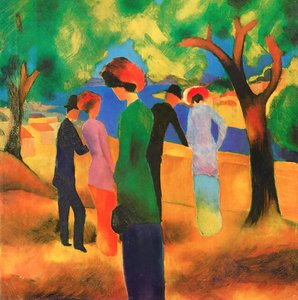
Four Girls
Afmetingen reproductie
August Macke's "Four Girls," painted in 1913, stands as a pivotal work within the artist’s trajectory and a compelling example of the burgeoning movement towards abstraction that was reshaping European art at the time. Created during a remarkably productive period in Bonn, this painting embodies Macke’s shift away from purely representational forms toward a more emotionally charged and visually dynamic style – a hallmark of his engagement with both German Expressionism and the innovative approaches emerging from Paris.
Painted in 1913, “Four Girls” reflects a crucial moment in art history – the collision of Impressionism’s influence with the rising tide of German Expressionism. Macke, like many artists of his generation, was grappling with the rapid changes occurring in Paris and seeking to synthesize these diverse influences into a uniquely German aesthetic. The painting's rhythmic colour harmonies and simplified forms align with the Blaue Reiter group’s exploration of abstraction and emotional expression, while simultaneously retaining a distinctly Impressionistic sensibility in its focus on light and atmosphere.
Macke’s artistic journey was profoundly shaped by his travels and intellectual explorations. His time in Tunis in 1914 further intensified his experimentation with transparency, flatness, and abstract forms, anticipating the developments of Cubism and Abstraction that would dominate the art world in the years to come.
Macke’s technique is characterized by a confident brushstroke and a deliberate layering of colour. He employed a palette knife alongside traditional brushes to build up thick impasto surfaces, creating a tactile quality that adds to the painting's visual richness. The use of pure pigments, combined with Macke’s innovative approach to colour mixing, results in vibrant, luminous tones that seem to shimmer and vibrate on the canvas. The scale of this artwork – 810 x 1050 cm – further amplifies its impact, allowing for an immersive experience of colour and form.
"Four Girls" transcends a simple portrait; it’s a meditation on youth, leisure, and the beauty of nature. The presence of the dog and handbag adds subtle details that enhance the sense of everyday life and human connection. Macke's ability to capture not just the outward appearance of his subjects but also their inner emotions is what elevates this work beyond mere representation. It speaks to a yearning for simplicity, harmony, and the joy of shared experience – themes that resonate deeply with viewers even today.

1887 - 1914 , Duitsland

Explore the visceral world of German Expressionism. Discover how masters like Ernst Ludwig Kirchner used bold colors and distortion to convey raw emotion, through our expert-led deep dive into this transformative era of art history.


Blijf op de hoogte van het laatste kunstnieuws, exclusieve aanbiedingen en decoratie-ideeën.
Vertel ons over uw project en onze kunstexperts geven u 3 gepersonaliseerde kunstsuggesties.
Wij stellen drie opties speciaal voor u samen – gratis!


 Voorvertoning
 Verstuur
 Delen
Delen
 Details bekijken

 Download
 Vergelijkbare items
 Röntgenonderzoek
 Diavoorstelling
 Lees meer







 De optie voor glas is alleen beschikbaar bij een formaat kleiner dan 110 cm.