

Koop een digitale afbeelding in hoge resolutie met verbeterde kwaliteit, die veel superieur is aan de online voorvertoning.
Elk bestand wordt met uiterste precisie voorbereid door onze interne specialisten, met behulp van geavanceerde tools en deskundige handmatige retouche. Wij garanderen dat elke afbeelding een uitzonderlijke helderheid, nauwkeurige kleurweergave en verfijnde details bezit.
Het uiteindelijke bestand wordt binnen 72 uur per e-mail geleverd, geoptimaliseerd voor direct gebruik in professionele, redactionele en printomgevingen. Dit is dezelfde kwaliteit waarop topontwerpstudio's, uitgevers en galerieën vertrouwen.
Download een bestand met hoge resolutie voor persoonlijke weergave, afdrukken en creatieve projecten. ( Bestel een print Bestel een handgeschilderde reproductie van dit verzamelobject)
Wanneer u kiest voor BuyPopArt.com, ontvangt u niet alleen een afbeelding – u krijgt een professioneel verbeterd digitaal kunstwerk, met precisie vervaardigd en voorzien van een tevredenheidsgarantie. Dit is alles wat automatisch bij uw bestelling is inbegrepen:

Uw hoogwaardige digitale afbeeldingsbestand wordt binnen 72 uur na bestelling naar u gemaild – klaar voor direct gebruik.

Uw kunstwerk wordt professioneel geoptimaliseerd met behulp van geavanceerde AI-tools en handmatige bewerkingen, waardoor maximale details, helderheid en kleurnauwkeurigheid worden gegarandeerd.

Je bestand per ongeluk verwijderd of kwijtgeraakt? Geen zorgen – we sturen het u op elk gewenst moment gratis opnieuw toe.

Geniet direct van uw kunstwerk zonder invoerrechten, belastingen of verzendkosten – digitale downloads zijn altijd belastingvrij.

Met behulp van professionele hulpmiddelen en kleurbeheer zorgen wij ervoor dat uw digitale afbeelding de originele kleuren zo nauwkeurig mogelijk weergeeft.

Als u niet tevreden bent met uw digitale afbeelding, passen wij deze aan of storten wij 100% terug binnen 60 dagen – zonder vragen gesteld.

Niet tevreden? Ontvang binnen 60 dagen na ontvangst van uw digitale bestand uw volledige aankoopbedrag terug – zonder vragen te stellen.

Koop 3 afbeeldingen, bespaar 10% - Koop 5, bespaar 15% - Koop 10+, bespaar 20%. Ideaal voor creatieve projecten, galerieën en bureaus.
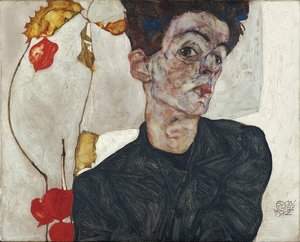
Egon Schiele’s “Eros,” painted in 1911, isn't merely a depiction of love; it’s a visceral confrontation with the unsettling realities of human existence. Far removed from the idealized notions of romantic affection prevalent at the time, this intensely personal Expressionist work plunges us into a world saturated with psychological turmoil and a profound sense of isolation. Schiele, grappling with his own mortality and the societal pressures of early 20th-century Vienna, created an image that remains both unsettlingly intimate and profoundly moving – a testament to his unique ability to distill raw emotion onto canvas.
The painting immediately draws the viewer in through its tight composition. The seated male figure dominates the frame, rendered with a deliberate distortion of facial features: eyes magnified, nose prominent, brow furrowed—all contributing to an overwhelming sense of distress. Draped in layers of rough, almost burlap-like fabric, he appears vulnerable and exposed, hinting at poverty or hardship. Yet, it’s not simply sadness that emanates from this figure; there's a palpable tension, a coiled energy suggesting suppressed anxieties and perhaps even a simmering rage. The muted color palette – dominated by earthy browns, ochres, and somber greens – reinforces this melancholic atmosphere, creating a space of quiet contemplation tinged with unease.
“Eros” is a quintessential example of Expressionism, a movement that prioritized emotional impact over realistic representation. Schiele abandons traditional artistic conventions, opting for loose, gestural brushstrokes and a flattened perspective. The visible texture of the oil paint—thickly applied in areas, almost sculpted onto the canvas—adds to this sense of immediacy and rawness. Lines aren’t clean or precise; they writhe and twist, mirroring the emotional turbulence within the subject. This deliberate distortion isn't merely stylistic; it’s a crucial element in conveying Schiele’s psychological vision. The artist wasn’t aiming for beauty; he was striving to capture the *feeling* of anguish, the internal landscape of a troubled soul.
Born in 1890, Egon Schiele's life unfolded during a period of immense social and political upheaval. Vienna at the turn of the century was a city grappling with modernity, repression, and the looming threat of war – a cauldron of anxieties that profoundly influenced his work. His early training under Gustav Klimt, a master of decorative elegance, proved formative, but Schiele quickly diverged from his mentor’s polished aesthetic, forging his own distinct style characterized by psychological intensity and often unsettling imagery. The *Wiener Werkstätte* (Vienna Workshop), with its emphasis on craftsmanship and design, also exerted an influence, though Schiele ultimately rejected their principles in favor of a more direct and emotionally charged approach to portraiture.
Schiele’s personal life further shaped his artistic vision. His father's early death from syphilis cast a long shadow over the family, instilling within him a preoccupation with mortality and illness. The subsequent loss of his sister Elvira at a young age only deepened this sense of vulnerability. These experiences, combined with the societal pressures of Vienna’s conservative climate, fueled his exploration of taboo subjects—sexuality, death, and psychological distress—making “Eros” not just a personal statement but also a reflection of its time.
The symbolism within “Eros” is deliberately ambiguous, inviting multiple interpretations. The distorted face speaks to inner turmoil and psychological fragmentation, while the prominent red object—a bold, almost aggressively rendered phallus—introduces themes of sexuality, shame, or perhaps a critique of societal norms surrounding desire. It’s not simply a depiction of physical lust; it carries a weight of repressed urges, anxieties about masculinity, and a sense of alienation from conventional morality. The overall atmosphere evokes a profound sense of existential angst – a feeling of being adrift in a meaningless world, grappling with the inevitability of death and the complexities of human relationships.
Schiele’s willingness to confront these uncomfortable truths made him a controversial figure during his lifetime, yet it also cemented his legacy as an artist who dared to explore the darker aspects of the human experience. “Eros” is not merely a painting to be observed; it's an emotional encounter that lingers long after one turns away – a powerful reminder of the fragility and complexity of the human psyche.
1890 - 1918 , Oostenrijk


Blijf op de hoogte van het laatste kunstnieuws, exclusieve aanbiedingen en inspirerende interieurideeën.
Vertel ons over uw project en onze kunstexperts geven u 3 gepersonaliseerde kunstsuggesties.
Wij stellen 3 opties speciaal voor u samen – Gratis!


 Bekijk op ware grootte
 Verstuur
 Delen
Delen
 Details bekijken

 Download
 Vergelijkbare werken
 Röntgenonderzoek
 Diavoorstelling

 Lees meer