Giclée- of canvasafdruk van museumkwaliteit met een snelle productie en flexibele afwerkingsmogelijkheden. ( Bestel handgeschilderde reproductie Koop afbeelding)
Kies uit onze vooraf ingestelde maten die overeenkomen met de originele verhoudingen van het kunstwerk.

U kunt uw eigen afmetingen opgeven om in een specifieke lijst of ruimte te passen. Als de door u gekozen maat niet overeenkomt met de proporties van het originele kunstwerk, zullen wij de afbeelding bijsnijden of uitbreiden met een gespiegelde of effen rand. Een digitaal mockup wordt ter goedkeuring naar u verzonden voordat de productie begint.
Houd er rekening mee dat de preview op het scherm de werkelijke bijsneding of uitbreiding niet weergeeft. Alleen de mockup toont de uiteindelijke compositie nauwkeurig.
Hoewel aangepaste maten beschikbaar zijn, raden wij aan een afmeting uit de vooraf bepaalde lijst te kiezen om de originele proporties te behouden.
Wereldwijde levering () binnen 2 weken in plaats van de standaard 4/5 weken. (18 augustus)


untitled (7271)
Afmetingen reproductie
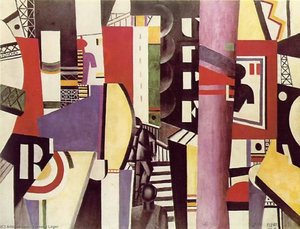
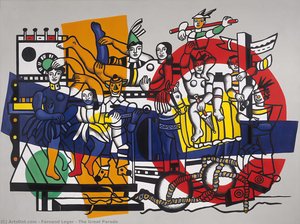
The world of Fernand Léger is one of exhilarating contradiction – a collision between the raw physicality of industrial machinery and an intensely personal, almost spiritual, vision. This particular work, a vibrant exploration of form and movement, exemplifies Léger’s groundbreaking approach to modern art, a departure from purely abstract concerns that sought to capture not just the *look* of the machine age, but its very essence – its energy, its rhythm, and its impact on human experience. It's a piece that demands attention, inviting the viewer into a world where geometric precision dances with organic fluidity.
Léger’s artistic journey began in the early 20th century, a period of unprecedented technological advancement. Witnessing the rise of factories and the proliferation of steel structures profoundly influenced his thinking. He developed what he termed “Tubism,” a style that sought to represent objects – particularly those associated with industry – by breaking them down into their fundamental geometric shapes: cylinders, cones, and cubes. However, Tubism wasn’t simply about replicating mechanical forms; it was an attempt to imbue these shapes with life, with movement, and with a sense of underlying harmony. Notice how the figures aren't static representations but seem poised in perpetual motion, echoing the dynamism of the industrial landscape.
Beyond its purely formal qualities, Léger’s work is rich in symbolic meaning. The figures themselves are often interpreted as representations of humanity – individuals caught within the transformative forces of modernity. Their simplified forms suggest a loss of individuality, yet their vibrant colors and dynamic poses convey a sense of resilience and even joy. The bright palette—bold reds, yellows, and blues—contrasts sharply with the muted tones of the industrial backdrop, highlighting the tension between human aspiration and mechanical constraint.
Léger emerged as a key figure in the Parisian avant-garde scene of the early 20th century, alongside artists like Picasso and Braque. While initially influenced by Cubism, he quickly developed his own distinct style, one that was both intellectually rigorous and deeply expressive. His work anticipated many later developments in art, including Pop Art’s embrace of popular imagery and its exploration of the relationship between art and industry. The Fernand Léger National Museum in Biot, France, houses a comprehensive collection of his works, offering invaluable insight into the evolution of this singular artistic vision.
This reproduction captures not just the visual impact of Léger’s original paintings but also the underlying emotional power. It's a piece that speaks to our fascination with technology, our anxieties about its potential consequences, and our enduring desire for beauty and harmony in a world increasingly dominated by machines. Whether adorning a contemporary interior or serving as a thoughtful addition to an art collection, this artwork offers a compelling dialogue between form, function, and the human spirit – a conversation that continues to resonate today.

1881 - 1955 , Frankrijk

Master the high-impact world of contemporary abstraction. Discover how bold colors, textures, and modern movements like Abstract Expressionism can transform your space with premium, high-energy art curated for the design-conscious professional.

Dive into the high-energy world of Lyrical Abstraction. Explore how bold colors, fluid motion, and emotional depth define this modern masterpiece movement. Discover iconic artists and learn to bring this vibrant, soulful energy into your contemporary space.

Discover the power of Neo-Abstract art. Explore how bold geometric forms and high-impact visual energy are redefining modern design. Learn to curate sophisticated, high-energy spaces with the latest trends in contemporary abstraction and structural color.

Dive into the high-energy world of Orphism. Discover how this color revolution broke Cubism's rules to define modern abstraction through light, motion, and pure visual impact. Explore the legacy of the Delaunays and bring bold, vibrant energy to your contemporary space.


Blijf op de hoogte van het laatste kunstnieuws, exclusieve aanbiedingen en decoratie-ideeën.
Vertel ons over uw project en onze kunstexperts geven u 3 gepersonaliseerde kunstsuggesties.
Wij stellen drie opties speciaal voor u samen – gratis!


 Voorvertoning
 Verstuur
 Delen
Delen
 Details bekijken

 Download
 Vergelijkbare items
 Röntgenonderzoek
 Diavoorstelling

 Lees meer




































 De optie voor glas is alleen beschikbaar bij een formaat kleiner dan 110 cm.