PreviewPreview Bestel schilderij Bestel schilderijKoop afbeelding in hoge resolutie Koop afbeelding in hoge resolutie VerstuurVerstuur
Details bekijkenDetails bekijken Toevoegen aan favorieten Toevoegen aan favorieten DownloadDownload Vergelijkbare werkenVergelijkbare werken RöntgenonderzoekRöntgenonderzoek DiavoorstellingDiavoorstelling

De Boerderij

Verken Miró's 'De Boerderij': Een droomachtige visie op het Catalane platteland, vol symboliek en persoonlijke herinneringen. Ontdek surrealisme, kleurrijke expressie & een unieke artistieke reis.

Ontdek Joan Miró's prachtige surrealistische kunst! Een icoon van de Spaanse avantgarde met kleurrijke vormen & symbolische kleuren. Bekijk zijn werken op BuyPopArt!

Giclée / Kunstafdruk

Giclée- of canvasafdruk van museumkwaliteit met snelle productie en flexibele afwerkingsopties.

P118B $10
P118H $10
P118W $10
P438Z $10
P508JH $12
P508YH $12
P805H $10
P805Z $10
P919BZ $10
P919G $10
P919XJ $10
P959ZH $10
P968JZ $12
W106C $8
W218G $10
W218JH $8
W218Y $10
W307PJ $10
W316G $10
W316PJ $8
W316Y $10
W398PJ $8
W4111J $10
W500HY $15
W500JH $15
W692G $12
W849H $8
W940BG $15
W953PJ $8

Standard
custom
CM
INCH

Kies uit onze vooraf ingestelde maten die overeenkomen met de originele verhoudingen van het kunstwerk.

breedte
hoogte

U kunt uw eigen afmetingen opgeven om in een specifieke lijst of ruimte te passen. Als de door u gekozen maat niet overeenkomt met de proporties van het originele kunstwerk, zullen wij de afbeelding bijsnijden of uitbreiden met een gespiegelde of effen rand. Een digitaal mockup wordt ter goedkeuring naar u verzonden voordat de productie begint.
Houd er rekening mee dat de preview op het scherm de werkelijke bijsneding of uitbreiding niet weergeeft. Alleen de mockup toont de uiteindelijke compositie nauwkeurig.
Hoewel aangepaste maten beschikbaar zijn, raden wij aan een afmeting uit de vooraf bepaalde lijst te kiezen om de originele proporties te behouden.

Wereldwijde levering () binnen 2 weken in plaats van de standaard 4/5 weken. (23 juli)

why_choose_icon
Gratis wereldwijde expressverzending
why_choose_icon
Hoogwaardig linnen canvas
why_choose_icon
Volledige verzendverzekering
why_choose_icon
Garantie op terugbetaling van invoerrechten
why_choose_icon
Garantie op exacte kleurweergave
why_choose_icon
60 dagen retourbeleid (alleen bij defecten)
why_choose_icon
100% Geld-terug-garantie
why_choose_icon
Korting bij meerdere afnames

Totaalprijs

-

reproduction

De Boerderij

Giclée / Kunstafdruk

Afmetingen reproductie

-

Eindtotaal

-

Snelle feiten

  • movement: Surrealism, Naive Art
  • subject: Farm scene, rural life
  • style: Stylized, Surreal, Naive
  • year: 1922
  • dimensions: 132 x 147 cm
  • title: The Farm
  • influences: Cubism, Catalan symbolism

Kunstquiz

Er is slechts één correct antwoord op elke vraag.

Vraag 1:
In what year was Joan Miró's 'The Farm' created?
Vraag 2:
Which artistic movements heavily influenced the style of 'The Farm'?
Vraag 3:
'The Farm' is notable for its inclusion of seemingly random objects alongside farm elements. What purpose do these likely serve?
Vraag 4:
What is the approximate size of 'The Farm' in centimeters?
Vraag 5:
What is a key characteristic of the perspective used in 'The Farm'?

Beschrijving verzamelobject

Een Visioen van Plattelandse Herinnering: Het Ontcijferen van Miró’s Meesterwerk uit 1922

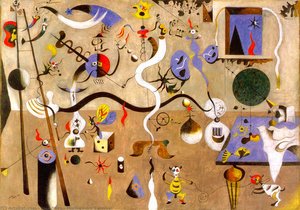
Dit fascinerende kunstwerk van Joan Miró, geschilderd in 1922, overstijgt een eenvoudige afbeelding van het plattelandsleven en biedt in plaats daarvan een rijk symbolische en emotioneel resonerende visie op het Catalaanse landschap. Met een afmeting van 132 x 147 cm is het een substantiële werk die direct de aandacht opeist, waarbij de kijker wordt uitgenodigd in een droomachtige wereld die is geconstrueerd uit herinnering en verbeelding.

Stijlinnovatie: Een Brug tussen Naïeve Kunst en Surrealisme

Dit werk neemt een cruciale plaats in binnen Miró’s artistieke ontwikkeling en toont zijn unieke vermogen om diverse invloeden te synthetiseren. Hoewel het geworteld is in de vereenvoudigde vormen en levendige kleurenpaletten van de naïeve kunst, anticipeert het tegelijkertijd op de opkomende surrealistische beweging. Het afgeplatte perspectief, de onconventionele compositie en de onlogische juxtaposities van objecten creëren een sfeer van speelse desoriëntatie, die traditionele representatieve normen uitdaagt. Het is een getuigenis van Miró’s pioniersgeest en zijn verwerping van academische beperkingen.

Een Heruitgevonden Boerderij: Onderwerp & Symboliek

Op het eerste gezicht presenteert het kunstwerk een boerderijscène – gebouwen, werktuigen en vegetatie zijn allemaal aanwezig. Dit is echter geen idyllisch pastoraal landschap. Verspreid tussen deze herkenbare elementen bevinden zich ogenschijnlijk willekeurige objecten—een bolhoed, een kan, een schoen en de letter “A”—elk doordrenkt met een mogelijke symbolische betekenis. Deze toevoegingen suggereren lagen van persoonlijke herinnering, de complexiteit van het landleven of zelfs abstracte concepten die te maken hebben met identiteit en verbondenheid. De dominante boom in het centrum wordt vaak geïnterpreteerd als een symbool voor leven, groei en de verbinding met de natuur, terwijl de maan hint naar cycli en het verstrijken van de tijd.

Techniek & Palet: Een Krachtige Expressie

Miró maakt gebruik van een gedurfd en verzadigd kleurenpalet, gedomineerd door warme oranje- en bruintinten die contrasteren met een bijna kunstmatige blauwe lucht. Dit bewuste gebruik van complementaire kleuren versterkt de levendigheid en draagt bij aan de droomachtige kwaliteit van het werk. De techniek wordt gekenmerkt door duidelijke lijnen, geometrische vormen en minimale menging, wat zorgt voor een gevoel van helderheid en precisie ondanks de algehele surrealistische atmosfeer. Patroon speelt een cruciale rol, met name in het metselwerk en de begroeiing, wat zorgt voor een texturale rijkdom.

Historische Context: Een Catalaanse Identiteit

Dit werk, gecreëerd tijdens een periode van significante artistieke experimenten na de Eerste Wereldoorlog, weerspiegelt Miró’s diepe verbondenheid met zijn geboortegrond Catalonië. Hij keerde regelmatig terug naar Mont-roig del Camp, de boerderij van zijn familie, om inspiratie op te doen uit het landschap en het landelijke leven. Het kunstwerk kan worden gezien als een poging om niet alleen het uiterlijk van de boerderij vast te leggen, maar ook de essentie ervan – een distillatie van herinneringen, emoties en culturele identiteit. Het is een krachtig statement over plaats en verbondenheid.

Emotionele Resonantie & Impact op het Interieur

“De Boerderij” roept een gevoel van zowel vertrouwdheid als vreemdheid op, wat aanzet tot contemplatie in plaats van een eenvoudige interpretatie. De levendige kleuren en de speelse compositie kunnen energie en persoonlijkheid injecteren in elke ruimte. Als reproductie biedt het een uniek middelpunt voor moderne interieurs, waarbij het gesprekken aanwakkert en een vleugje artistieke verfijning toevoegt. Dit kunstwerk is niet louter een decoratief element; het is een uitnodiging om de diepten van de verbeelding en de kracht van persoonlijke herinnering te verkennen.

Biografie van de kunstenaar

A Catalan Visionary: The Life and Art of Joan Miró

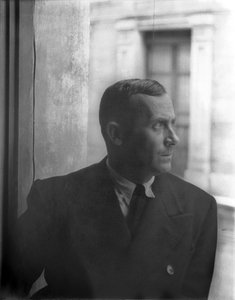
Joan Miró i Ferrà, born in Barcelona in 1893, stands as one of the most significant figures in 20th-century art. His journey was not merely a progression through styles but an exploration of inner worlds, translating dreams, memories, and Catalan identity onto canvas with a uniquely poetic visual language. From humble beginnings marked by illness and initial parental reservations about his artistic pursuits, Miró persevered, driven by an innate need to express the intangible—the emotions, sensations, and subconscious currents that lie beneath the surface of reality. His early life was steeped in the traditions of Barcelona, a city brimming with architectural marvels thanks to Antoni Gaudí, whose organic forms would subtly influence Miró’s later abstractions. The goldsmithing profession of his father instilled an appreciation for meticulous craftsmanship, while the rugged Catalan landscape became a recurring motif and source of inspiration throughout his career.

Early Influences and the Path to Surrealism

Miró's formal artistic training began at La Llotja in Barcelona, where he honed his skills in traditional techniques. However, it was exposure to the avant-garde movements sweeping through Paris that truly ignited his creative evolution. The vibrant colors of Fauvism and the fragmented forms of Cubism resonated deeply, prompting him to move to Paris in 1920. This period proved pivotal as he encountered artists like Pablo Picasso and began experimenting with increasingly abstract compositions. Yet, Miró didn’t simply adopt these styles; he synthesized them, forging a path toward his own distinctive aesthetic. He sought to distill forms to their essence, stripping away representational details in favor of symbolic shapes and evocative colors. This exploration led him to the Surrealist group in 1924, aligning him with artists such as Max Ernst and Salvador Dalí. While embracing the Surrealist interest in the subconscious, Miró maintained a unique sensibility—his work was less about shocking imagery or Freudian symbolism than it was about creating a world of playful forms and poetic suggestion.

The Language of Symbols: Key Works and Artistic Innovations

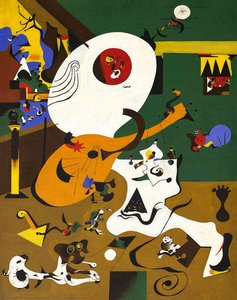
Throughout the 1920s and 30s, Miró developed his signature visual vocabulary—a universe populated by biomorphic shapes, floating forms, and vibrant colors. The Farm (1922), often considered a cornerstone of his oeuvre, exemplifies this transition. It’s not merely a depiction of rural life but an evocation of Catalan identity and a symbolic representation of the natural world. His collaborative spirit led to innovative techniques like *grattage*, pioneered with Max Ernst in 1926 for designs intended for Sergei Diaghilev's ballet, where textures were revealed by scraping paint across canvas. The Dutch Interiors (1928) series demonstrated his ability to reinterpret the Old Masters through a distinctly modern lens, transforming domestic scenes into dreamlike abstractions. Painting (1933), with its bold colors and simplified forms, encapsulates Miró’s exploration of the subconscious and his rejection of conventional artistic boundaries. Beyond painting, Miró fearlessly experimented with sculpture, ceramics, and printmaking, expanding his creative horizons and demonstrating a remarkable versatility.

Legacy and Enduring Influence

Joan Miró's impact on 20th-century art is undeniable. He wasn’t simply a painter; he was a visionary who challenged the very definition of artistic expression. His work paved the way for abstract expressionism and continues to inspire artists across disciplines. He established two foundations—the Fundació Joan Miró in Barcelona (1975) and the Fundació Pilar i Joan Miró in Palma de Mallorca (1981)—ensuring that his legacy would endure, providing spaces for artistic exploration and education. Throughout his long career, he remained committed to pushing boundaries, questioning conventions, and exploring the depths of human imagination. Miró’s art is a testament to the power of abstraction, symbolism, and poetic expression—a vibrant celebration of life, dreams, and the enduring spirit of Catalan culture. His work continues to resonate with audiences worldwide, inviting us to enter a world where anything is possible and the boundaries between reality and fantasy blur into a captivating dance of color and form.
Joan Miró

Joan Miró

1893 - 1983 , Spanje

Belangrijkste feiten

  • Artistic Movement Or Style: Surrealisme, Abstract Art
  • Artists Who Influenced This Artist:
    • Pablo Picasso
    • Sergei Diaghilev
  • Date Of Birth: 20 april 1893
  • Full Name: Joan Miró i Ferrà
  • Nationality: Spanish
  • Notable Artworks:
    • The Farm
    • Dutch Interiors
    • Painting
  • Place Of Birth: Barcelona, Spain
Ontdek kunstwerken georganiseerd op thema's, stijlen en kenmerken.