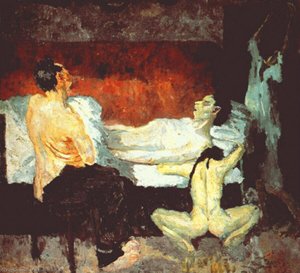
Acrylic On CanvasWallArtGerman Expressionism
 1926
1926 101.0 x 71.0 cm
 Metropolitan Museum of Art
Giclée- of canvasafdruk van museumkwaliteit met een snelle productie en flexibele afwerkingsmogelijkheden. ( Bestel handgeschilderde reproductie Koop afbeelding)





























Kies uit onze vooraf ingestelde maten die overeenkomen met de originele verhoudingen van het kunstwerk.

U kunt uw eigen afmetingen opgeven om in een specifieke lijst of ruimte te passen. Als de door u gekozen maat niet overeenkomt met de proporties van het originele kunstwerk, zullen wij de afbeelding bijsnijden of uitbreiden met een gespiegelde of effen rand. Een digitaal mockup wordt ter goedkeuring naar u verzonden voordat de productie begint.
Houd er rekening mee dat de preview op het scherm de werkelijke bijsneding of uitbreiding niet weergeeft. Alleen de mockup toont de uiteindelijke compositie nauwkeurig.
Hoewel aangepaste maten beschikbaar zijn, raden wij aan een afmeting uit de vooraf bepaalde lijst te kiezen om de originele proporties te behouden.
Wereldwijde levering () binnen 2 weken in plaats van de standaard 4/5 weken. (16 augustus)


The Old Actress
Afmetingen reproductie
Max Beckmann’s “The Old Actress,” painted in 1926, stands as a haunting testament to the complexities of human experience—a masterful blend of psychological insight and artistic innovation that continues to captivate audiences today. This striking portrait delves into themes of aging, memory, and quiet contemplation, capturing not merely an image but a profound emotional resonance.
Symbolism & Emotional Impact: The woman’s severe black dress, adorned with white trim and lace insert, subtly references clerical garb – a deliberate allusion to piety and perhaps hinting at a past burdened by moral considerations. Her gaze directs towards the horizon, symbolizing both escape from earthly concerns and acceptance of life's inevitable passage. The cat nestled in her lap serves as a comforting presence, yet simultaneously underscores the vulnerability inherent in aging.
Provenance & Recognition: Acquired by Julius Meier-Graefe in 1926 and subsequently championed by Abby Aldrich Rockefeller—a pivotal figure in establishing Modern Art—the painting cemented Beckmann’s reputation as one of Germany's foremost artists. Critics lauded its expressive power, recognizing it as “great” and among Beckmann’s “major works,” solidifying its place within the canon of 20th-century art.
This evocative portrait invites viewers to contemplate the quiet dignity of aging and the profound beauty found in confronting life's hardships with unwavering resolve. Beckmann’s masterful technique and symbolic depth ensure that “The Old Actress” continues to inspire admiration and provoke thoughtful reflection for generations to come.
Max Beckmann, a renowned german painter, draftsman, printmaker, sculptor, and writer, was born on february 12, 1884, in leipzig, saxony. his artistic journey began with academically correct depictions, which later transformed into distorted figures and spaces, reflecting his altered vision of humanity after serving as a medical orderly in world war i.
His formative years were marked by an initial adherence to traditional academic styles—a deliberate rejection of the expressive fervor championed by artists like Vincent van Gogh and Edvard Munch. However, this early inclination swiftly yielded to a profound shift in artistic sensibility, fueled by the harrowing realities of the Great War. Witnessing firsthand the devastation and suffering inflicted upon soldiers instilled within him a visceral understanding of human vulnerability and trauma—a perspective that would irrevocably reshape his oeuvre.
Beckmann’s distinctive aesthetic emerged from a confluence of artistic inspirations, notably Cézanne's geometric explorations and Rembrandt’s masterful use of chiaroscuro. He absorbed the brooding atmosphere of Blake’s visionary poetry and embraced the expressive dynamism of Rubens’ monumental canvases.
Furthermore, Beckmann drew heavily upon the iconography of medieval stained glass—a visual language characterized by vibrant colors and stylized forms—demonstrating a fascination with symbolism and spiritual contemplation. His artistic vision was profoundly shaped by artists of the late middle ages and early renaissance, including Bosch, Bruegel, and Matthias Grünewald, whose unsettling imagery conveyed moral judgments and explored themes of human folly.
Among Beckmann’s most celebrated creations is “The Bark,” acquired by the National Gallery in Berlin—a monumental canvas depicting a desolate landscape imbued with melancholic grandeur. Equally impactful is “Self-Portrait in Tuxedo,” purchased in 1928, which captures Beckmann's introspective gaze against a backdrop of muted hues.
His artistic reputation soared during the Weimar Republic, culminating in retrospectives at the Städelschule Mannheim (1928) and Basel & Zurich (1930), cementing his position as one of Germany’s foremost artists of the era. These exhibitions showcased the breadth and depth of his stylistic evolution—from early landscapes to psychologically charged portraits.
Beckmann's fortunes took a dramatic turn with the ascent of Adolf Hitler to power, triggering his expulsion from the art school in Frankfurt and resulting in the confiscation of over 500 of his artworks. Forced into self-imposed exile in Amsterdam for ten years, he struggled unsuccessfully to secure a visa for the United States—a poignant symbol of artistic freedom curtailed by political repression.
Despite facing considerable adversity, Beckmann continued to produce groundbreaking art during his exile—primarily in Amsterdam—where he created approximately 280 paintings—a third of his total output. His work stands as a testament to resilience and unwavering commitment to artistic integrity.
Beckmann’s influence extended beyond the confines of his own lifetime, shaping subsequent generations of artists who embraced Expressionism's uncompromising exploration of emotion and psychological complexity. He was honored with a professorship at Washington University in St. Louis and the Brooklyn Museum, and his retrospective in 1948 at Saint Louis cemented his enduring legacy as a pivotal figure in modern German art.

1884 - 1950 , Duitsland

Explore the emotionally charged world of Egon Schiele (1890-1918). Discover his Expressionist masterpieces, psychological themes, and lasting impact on modern art. A comprehensive guide for collectors & enthusiasts.
Ontdek de 25 meest iconische werken van Egon Schiele! Duik diep in zijn expressionistische wereld vol intense portretten en emotionele kracht. Vind museumkwaliteit reproducties & unieke wanddecoratie op BuyPopArt.com. Exploreer de collectie online!
Explore the powerful world of Figurative Expressionism with BuyPopArt. Discover key artists like Kirchner & Beckmann, understand its emotional depth, and learn how to collect this influential 20th-century art movement.

Transformeer uw dierbare herinneringen tot een tijdloos meesterwerk! Handgeschilderde familieportretten met klassieke technieken. Expertise, 100% tevredenheidsgarantie & museumkwaliteit bij BuyPopArt.
Ontdek de 25 meest iconische meesterwerken van James Abbott McNeill Whistler, pionier van het esthetisme en impressionisme. Van zijn betoverende Nocturnes tot portretten vol harmonie. Vind museumkwaliteit reproducties & decoratie-inspiratie op BuyPopArt.com


Blijf op de hoogte van het laatste kunstnieuws, exclusieve aanbiedingen en decoratie-ideeën.
Vertel ons over uw project en onze kunstexperts geven u 3 gepersonaliseerde kunstsuggesties.
Wij stellen drie opties speciaal voor u samen – gratis!


 Voorvertoning
 Verstuur
 Delen
Delen
 Details bekijken

 Download
 Vergelijkbare items
 Röntgenonderzoek
 Diavoorstelling
 Lees meer







 De optie voor glas is alleen beschikbaar bij een formaat kleiner dan 110 cm.