Giclée- of canvasafdruk van museumkwaliteit met een snelle productie en flexibele afwerkingsmogelijkheden. ( Bestel handgeschilderde reproductie Koop afbeelding)





























Kies uit onze vooraf ingestelde maten die overeenkomen met de originele verhoudingen van het kunstwerk.

U kunt uw eigen afmetingen opgeven om in een specifieke lijst of ruimte te passen. Als de door u gekozen maat niet overeenkomt met de proporties van het originele kunstwerk, zullen wij de afbeelding bijsnijden of uitbreiden met een gespiegelde of effen rand. Een digitaal mockup wordt ter goedkeuring naar u verzonden voordat de productie begint.
Houd er rekening mee dat de preview op het scherm de werkelijke bijsneding of uitbreiding niet weergeeft. Alleen de mockup toont de uiteindelijke compositie nauwkeurig.
Hoewel aangepaste maten beschikbaar zijn, raden wij aan een afmeting uit de vooraf bepaalde lijst te kiezen om de originele proporties te behouden.
Wereldwijde levering () binnen 2 weken in plaats van de standaard 4/5 weken. (13 augustus)


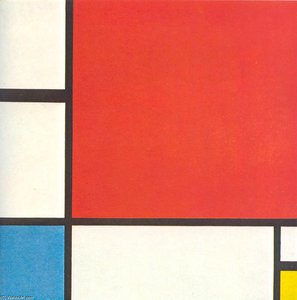
Composition with two lines
Afmetingen reproductie
Piet Mondrian's "Composition with Two Lines" is not merely an arrangement of black lines against a white field; it represents a pivotal moment in the evolution of abstract art, and a distillation of a lifelong pursuit of spiritual harmony. Created sometime before his death in 1944, though its precise date remains elusive, this work embodies the core principles of Neoplasticism – an artistic movement Mondrian himself championed. To understand this painting is to delve into a philosophy that sought to transcend the chaotic reality of the visible world and arrive at a universal language of form and color.
Mondrian’s journey toward abstraction was not sudden, but rather a gradual shedding of representational constraints. Born in Amersfoort, Netherlands, in 1872, he initially trained as a teacher while simultaneously honing his artistic skills. His early works were steeped in the traditions of Dutch landscape painting, echoing the muted tones and naturalistic depictions of the Hague School. However, even then, a fascination with underlying structure began to emerge. He experimented with various styles – Pointillism, Fauvism – each step pushing him further away from simply *depicting* nature towards *interpreting* its essential forms. The move to Paris in 1912 proved transformative, exposing him to the radical ideas of Cubism and sparking a period of intense experimentation. He began deconstructing objects into their geometric components, dismantling traditional perspective and challenging the very notion of pictorial space.
By the 1920s, Mondrian had fully embraced what he termed Neoplasticism – “New Plastic Art.” This wasn’t simply about removing recognizable imagery; it was a deliberate attempt to express a deeper spiritual reality through pure abstraction. He believed that by reducing art to its most fundamental elements—horizontal and vertical lines representing opposing forces, and the primary colors of red, blue, and yellow alongside black, white, and gray – he could achieve a universal aesthetic harmony. “Composition with Two Lines” exemplifies this philosophy in its purest form. The intersecting black lines aren’t arbitrary; they represent a dynamic equilibrium, a balance between opposing energies. The stark white background isn't emptiness but rather an essential void, allowing the lines to breathe and resonate. It is important to note that Mondrian wasn’t aiming for cold calculation, but rather a carefully considered arrangement meant to evoke a sense of order and serenity.
The enduring appeal of “Composition with Two Lines,” and indeed all of Mondrian's Neoplastic works, lies in their ability to transcend the purely visual. While seemingly austere, these paintings possess a quiet power that invites contemplation. They are not about *what* is depicted, but rather *how* it is perceived. The simplicity encourages viewers to engage with the work on an emotional and intellectual level, prompting questions about balance, harmony, and the nature of reality itself. This painting continues to inspire artists, designers, and architects today, its influence visible in everything from fashion to furniture. A reproduction of “Composition with Two Lines” isn’t just a decorative element; it's an invitation to bring a piece of art history – and a philosophy of pure abstraction – into your space.

1872 - 1944 , Nederland

Discover the power of Neo-Abstract art. Explore how bold geometric forms and high-impact visual energy are redefining modern design. Learn to curate sophisticated, high-energy spaces with the latest trends in contemporary abstraction and structural color.

Discover the high-impact world of Geometric Abstraction. From Cubist roots to modern urban trends, explore how bold shapes and colors redefine contemporary design. Elevate your space with expert art insights and custom-made abstract masterpieces.


Blijf op de hoogte van het laatste kunstnieuws, exclusieve aanbiedingen en decoratie-ideeën.
Vertel ons over uw project en onze kunstexperts geven u 3 gepersonaliseerde kunstsuggesties.
Wij stellen drie opties speciaal voor u samen – gratis!


 Voorvertoning
 Verstuur
 Delen
Delen
 Details bekijken

 Download
 Vergelijkbare items
 Röntgenonderzoek
 Diavoorstelling

 Lees meer







 De optie voor glas is alleen beschikbaar bij een formaat kleiner dan 110 cm.