

Met de hand geschilderd in olieverf op canvas in uw gewenste maat en lijst, op bestelling gemaakt door onze kunstenaars. ( Bestel print Koop afbeelding)





























Kies uit onze vooraf ingestelde maten die overeenkomen met de originele verhoudingen van het kunstwerk.

U kunt uw eigen afmetingen invoeren om in een specifieke lijst of ruimte te passen. Als de door u gekozen maat niet overeenkomt met de verhoudingen van het originele beeld, zullen we het kunstwerk bijsnijden of het schilderij uitbreiden met extra handgeschilderde elementen. Een digitale mockup wordt ter goedkeuring naar u verzonden voordat de productie begint.
Houd er rekening mee dat de preview op het scherm niet de werkelijke uitsnede of uitbreiding weergeeft. Alleen de mockup toont de uiteindelijke compositie nauwkeurig.
Hoewel aangepaste afmetingen mogelijk zijn, raden we aan een maat uit de vooraf gedefinieerde lijst te selecteren om de originele verhoudingen te behouden.
Wereldwijde levering () binnen 3 tot 4 weken in plaats van de standaard 5 weken. (21 augustus). Zonder concessies aan de kwaliteit.


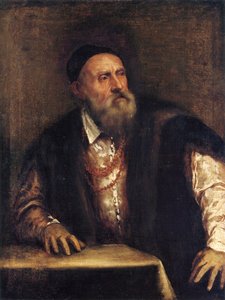
Pope Paul
Afmetingen reproductie
In the hallowed halls of Renaissance history, few images command as much reverence as Titian’s portrait of Pope Paul. This masterpiece serves as more than a mere likeness; it is a profound meditation on power, aging, and the weight of spiritual authority. As the viewer approaches this canvas, they are immediately struck by the dramatic interplay of light and shadow, a technique known as chiaroscuro, which pulls the elderly figure from a dark, indistinct background into a sharp, visceral reality. The composition is anchored by a powerful verticality, where the heavy, draped fabrics of the papal vestments create a sense of monumental stability. Every fold in the rich crimson and gold robes seems to hold the gravity of the Church itself, grounding the subject in a space that feels both intimate and eternal.
Titian, the legendary Venetian Titan, employs his unparalleled mastery of oil paint to breathe life into the textures of the scene. The technique is nothing short of miraculous; one can almost feel the contrast between the smooth, weathered skin of the Pope’s face and the coarse, opulent weight of his ceremonial attire. His brushwork, though controlled, possesses a rhythmic vitality that suggests movement even within a static portrait. Through subtle gradations of tone, Titian captures the delicate nuances of an aged countenance—the wisdom etched in deep-set wrinkles and the solemnity reflected in a steady, piercing gaze. For the discerning collector or interior designer, this painting offers a profound sense of depth, making it a centerpiece capable of anchoring a room with its historical weight and sophisticated color palette.
The emotional resonance of this work lies in its ability to balance grandeur with a poignant sense of melancholy. While the palette is dominated by warm, regal tones—deep reds, burnt umbers, and shimmering golds—there is an underlying softness that speaks to the fleeting nature of human life. The Pope is depicted not just as a political leader, but as a man navigating the twilight of his years, carrying the immense responsibility of his office. This duality creates a captivating tension: the outward display of indestructible institutional power versus the inward reality of mortal frailty. It is this very complexity that makes the portrait so enduringly relevant to modern sensibilities.
For those looking to integrate such a masterpiece into a curated space, the painting offers endless inspiration. Its rich textures and dramatic lighting provide a sophisticated focal point that complements both classical and contemporary decor. Whether placed in a library lined with leather-bound volumes or as a bold statement in a modern gallery-style living room, a high-quality reproduction of this work brings with it an aura of timeless elegance. To possess such an image is to invite the spirit of the Italian Renaissance into one's home, surrounding oneself with the artistry of a master who understood, perhaps better than any other, how to capture the very soul of his subjects through the medium of light and color.

Tiziano Vecellio, even more famously known as Titian, stands as a monumental figure of the Italian Renaissance—perhaps its most celebrated colorist and a master who fundamentally reshaped the possibilities of oil painting. Born around 1490 in Pieve di Cadore, nestled amidst the dramatic landscapes of the Venetian Alps, his journey from humble beginnings to international acclaim is a testament to prodigious talent and an unwavering dedication to artistic innovation. The details surrounding Titian’s early life remain somewhat shrouded in mystery, but we know he was one of several children born to Gregorio Vecellio, a military man, and Lucia. Recognizing their sons' potential, the family arranged for young Tiziano and his brother Francesco to apprentice with an artist in Venice—a decision that would irrevocably alter the course of art history.
Venice at the turn of the 16th century was a vibrant hub of commerce, culture, and artistic ferment. Titian’s initial training took place within the workshop of Sebastiano Zuccato, a mosaicist, followed by brief periods under the tutelage of Gentile Bellini and, crucially, his brother Giovanni. However, it was his association with Giorgione—a fellow Venetian painter whose work possessed an ethereal poetic quality—that proved most formative. The two artists collaborated on several projects, including the exterior frescoes for the Fondaco dei Tedeschi, a bustling trading post for German merchants. Even in these early works, Titian’s exceptional skill was evident, earning him recognition among his contemporaries and foreshadowing the brilliance that would soon blossom.
Titian’s artistic development can be characterized by a remarkable versatility and an ongoing exploration of painterly techniques. His early works, heavily influenced by Giorgione, exhibit a delicate lyricism and a masterful use of color to create atmospheric effects. Paintings like *A Man with a Quilted Sleeve* (circa 1509) demonstrate his emerging talent for portraiture, capturing not only the physical likeness of his subjects but also their inner character. He favored soft, diffused light and subtle gradations of tone, mirroring Giorgione’s approach. As he matured, Titian began to move away from Giorgione’s delicate subtlety and embrace a bolder, more dramatic approach to color. *The Visitation of Mary and Elizabeth* (now in the Accademia, Venice) exemplifies this shift, showcasing his growing confidence in handling complex compositions and vibrant hues. He experimented with layering colors—often applying thin glazes over dried underpaintings—to achieve luminous effects and intense saturation.
Throughout his long career, Titian consistently pushed the boundaries of artistic expression. He explored a vast range of subjects – mythological scenes, religious narratives, portraits of nobility, and even genre paintings depicting everyday life. He wasn’t afraid to break with convention, often employing unconventional compositions and dramatic lighting. His portraits became renowned for their psychological depth and realistic portrayal of textures and fabrics; he meticulously rendered the sheen of silk, the weight of velvet, and the warmth of skin tones. Simultaneously, he excelled in mythological and religious subjects, imbuing them with a sensuality and dramatic intensity that captivated audiences. A prime example is *Venus of Urbino*, a masterpiece that redefined the depiction of the female nude and established Titian as a leading figure in Venetian painting.
Titian’s talent attracted the attention of powerful patrons from across Europe. He served as court painter to Emperor Charles V, King Philip II of Spain, and Pope Paul III, among others. This patronage not only provided him with financial security but also allowed him to create monumental works that showcased his artistic prowess on a grand scale. His ability to adapt his style to the tastes of different courts while maintaining his own distinctive voice is a testament to his exceptional skill and diplomatic finesse. He was known for his lavish use of gold leaf, particularly in portraits commissioned by royalty, further enhancing their prestige.
Titian’s influence on subsequent generations of artists was profound. From Peter Paul Rubens and Rembrandt to Eugène Delacroix and Édouard Manet, countless painters drew inspiration from his masterpieces. His innovative use of color, his loose brushwork, and his emphasis on capturing the emotional essence of his subjects profoundly influenced their artistic approaches. He is considered a pivotal figure in the transition from the High Renaissance to the Baroque period, paving the way for new artistic styles and techniques.
Titian passed away in Venice in 1576, leaving behind an extraordinary body of work that continues to inspire awe and admiration. His paintings can be found in museums around the world, including the Galleria Palatina in Florence, the Prado Museum in Madrid, and the National Gallery in London. To experience a Titian is to encounter a master craftsman at the peak of his powers—a painter who possessed an unparalleled ability to capture the beauty, drama, and complexity of the human condition.
1490 - 1576 , Italië

Master the art of impact with our expert guide to oil on panel. Discover how impasto textures and heavy-body pigments create 3D depth and bold visual energy for modern interiors. Elevate your space with high-impact, hand-painted masterpieces designed for maximum aesthetic punch.


Blijf op de hoogte van het laatste kunstnieuws, exclusieve aanbiedingen en decoratie-ideeën.
Vertel ons over uw project en onze kunstexperts geven u 3 gepersonaliseerde kunstsuggesties.
Wij stellen drie opties speciaal voor u samen – gratis!


 Voorvertoning
 Verstuur
 Delen
Delen
 Details bekijken

 Download
 Vergelijkbare items
 Röntgenonderzoek
 Diavoorstelling

 Lees meer







 De optie voor glas is alleen beschikbaar bij een formaat kleiner dan 110 cm.


