
 PaintingBaroque Rococo
 1746Early Modern
 50.0 x 62.0 cm
 Pinacoteca di Brera
Kjøp et høyoppløselig, forbedret digitalt bilde som er langt bedre enn forhåndsvisningen på nettet.
Hver fil er omhyggelig klargjort av våre egne spesialister ved hjelp av avanserte verktøy og profesjonell manuell retusjering. Vi sørger for at hvert bilde har eksepsjonell klarhet, presis fargegjengivelse og fine detaljer.
Den endelige filen leveres via e-post innen 72 timer, optimalisert for umiddelbar bruk i profesjonelle, redaksjonelle og trykte miljøer. Dette er den samme kvaliteten som benyttes av ledende designstudioer, utgivere og gallerier.
Last ned en høyoppløselig fil for personlig bruk, utskrift og kreative prosjekter. ( Kjøp trykk Kjøp håndlaget maleri)
Når du velger BuyPopArt.com, får du ikke bare et bilde – du mottar et profesjonelt forbedret digitalt kunstverk, skapt med presisjon og med en garantert tilfredshetsgaranti. Her er alt som automatisk følger med din bestilling:

Din høyoppløselige digitale bildefil sendes til din e-post innen 72 timer etter bestilling – klar til umiddelbar bruk.

Ditt kunstverk blir profesjonelt optimalisert ved hjelp av avanserte AI-verktøy og manuell redigering, noe som sikrer maksimal detaljrikdom, klarhet og fargegjengivelse.

Har du ved et uhell slettet eller mistet filen din? Ingen bekymring – vi sender den på nytt når som helst, helt gratis.

Nyt ditt kunstverk umiddelbart uten toll, avgifter eller leveringskostnader – digitale nedlastinger er alltid avgiftsfrie.

Vi sikrer at ditt digitale bilde gjenspeiler de originale fargene så nøyaktig som mulig ved hjelp av profesjonelle verktøy og fargehåndtering.

Hvis du ikke er fornøyd med ditt digitale bilde, vil vi revidere det eller refundere 100% innen 60 dager – uten spørsmål.

Ikke fornøyd? Få full refusjon innen 60 dager etter at du har mottatt din digitale fil – uten spørsmål.

Kjøp 3 bilder, spar 10% - Kjøp 5, spar 15% - Kjøp 10+, spar 20%. Ideelt for kreative prosjekter, gallerier og byråer.
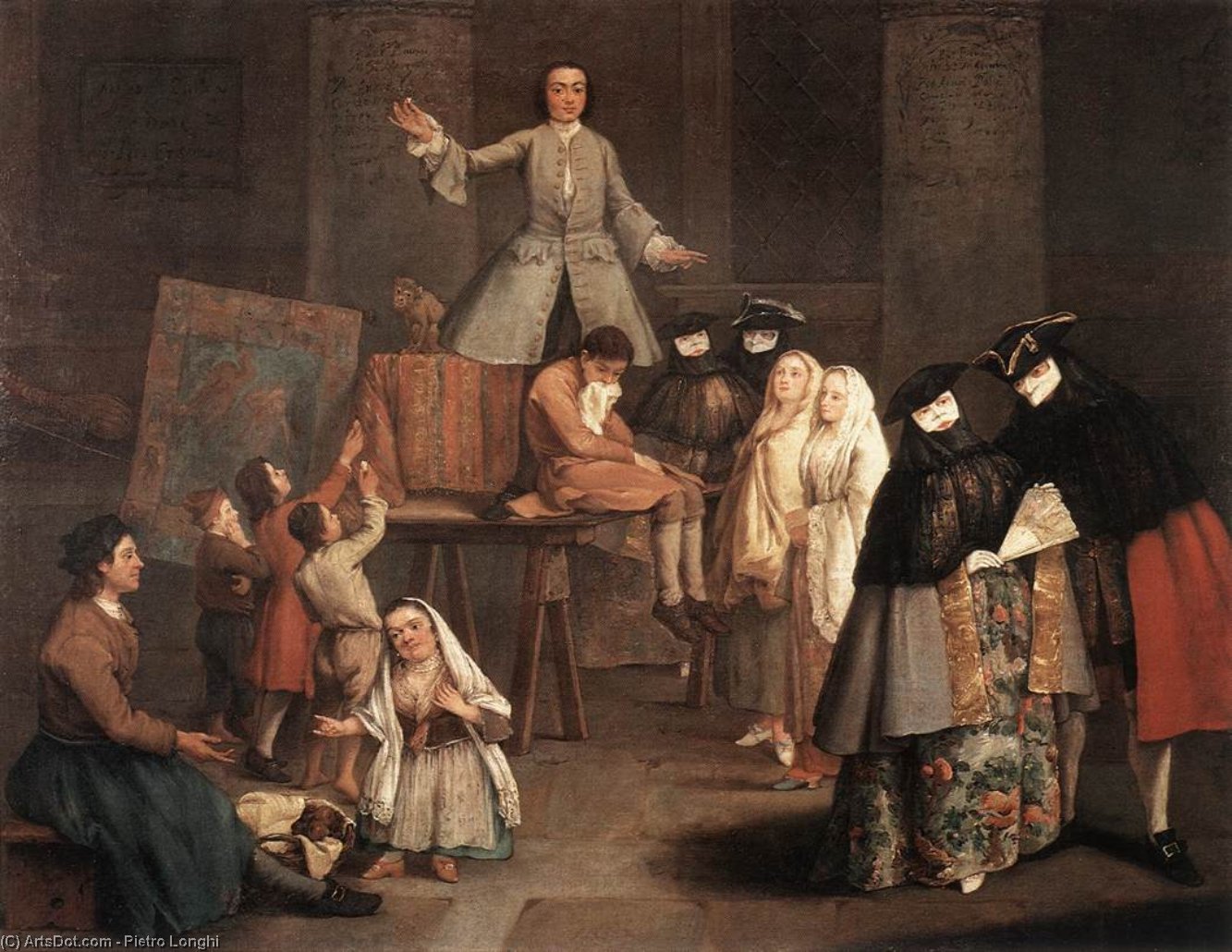
To stand before Pietro Longhi’s depiction of The Tooth Puller is not merely to observe an event; it is to slip, quite unexpectedly, into the vibrant, intimate tapestry of 18th-century Venice. This painting transports us beyond the grand pronouncements of mythology or history that often dominated art, offering instead a profoundly human moment—a scene unfolding within what appears to be a richly furnished domestic space. The composition buzzes with life, capturing a gathering around a central dining table. One can almost hear the murmur of conversation mingling with the focused tension surrounding the procedure taking place in the foreground. Longhi masterfully frames this confluence of everyday activity and minor drama, inviting the viewer not as an objective spectator, but as a privileged guest who has stumbled upon a private moment.
Pietro Longhi is celebrated precisely because he dared to look at the mundane and find it extraordinary. As a chronicler of daily life, his genius lay in elevating genre scenes—the gatherings, the meals, the simple acts of human interaction—to the level of high art. In The Tooth Puller, the sheer number of figures, numbering at least twelve, creates a complex social ecosystem. They are arranged with an almost theatrical naturalism; some stand observing from the periphery, others are seated in close proximity to the action. This density is not chaotic; rather, it suggests the interwoven nature of community life in Venice—a place where public and private spheres constantly overlapped. The black and white quality of this particular rendition lends a timeless, almost photographic quality, allowing us to focus intensely on gesture, expression, and the subtle dynamics between the assembled company.
The technical brilliance evident in Longhi’s hand is palpable. While the original medium would have allowed for rich color, this reproduction captures the delicate brushwork that defined his style—a lightness of touch paired with an acute understanding of human anatomy and costume. The setting itself, suggested by the dining table and surrounding furniture, speaks volumes about the social strata and domestic elegance of the era. Longhi’s ability to render texture, from the folds of clothing to the polished wood of the room, anchors the viewer firmly in the year 1746. It is a masterclass in observational painting, where the artist acts as both chronicler and skilled illusionist.
At its heart, the scene carries a subtle undercurrent of vulnerability juxtaposed against communal support. The tooth extraction itself is an act of necessary discomfort, a moment of focused pain managed by expertise. Yet, this singular medical event becomes the focal point for an entire social circle. It symbolizes how human experience—even moments of minor distress—are always shared, witnessed, and absorbed by the surrounding community. For the collector or decorator, owning such a piece is acquiring more than just decoration; it is acquiring a narrative device—a conversation starter that speaks to the enduring power of human connection against the backdrop of daily routine.

1701 - 1785 , Italia


Hold deg oppdatert med de siste kunstnyhetene, eksklusive tilbud og dekorasjonsideer.
Fortell oss om prosjektet ditt, så vil våre kunsteksperter gi deg 3 personlige kunstforslag.
Vi velger ut 3 alternativer kun for deg – helt gratis!


 Forhåndsvisning
 Send
Send Del med andre
 Vis detaljer

 Last ned bildet
 Liknende objekter
 Røntgenundersøkelse
 Lysbildefremvisning
 Vis hele teksten