

 Barbizon School
 72.0 x 92.0 cm
Giclée- eller lerretsprint av museumskvalitet med rask produksjon og fleksible valgmuligheter for etterbehandling. ( Kjøp håndlaget maleri Kjøp bilde)





























Velg mellom våre forhåndsdefinerte størrelser som bevarer kunstverkets opprinnelige proporsjoner.

Du kan oppgi egne mål for å tilpasse en spesifikk ramme eller et bestemt område. Dersom den valgte størrelsen ikke samsvarer med det originale bildets proporsjoner, vil vi enten beskjære kunstverket eller utvide bildet med en speilet eller ensfarget kant. En digital mockup vil bli sendt til din godkjenning før produksjonen starter.
Vennligst merk at forhåndsvisningen på skjermen ikke gjenspeiler den faktiske beskjæringen eller utvidelsen. Kun mockuppen vil vise den endelige komposisjonen nøyaktig.
Selv om tilpassede størrelser er tilgjengelige, anbefaler vi å velge et mål fra den forhåndsdefinerte listen for å bevare de originale proporsjonene.
Verdensomspennende levering () på 2 uker i stedet for standard 4/5 uker. (24 August)


Noonday
Størrelse på reproduksjon
In the tapestry of late Victorian art, few threads possess the quiet, evocative strength of William Edward Stott. Born in 1855 amidst the industrial landscape of Wardleworth, near Rochdale, Stott emerged from a world defined by the rhythmic toil of Lancashire’s cotton mills. While his father, Samuel Stott, presided over a successful mill, the young artist’s gaze was frequently drawn away from the smoke of industry toward the enduring beauty of the natural world. This early exposure to the stark contrasts between industrial progress and rural tradition would become a cornerstone of his artistic identity, instating in him a profound empathy for the lives of those tethered to the land.
Stott’s journey was one of significant geographical and stylistic evolution. His formal training took him to the heart of the art world in Paris, where he studied under the esteemed academic painter Carolus Duran. While this period provided him with a rigorous foundation in meticulous technique and classical composition, it also placed him at the epicenter of a burgeoning revolution. The whispers of Impressionism and the soulful, earth-bound realism of the Barbizon School began to permeate his consciousness. He found himself deeply moved by the work of Jules Bastien-Lepage, whose ability to marry naturalistic detail with an atmospheric, almost poetic sense of light offered Stott a new vocabulary for his own explorations.
As his style matured, Stott transitioned from the rigid constraints of academicism toward a more fluid, emotive approach. His canvases became windows into a vanishing way of life, capturing the subtle shifts of light that define the English countryside. He did not merely paint landscapes; he painted atmospheres. Whether it was the soft, encroaching shadows in Approaching Night or the warm, sun-drenched serenity found in The Watering Place, Stott possessed a rare gift for rendering the ephemeral qualities of the air and the earth.
His subject matter often centered on the dignity of rural labor and the quiet rhythms of pastoral existence. In works such as Ploughing, Early Spring, one can sense the connection between the artist and his subjects—a shared understanding of the seasonal cycles and the physical reality of the landscape. His technique utilized a sophisticated palette to evoke mood, often employing:
Though Stott may not have attained the global celebrity of his contemporaries like Monet or Renoir, his contribution to the British aesthetic remains vital. He stood at a pivotal historical crossroads, navigating the transition from the structured traditions of the 19th century to the more experimental sensibilities of the early 20th century. His work serves as a poignant historical record, preserving the essence of an English landscape and a social order that were rapidly being transformed by the very industrial forces he witnessed in his youth.
Today, Stott’s paintings continue to resonate with a modern audience, offering a sense of tranquility and a nostalgic connection to the pastoral. His ability to imbue ordinary scenes with extraordinary emotional weight ensures his place in the canon of British Naturalism. To view a Stott painting is to experience a moment of stillness—a chance to witness the quiet dignity of the earth and the enduring, beautiful melancholy of the passing light.

1918 -

Oppdag Edward Hoppers 25 mest ikoniske malerier! Fordyp deg i amerikansk realisme, lysets spill og stemningen av isolasjon. Finn kunsttrykk & inspirasjon til hjemmet ditt på BuyPopArt.no – museumskvalitet for enhver smak.

Explore the serene landscapes of Edward Wilkins Waite (1854-1924), a prolific Victorian painter celebrated for his depictions of Surrey's countryside. Discover his artistic influences, career highlights & collecting guide.
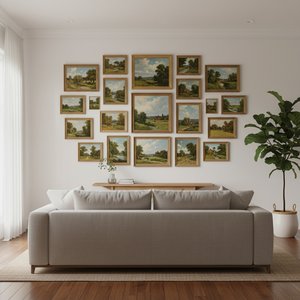
Opplev John Constables 25 mest ikoniske malerier! Fordyp deg i engelsk romantikk, landskapskunst og atmosfæriske scener. Finn museumskvalitets reproduksjoner & interiørinspirasjon på BuyPopArt.com. Utforsk samlingen online!

Explore the rich history of rural landscape painting with BuyPopArt. Discover Impressionist masterpieces, key artists & movements. Find your perfect serene artwork and bring nature's beauty home.

Explore the profound impact of the Barbizon School on landscape painting. Discover how masters like Rousseau and Corot revolutionized art through plein air naturalism, moving from academic idealism to the authentic beauty of the French countryside.


Hold deg oppdatert med de siste kunstnyhetene, eksklusive tilbud og dekorasjonsideer.
Fortell oss om prosjektet ditt, så vil våre kunsteksperter gi deg 3 personlige kunstforslag.
Vi velger ut 3 alternativer kun for deg – helt gratis!


 Forhåndsvisning
 Send
Send Del med andre
 Vis detaljer

 Last ned bildet
 Liknende objekter
 Røntgenundersøkelse
 Lysbildefremvisning
 Vis hele teksten







 Glassalternativet er kun tilgjengelig i størrelser under 110 cm


