

 Oil On CanvasWallArtCubist Style
 1913Early Medieval
 188.0 x 158.0 cm
Kup wysokiej rozdzielczości, ulepszony obraz cyfrowy o znacznie wyższej jakości niż podgląd online.
Każdy plik jest starannie przygotowywany przez naszych specjalistów przy użyciu zaawansowanych narzędzi oraz profesjonalnej, ręcznej retuszy. Dbamy o to, aby każdy obraz cechował się wyjątkową ostrością, precyzyjnym odwzorowaniem kolorów i subtelnymi detalami.
Ostateczny plik dostarczany jest drogą mailową w ciągu 72 godzin, zoptymalizowany do natychmiastowego wykorzystania w profesjonalnych zastosowaniach redakcyjnych i poligraficznych. To ta sama jakość, której ufają czołowe studia projektowe, wydawnictwa oraz galerie sztuki.
Pobierz plik o wysokiej rozdzielczości do osobistego wyświetlania, druku oraz projektów kreatywnych. ( Zamów wydruk Zamów ręcznie malowaną reprodukcję)
Wybierając BuyPopArt.com, nie otrzymujesz jedynie obrazu – otrzymujesz profesjonalnie udoskonalone cyfrowe dzieło sztuki, stworzone z najwyższą precyzją i objęte gwarancją satysfakcji. Oto wszystko, co automatycznie dołączane jest do Twojego zamówienia:

Plik z obrazem cyfrowym w wysokiej rozdzielczości zostanie przesłany na Twój adres e-mail w ciągu 72 godzin od złożenia zamówienia – gotowy do natychmiastowego użycia.

Twoja grafika została profesjonalnie zoptymalizowana przy użyciu zaawansowanych narzędzi AI oraz ręcznej edycji, co zapewnia maksymalną szczegółowość, klarowność i wierność kolorów.

Przypadkowo usunąłeś lub zgubiłeś swój plik? Bez obaw – prześlemy go Tobie ponownie w dowolnym momencie, bez żadnych opłat.

Ciesz się swoją sztuką natychmiast, bez żadnych opłat celnych, należności ani kosztów dostawy – pliki cyfrowe są zawsze wolne od podatku.

Dzięki zastosowaniu profesjonalnych narzędzi i procesów zarządzania barwą zapewniamy, że Twoje cyfrowe zdjęcie odzwierciedla oryginalne kolory tak wiernie, jak to tylko możliwe.

Jeśli nie będziesz zadowolony ze swojego cyfrowego obrazu, dokonamy jego poprawki lub zwrócimy 100% kosztów w ciągu 60 dni – bez żadnych pytań.

Nie jesteś zadowolony? Otrzymaj pełny zwrot kosztów w ciągu 60 dni od otrzymania pliku cyfrowego – bez zbędnych pytań.

Kup 3 obrazy, oszczędź 10% - Kup 5, oszczędź 15% - Kup 10+, oszczędź 20%. Idealne do projektów kreatywnych, galerii i agencji.
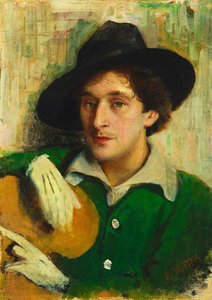
Marc Chagall's "The Fiddler," painted in 1913, isn’t merely a depiction of a man playing his instrument; it’s an immersion into a world brimming with personal mythology and the vibrant spirit of Eastern European Jewish life. This oil on canvas, measuring 188 x 158 cm, stands as a cornerstone of Chagall's early Cubist explorations, seamlessly blending fantastical elements with poignant realism. The painting immediately captivates with its explosion of color – deep blues, fiery oranges, and earthy greens—a palette that evokes both the twilight skies of Vitebsk and the warmth of family gatherings. It’s a scene plucked from memory, rendered not as a literal representation but as a potent distillation of feeling and experience.
At first glance, the composition appears deceptively simple: a man, identified by his distinctive white coat and flowing beard, stands perched atop a table, lost in the melody of his violin. Yet, this seemingly straightforward arrangement is layered with symbolic weight. The inclusion of an umbrella, tilted at a whimsical angle, hints at the unpredictable nature of life – a subtle acknowledgment of both joy and hardship. The other figures surrounding him—a woman gazing intently, a child reaching out, and a group engaged in various activities—suggest a community bound together by shared heritage and traditions. This isn’t just a portrait; it's a snapshot of a world, a testament to the enduring power of collective memory.
“The Fiddler” firmly establishes Chagall within the burgeoning movement of Cubism, though he quickly developed his own distinctive style. While influenced by Picasso and Braque’s exploration of fragmented forms and multiple perspectives, Chagall injects a deeply personal element into the technique. The figures are not rendered with photographic accuracy; instead, they are stylized and abstracted, their bodies flattened and rearranged to emphasize emotional impact over strict spatial representation. The use of bold, intersecting planes creates a dynamic sense of movement, as if the scene is perpetually shifting between moments in time. This deliberate distortion isn’t an exercise in deconstruction but rather a means of conveying the subjective experience of memory—a process where details blur and perspectives shift.
Chagall's masterful use of color further enhances this effect. He employs vibrant hues not to mimic reality, but to amplify the emotional resonance of each element. The deep blues evoke a sense of melancholy and nostalgia, while the fiery oranges represent passion and vitality. The interplay between these colors creates a dreamlike atmosphere, transporting the viewer into Chagall’s inner world.
Delving deeper reveals a rich tapestry of symbolism deeply rooted in Chagall's Hasidic Jewish upbringing. The fiddle itself is a potent symbol—a vehicle for spiritual expression and communal celebration within Jewish tradition. The setting, reminiscent of Vitebsk, the artist’s birthplace, immediately anchors the painting in a specific cultural context. The inclusion of elements like the table, a common gathering place, reinforces this sense of community and shared experience. Even the posture of the fiddler—his head tilted back as if lost in contemplation—suggests a connection to something beyond the earthly realm.
Furthermore, the painting’s overall composition echoes themes prevalent in Jewish folklore – stories of wandering, exile, and the enduring spirit of faith. The floating figures, a recurring motif in Chagall's work, represent a yearning for transcendence and a belief in the power of imagination. “The Fiddler” is therefore not simply a portrait; it’s an allegory—a visual poem exploring universal themes through the lens of personal memory and cultural heritage.
“The Fiddler” stands as one of Chagall's most beloved works, a testament to his unique artistic vision. Its influence extends far beyond the confines of Cubism, inspiring generations of artists with its dreamlike atmosphere and evocative symbolism. Works like “The Betrothed” and “Eiffel Tower,” also available through BuyPopArt.com, demonstrate the breadth of Chagall’s creative exploration. The painting's enduring appeal lies in its ability to transport viewers to a world where reality and fantasy intertwine, inviting us to contemplate the complexities of memory, faith, and the human spirit. Reproductions offer a remarkable opportunity to bring this captivating masterpiece into your home or studio, allowing you to experience the magic of Chagall’s vision firsthand.
1887 - 1985 , Білорусь


Bądź na bieżąco z najnowszymi wiadomościami ze świata sztuki, ekskluzywnymi ofertami i inspiracjami dekoratorskimi.
Opowiedz nam o swoim projekcie, a nasi eksperci przygotują dla Ciebie 3 spersonalizowane propozycje dzieł sztuki.
Przygotujemy dla Ciebie 3 propozycje zupełnie za darmo!


 Podgląd w skali
 Wyślij jako kartkę
 Udostępnij
 Szczegóły dzieła

 Pobierz
 Podobne obiekty
 RTG
RTG Pokaz slajdów
 Rozwiń treść