

Impressão giclée ou em tela de qualidade de museu, com produção rápida e opções flexíveis de acabamento. ( Comprar pintura feita à mão Comprar imagem)
Escolha entre os nossos tamanhos pré-definidos que respeitam as proporções originais da obra de arte.

Você pode inserir suas próprias dimensões para se ajustar a uma moldura ou espaço específico. Se o tamanho selecionado não corresponder às proporções da imagem original, iremos recortar a obra de arte ou estender a imagem com uma borda espelhada ou preenchimento sólido. Um mockup digital será enviado para sua aprovação antes do início da produção.
Por favor, observe que a visualização na tela não reflete o recorte ou a extensão real. Apenas o mockup mostrará com precisão a composição final.
Embora tamanhos personalizados estejam disponíveis, recomendamos selecionar uma dimensão da lista predefinida para preservar as proporções originais.
Entrega mundial () em 2 semanas, em vez das 4/5 semanas padrão. (12 Agosto)


Axehead
Dimensões da Reprodução
Sir Anthony Cragg, a titan of British contemporary sculpture, possesses the rare ability to breathe life into the inanimate. Born in Liverpool in 1949, Cragg’s artistic consciousness was shaped by an early mastery of painting, yet it was his profound fascination with the three-dimensional realm that would eventually redefine the boundaries of modern sculpture. His journey through the Gloucestershire College of Arts and Technology and Wimbledon School of Art provided a rigorous foundation, but it was his move to Germany in 1977 that acted as a true catalyst, thrusting him into an international dialogue with the avant-garde and expanding his sculptural vocabulary beyond the limits of traditional medium.
In the early stages of his career, Cragg emerged as a pioneer of the assemblage movement, finding profound beauty in the discarded and the mundane. He possessed a singular vision for transforming everyday detritus—stacked chairs, weathered tables, and forgotten boxes—into complex, rhythmic reliefs. Through works such as “Stack” (1975), he demonstrated an uncanny ability to manipulate spatial arrangement and color, turning fragments of plastic and wood into vibrant geometric abstractions. This period was defined by a philosophical rejection of representational imagery; instead, Cragg sought to distill visual language into its purest essence, forcing the viewer to confront the raw energy of form and texture without the distraction of recognizable subjects.
As his career progressed through the mid-1970s and into the 1980s, Cragg’s ambitions grew from the intimate scale of wall-mounted reliefs to the monumental presence of large-scale installations. He began to bridge the gap between architecture and sculpture, creating works that engaged aggressively with the spaces they inhabited. His mastery over diverse materials—ranging from the industrial coldness of fiberglass to the timeless weight of bronze—allowed him to explore a spectrum of textures and densities. In pieces like “Red Indian” (1982–3), one can observe his meticulous method of arranging individual fragments to generate larger, more complex images that simultaneously evoke organic, natural growth and rigid, geometric precision.
The brilliance of Cragg’s development lies in his ability to navigate the tension between the artificial and the biological. His later series, such as 'Early Forms' and 'Rational Beings', showcase a sculptor deeply invested in the concept of emergence—the way complex structures arise from simple components. His sculptures often appear to be in a state of flux, caught in a moment of transformation or unfolding. This sense of kinetic energy, even within static bronze or resin, creates a psychological depth that challenges our perceptions of stability and permanence.
The historical significance of Sir Anthony Cragg cannot be overstated; he has fundamentally altered the trajectory of contemporary sculpture by dismantling the distinction between found objects and fine art. His work serves as a bridge between the sculptural traditions of the past and the fragmented, multi-material reality of the present. By treating the fragment not as a broken piece, but as a building block for new realities, he has provided a visual language for an era defined by complexity and interconnectedness.
Today, Cragg remains a vital force in the global art scene, his influence felt in the way contemporary artists approach materiality and spatial intervention. His achievements are marked by:

1949 -

Discover the explosive artistry of Henri Gaudier-Brzeska (1891-1915), a key figure in British Modern sculpture and Vorticism. Explore his powerful direct carvings, tragic life & lasting impact. Handmade reproductions available at BuyPopArt.
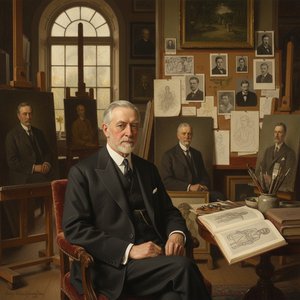
Explore the life & art of Sir William Rothenstein – a pivotal figure in British Modernism. Discover his portraits, war paintings, and influential role at the Royal College of Art. A comprehensive biography for art enthusiasts.

Explore the vibrant life & prolific work of Frank Brangwyn, a master of British art. Discover his stunning paintings, designs, and monumental Empire Panels – a celebration of colour, craft, and artistic innovation.
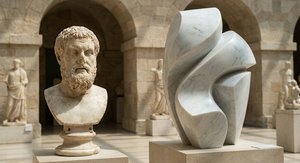
Explore the captivating history of marble sculpture from ancient Greece to modern art. Discover renowned artists like Canova & Michelangelo, carving techniques, and investment insights at BuyPopArt.

Explore the life & work of Dame Laura Knight, a pioneering British artist who challenged conventions with her vibrant depictions of theatre, ballet, and wartime scenes. Discover her feminist legacy & artistic innovations.


Fique por dentro das últimas notícias de arte, ofertas exclusivas e ideias de decoração.
Conte-nos sobre o seu projeto e os nossos especialistas em arte fornecerão 3 sugestões de arte personalizadas.
Deixe que selecionamos 3 opções especialmente para você – Grátis!


 Visualizar em escala
 Enviar
 Compartilhar
 Ver detalhes

 Baixar
 Semelhantes
 Raio X
 Apresentação de slides

 Ver mais




































 A opção de vidro está disponível apenas para tamanhos inferiores a 110 cm


