

 OilWallArtBaroque
 1638Early Modern
 55.0 x 68.0 cm
 Musée Des Beaux
Giclée- eller canvasprint av museumskvalitet med snabb produktion och flexibla ytbehandlingsalternativ. ( Beställ handmålad reproduktion Köp högupplöst bild)





























Välj bland våra förinställda storlekar som motsvarar konstverkets ursprungliga proportioner.

Du kan ange egna mått för att passa en specifik ram eller yta. Om det valda måttet inte överensstämmer med originalbildens proportioner kommer vi antingen att beskära konstverket eller utöka bilden med en speglad eller enfärgad kant. En digital mockup skickas för ditt godkännande innan produktionen påbörjas.
Vänligen notera att förhandsvisningen på skärmen inte återspeglar den faktiska beskärningen eller utökningen. Endast mockuppen visar den slutgiltiga kompositionen korrekt.
Även om anpassade storlekar är möjliga, rekommenderar vi att du väljer ett mått från den fördefinierade listan för att bevara de ursprungliga proportionerna.
Leverans över hela världen () på 2 veckor istället för standard 4/5 veckor. (16 augusti)


The Five Senses
Storlek på reproduktion
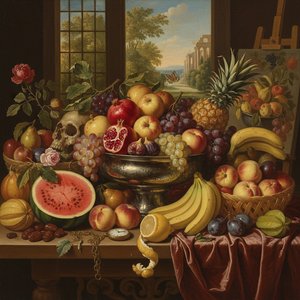
In the quiet, contemplative realm of 17th-century French still life, few works capture the delicate interplay between the physical world and the metaphysical soul as masterfully as Jacques Linard’s The Five Senses. Painted in 1638, this exquisite composition serves as more than a mere collection of objects; it is a poetic meditation on human perception. As one gazes upon the canvas, the viewer is invited into a meticulously arranged world where every element—from the soft curve of an orange to the reflective surface of a mirror—whispers a story of beauty and transience. Linard, a pioneer of the French still life tradition, utilizes a rich, Baroque sensibility to transform a simple tabletop scene into a profound sensory experience that resonates across centuries.
The composition is a masterclass in balance and depth. At the heart of the painting lies a bountiful arrangement of fruit, where the vibrant hues of apples and oranges contrast beautifully with the deep, succulent tones of clustered grapes. These organic forms are anchored by the presence of two elegant vases, which provide vertical structure to the scene, while an open book rests upon the table, suggesting the intellectual pursuit of knowledge that accompanied the era's scientific curiosity. The inclusion of a clock hanging subtly on the wall serves as a poignant memento mori, a gentle reminder of the relentless passage of time that governs all living things. This layering of objects creates a rhythmic flow that guides the eye through a landscape of textures and light.
What elevates this work from a traditional still life to a masterpiece of symbolic depth is Linard’s use of reflection and light. The presence of a mirror within the scene is particularly striking; it does not merely duplicate the fruit arrangement but adds a complex dimension of spatial illusion, pulling the viewer deeper into the painted reality. This technique reflects the 17th-century fascination with optics and the way light defines our understanding of form. Through the mirror, the artist explores the concept of truth versus appearance, inviting us to question the boundaries between what is seen and what is felt.
Every element in The Five Senses acts as a conduit for one of the human senses: the sweetness of the fruit evokes taste, the vibrant colors stir sight, the tactile presence of the textures suggests touch, the implied aroma of ripening fruit hints at smell, and the silent, scholarly atmosphere of the book and clock evokes the internal rhythm of hearing and thought. For the discerning collector or interior designer, this painting offers a sophisticated narrative that transcends simple decoration. It is an intellectual centerpiece, perfect for spaces that value quiet contemplation, classical elegance, and the enduring power of historical storytelling.
For those seeking to infuse their living spaces with a sense of history and soulful grace, a high-quality reproduction of Linard’s work provides an unparalleled opportunity. The painting’s palette—rich in earthy tones, warm golds, and deep botanical greens—complements a wide array of interior styles, from the stately grandeur of a traditional library to the muted, organic textures of contemporary minimalist design. Owning such a piece is not merely about displaying art; it is about curating an atmosphere of refinement and intellectual depth.
As a hand-painted tribute to one of France's most significant early still-life masters, this reproduction captures the meticulous brushwork and luminous glazing that define Linard’s original technique. It brings the light of 1638 into the modern home, offering a window into a world where every object holds a secret, and every shadow tells a story of the enduring human experience.

Explore the profound beauty of fruit arrangement masterpieces. From Dutch Golden Age opulence to Baroque chiaroscuro, discover the art history, symbolism, and timeless elegance of classical still life paintings for the discerning collector.

Explore the life & art of Simon Vouet, a pivotal French Baroque painter who introduced Italian styles to France. Discover his masterpieces and lasting influence on 17th-century art.
Explore the rich history of still life painting & the symbolism of fruit across art movements. Discover masterpieces from Caravaggio to Cézanne with BuyPopArt – expert guidance & museum-quality reproductions.

Upptäck barockens dramatik och lyx! Lär dig hur du integrerar denna klassiska stil i ditt hem med våra experttips och inspirerande exempel. Skapa en palatskänsla idag!

Discover the profound beauty of fruit still life paintings. Explore the rich symbolism, Baroque mastery, and timeless allure of nature's bounty through an art-historical lens, perfect for collectors and enthusiasts of classical fine art.


Håll dig uppdaterad med de senaste konstnyheterna, exklusiva erbjudanden och inredningsidéer.
Berätta om ditt projekt så kommer våra konstexperter att ge dig 3 personliga konstförslag.
Vi skapar ett urval av 3 alternativ helt anpassat för dig – gratis!


 Förhandsvisa
 Skicka
 Dela
Dela
 Visa detaljer

 Ladda ner
 Liknande objekt
 Röntgen
 Bildspel
 Visa mer







 Glasalternativet är endast tillgängligt i storlekar under 110 cm.


