Köp tryck Köp tryckKöp högupplöst digital bild Köp högupplöst digital bild SkickaSkicka
Visa detaljerVisa detaljer Lägg till i favoriter Lägg till i favoriter Ladda nerLadda ner Liknande objektLiknande objekt RöntgenRöntgen BildspelBildspel

Acrobates

Experience Chagall's vibrant 1961 'Acrobates,' a dreamlike piece capturing dynamic aerial performance in a naive style; discover this colorful masterpiece today.

Upplev Marc Chagalls drömlika "En sommarnattsdröm" (Midsummer Night's Dream). Ett surrealistiskt mästerverk fyllt av symbolik, kärlek och magi – fånga konstens essens!

Handgjord oljereproduktion

Handmålad olja på duk i din valda storlek och ram, tillverkad efter beställning av våra konstnärer.

Standard
custom
CM
INCH

Välj bland våra förinställda storlekar som motsvarar konstverkets ursprungliga proportioner.

bredd
höjd

Du kan ange egna mått för att passa en specifik ram eller yta. Om den valda storleken inte matchar originalbildens proportioner kommer vi antingen att beskära konstverket eller utöka målningen med ytterligare handmålade element. En digital skiss skickas till dig för godkännande innan produktionen påbörjas.
Observera att förhandsvisningen på skärmen inte återspeglar den faktiska beskärningen eller utökningen. Endast skissen visar den slutgiltiga kompositionen korrekt.
Även om anpassade storlekar är möjliga, rekommenderar vi att du väljer en dimension från den fördefinierade listan för att bevara originalproportionerna.

Exempel på vad som kan ändras: Byt ut ansiktet mot ett foto av kunden; Lägg till ett husdjur (t.ex. byt ut en katt mot en hund); Inkludera ett dolt meddelande i bakgrunden; Ändra bakgrundens landskap eller element.
Efter beställning kommer BuyPopArt.com team att mejla kunden för instruktioner och tillhandahålla en skissförhandsvisning

Leverans över hela världen () på 3–4 veckor istället för standard 5 veckor. (21 juli). Inga kompromisser med kvaliteten.

why_choose_icon
Fri expressfrakt över hela världen
why_choose_icon
Högkvalitativ linnecanvas
why_choose_icon
Fullständig fraktförsäkring
why_choose_icon
Garantier för återbetalning av tullavgifter
why_choose_icon
Garantier för exakt färgåtergivning
why_choose_icon
60 dagars returrätt (endast vid fabrikationsfel)
why_choose_icon
100% pengarna tillbaka-garanti
why_choose_icon
Mängdrabatt erbjuds

Totalpris

-

reproduction

Acrobates

Teknik för reproduktion

Storlek på reproduktion

-

Slutgiltigt pris

-

Kortfakta

  • Artistic style: Naive Art (Primitivism)
  • Subject or theme: Acrobatics/Performance
  • Artist: Marc Chagall
  • Notable elements or techniques:
    • Blue and green colors
    • Dynamic composition
  • Year: 1961

Konstquiz

Det finns endast ett korrekt svar på varje fråga.

Fråga 1:
What artistic style is “Acrobates” primarily characterized by?
Fråga 2:
Which color palette dominates the painting “Acrobates”?
Fråga 3:
Marc Chagall’s Vitebsk upbringing significantly influenced his artistic vision. What elements of Vitebsk’s cultural landscape appear frequently in his paintings?
Fråga 4:
The painting depicts acrobats performing in the air. What is a notable feature of Chagall’s depiction of these figures?
Fråga 5:
“Acrobates” exemplifies Chagall’s belief in the power of imagination. How is this reflected in the painting’s overall aesthetic?

Beskrivning av konstverket

The Aerial Ballet of Chagall's Acrobates

To gaze upon Marc Chagall’s Acrobates, painted in 1961, is to witness not merely a depiction of physical feats, but a vibrant, airborne dream. The canvas seems to vibrate with the energy of movement, capturing three figures suspended in an impossible ballet against a backdrop steeped in the artist's signature palette of ethereal blues and lush greens, punctuated by flashes of warm orange. This work immediately draws the viewer into its kinetic embrace, suggesting a moment stolen from a perpetual festival or a memory recalled through a veil of wonder.

A Style Rooted in Primitivism and Memory

What distinguishes Acrobates is its striking adherence to a Naïve Art sensibility, or what the art world recognizes as Primitivism. Chagall often channeled this raw, unpolished energy, allowing the subject matter—the acrobats seemingly falling or soaring—to take precedence over strict academic realism. This stylistic choice imbues the piece with an immediate, almost childlike sincerity, yet it is underpinned by the profound depth of a master's vision. The technique feels spontaneous, as if painted directly from the heart’s impulse rather than from careful study, allowing the viewer to feel the very breath of the artist during its creation.

Symbolism in Flight and Folklore

For Chagall, nothing was purely literal; everything resonated with folklore, memory, and the spiritual yearning inherent in his life. The act of acrobatics here transcends mere sport. These figures suspended in the air can be interpreted as souls ascending, memories taking flight, or perhaps the joyous chaos of a communal celebration echoing the vibrant Jewish culture that so deeply informed his existence. The blues and greens evoke the dreamlike quality of Vitebsk itself—a place where reality and myth perpetually overlapped. It is a visual poem about transcendence.

Bringing the Dream Home: Decorating with Chagall

For collectors and designers alike, Acrobates offers an unparalleled focal point for any space yearning for romance and narrative depth. Its dynamic composition means it interacts beautifully with varied interior aesthetics; in a room of modern lines, it introduces necessary organic warmth, while against more traditional decor, its vibrant color story acts as a breathtaking jewel. Owning a reproduction allows one to curate a corner that feels less like an arrangement of objects and more like a captured moment of pure, unadulterated joy—a permanent echo of Chagall’s poetic spirit.

Konstnärsbiografi

A Life Painted in Dreams: The World of Marc Chagall

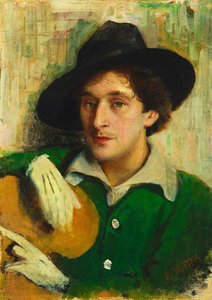
Marc Chagall, born Moishe Shagal in 1887 in the small Belarussian town of Liozna near Vitebsk, wasn’t merely a painter; he was a poet of color, a weaver of dreams, and a chronicler of memory. His life, spanning nearly a century, mirrored the tumultuous currents of the 20th century, yet his art remained steadfastly rooted in a deeply personal vision—one infused with the folklore of his Hasidic Jewish upbringing and an unwavering belief in the power of imagination. Vitebsk itself was more than just a birthplace; it became the emotional core of his artistic universe, a recurring motif populated by flying figures, whimsical animals, and the vibrant hues of remembered landscapes. The town’s unique blend of cultures—Russian Orthodox churches alongside bustling Jewish marketplaces—forged an aesthetic sensibility that would defy easy categorization throughout his long career. Though he sought formal training first with a local sign painter and later in St. Petersburg under Léon Bakst, and then in Paris at the Académie de la Grande Chaumière, Chagall never fully embraced any single artistic movement. He absorbed elements of Cubism, Symbolism, and Fauvism, but always filtered them through his own intensely personal lens, creating a style that was uniquely, unmistakably Chagall.

Early Influences and Artistic Beginnings

Chagall’s formative years were marked by the traditions of Vitebsk’s Jewish community—a world steeped in ritual, storytelling, and vibrant visual culture. These influences would permeate his artistic vision throughout his life. His initial training was modest, focusing on practical skills as a sign painter, but he quickly developed an interest in broader artistic concepts. St. Petersburg provided him with access to influential teachers like Léon Bakst, who encouraged experimentation and challenged conventional stylistic norms. This exposure to theatrical design—particularly Ballets Russes productions—would prove crucial in shaping his approach to composition and visual storytelling. However, Chagall resisted the allure of rigid academic doctrines, prioritizing intuition and emotional expression over technical precision. He sought inspiration from Impressionism and Post-Impressionism, particularly Cézanne and Gauguin, recognizing their ability to capture fleeting moments of beauty and emotion.

The Symbolist Vision: Fragments of Memory

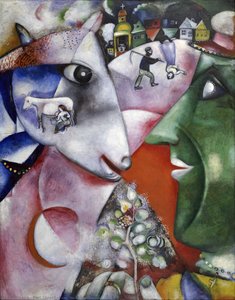
Chagall’s early paintings—such as I and the Village (1911)—demonstrate his fascination with Symbolism's exploration of psychological states and subconscious imagery. The village isn’t rendered realistically but as a fragmented collection of recollections, imbued with symbolic meaning. Figures float and dance across the canvas, defying gravity and logic, creating a dreamlike atmosphere that invites viewers into his inner world. This stylistic approach wasn’t accidental; it stemmed from a desire to move beyond mere imitation of reality and capture the essence of feeling, the weight of memory, and the power of folklore. The use of color—bold, non-naturalistic hues—served as a conduit for emotion rather than literal representation. Recurring motifs like birds, apples, and musical instruments reflect Chagall’s preoccupation with themes of flight, fertility, and artistic inspiration. These images are not simply decorative; they carry profound symbolic significance, conveying ideas about identity, spirituality, and the relationship between humanity and nature.

Cubism's Influence and Artistic Evolution

Despite his rejection of formal academic movements, Chagall absorbed elements of Cubism, particularly Picasso’s pioneering explorations of fractured perspectives. This influence is evident in works like The Musicians (1917), where figures are depicted simultaneously from multiple viewpoints—a technique that disrupts traditional spatial conventions and emphasizes the multiplicity of experience. However, Chagall skillfully blended Cubist principles with his own distinctive visual language, retaining a lyrical quality and emotional depth that distinguishes him from more intellectually rigorous artists. He continued to experiment with color and form throughout his career, refining his style while maintaining its core expressive power. The Russian Revolution profoundly impacted Chagall’s life and artistic practice, returning him to Vitebsk where he established an art school—a brief but significant endeavor aimed at fostering creativity and cultural renewal amidst the upheavals of the era.

International Recognition and Legacy

Chagall's emigration to Paris in 1923 marked a turning point in his artistic trajectory, propelling him onto the international stage. He embraced Surrealism’s fascination with dreams and irrationality, producing canvases that pulsate with imaginative energy—works like *White Crucifixion* (1938) reflecting the anxieties of wartime Europe. His subsequent move to New York City during World War II provided him with a new creative impetus, resulting in monumental paintings inspired by biblical narratives and American landscapes. Chagall’s influence extended far beyond his own lifetime, inspiring countless artists across disciplines—painting, sculpture, theater, and film—who sought to emulate his poetic vision and expressive style. His enduring legacy resides not only in his iconic artworks but also in the profound exploration of human emotion and spiritual yearning that characterizes his oeuvre. Marc Chagall remains one of the most celebrated artists of the twentieth century, a testament to the transformative power of imagination and the unwavering pursuit of artistic truth.
Marc Chagall

Marc Chagall

1887 - 1985 , Belarus

Kortfattad information

  • Artistic Movement Or Style: Modernism, Kubism
  • Artists Or Movements Influenced By This Artist: ['Surrealism']
  • Artists Who Influenced This Artist:
    • Bakst
    • Delaunay
    • Borovikovsky
  • Date Of Birth: 7 juli 1887
  • Date Of Death: 28 mars 1985
  • Full Name: Marc Chagall
  • Nationality: Russisk, senare fransk
  • Notable Artworks:
    • I och byen
    • Den Liggande Poeten
    • Valentina
  • Place Of Birth: Liozna, Belarus
Utforska konstverk organiserade efter teman, stilar och egenskaper.