

 Oil On CanvasWallArtCubist Style
 1913Early Medieval
 188.0 x 158.0 cm
Köp en högupplöst, förbättrad digital bild som är vida överlägsen förhandsvisningen online.
Varje fil är noggrant förberedd av våra interna specialister med hjälp av avancerade verktyg och professionell manuell retuschering. Vi säkerställer att varje bild har exceptionell skärpa, exakt färgåtergivning och fina detaljer.
Den slutgiltiga filen levereras via e-post inom 72 timmar, optimerad för omedelbar användning i professionella sammanhang, redaktionellt bruk och tryckmiljöer. Detta är samma kvalitet som med förtroende används av ledande designstudior, förlag och gallerier.
Ladda ner en högupplöst fil för personlig visning, utskrift och kreativa projekt. ( Beställ tryck Byt till handmålad målning)
När du väljer BuyPopArt.com får du inte bara en bild – du får ett professionellt förädlat digitalt konstverk, skapat med precision och med en garanterad tillfredsställelse. Här är allt som ingår i din beställning, automatiskt:

Din högupplösta digitala bild skickas till dig via e-post inom 72 timmar efter beställning – redo för omedelbar användning.

Ditt konstverk optimeras professionellt med hjälp av avancerade AI-verktyg och manuell redigering, vilket garanterar maximal detaljrikedom, skärpa och färgnoggrannhet.

Har du råkat radera eller tappa bort din fil? Ingen oro – vi skickar den kostnadsfritt till dig när som helst.

Njut av ditt konstverk omedelbart utan tull, importavgifter eller leveranskostnader – digitala nedladdningar är alltid skattefria.

Vi säkerställer att din digitala bild återger de ursprungliga färgerna så exakt som möjligt med hjälp av professionella verktyg och färghantering.

Om du inte är nöjd med din digitala bild kommer vi att revidera den eller återbetala 100% inom 60 dagar – utan frågor.

Inte nöjd? Få full återbetalning inom 60 dagar efter att du har tagit emot din digitala fil – utan frågor och diskussioner.

Köp 3 bilder, spara 10% – Köp 5, spara 15% – Köp 10+, spara 20%. Perfekt för kreativa projekt, gallerier och byråer.
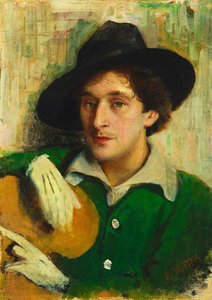
Marc Chagall's "The Fiddler," painted in 1913, isn’t merely a depiction of a man playing his instrument; it’s an immersion into a world brimming with personal mythology and the vibrant spirit of Eastern European Jewish life. This oil on canvas, measuring 188 x 158 cm, stands as a cornerstone of Chagall's early Cubist explorations, seamlessly blending fantastical elements with poignant realism. The painting immediately captivates with its explosion of color – deep blues, fiery oranges, and earthy greens—a palette that evokes both the twilight skies of Vitebsk and the warmth of family gatherings. It’s a scene plucked from memory, rendered not as a literal representation but as a potent distillation of feeling and experience.
At first glance, the composition appears deceptively simple: a man, identified by his distinctive white coat and flowing beard, stands perched atop a table, lost in the melody of his violin. Yet, this seemingly straightforward arrangement is layered with symbolic weight. The inclusion of an umbrella, tilted at a whimsical angle, hints at the unpredictable nature of life – a subtle acknowledgment of both joy and hardship. The other figures surrounding him—a woman gazing intently, a child reaching out, and a group engaged in various activities—suggest a community bound together by shared heritage and traditions. This isn’t just a portrait; it's a snapshot of a world, a testament to the enduring power of collective memory.
“The Fiddler” firmly establishes Chagall within the burgeoning movement of Cubism, though he quickly developed his own distinctive style. While influenced by Picasso and Braque’s exploration of fragmented forms and multiple perspectives, Chagall injects a deeply personal element into the technique. The figures are not rendered with photographic accuracy; instead, they are stylized and abstracted, their bodies flattened and rearranged to emphasize emotional impact over strict spatial representation. The use of bold, intersecting planes creates a dynamic sense of movement, as if the scene is perpetually shifting between moments in time. This deliberate distortion isn’t an exercise in deconstruction but rather a means of conveying the subjective experience of memory—a process where details blur and perspectives shift.
Chagall's masterful use of color further enhances this effect. He employs vibrant hues not to mimic reality, but to amplify the emotional resonance of each element. The deep blues evoke a sense of melancholy and nostalgia, while the fiery oranges represent passion and vitality. The interplay between these colors creates a dreamlike atmosphere, transporting the viewer into Chagall’s inner world.
Delving deeper reveals a rich tapestry of symbolism deeply rooted in Chagall's Hasidic Jewish upbringing. The fiddle itself is a potent symbol—a vehicle for spiritual expression and communal celebration within Jewish tradition. The setting, reminiscent of Vitebsk, the artist’s birthplace, immediately anchors the painting in a specific cultural context. The inclusion of elements like the table, a common gathering place, reinforces this sense of community and shared experience. Even the posture of the fiddler—his head tilted back as if lost in contemplation—suggests a connection to something beyond the earthly realm.
Furthermore, the painting’s overall composition echoes themes prevalent in Jewish folklore – stories of wandering, exile, and the enduring spirit of faith. The floating figures, a recurring motif in Chagall's work, represent a yearning for transcendence and a belief in the power of imagination. “The Fiddler” is therefore not simply a portrait; it’s an allegory—a visual poem exploring universal themes through the lens of personal memory and cultural heritage.
“The Fiddler” stands as one of Chagall's most beloved works, a testament to his unique artistic vision. Its influence extends far beyond the confines of Cubism, inspiring generations of artists with its dreamlike atmosphere and evocative symbolism. Works like “The Betrothed” and “Eiffel Tower,” also available through BuyPopArt.com, demonstrate the breadth of Chagall’s creative exploration. The painting's enduring appeal lies in its ability to transport viewers to a world where reality and fantasy intertwine, inviting us to contemplate the complexities of memory, faith, and the human spirit. Reproductions offer a remarkable opportunity to bring this captivating masterpiece into your home or studio, allowing you to experience the magic of Chagall’s vision firsthand.
1887 - 1985 , Belarus


Håll dig uppdaterad med de senaste konstnyheterna, exklusiva erbjudanden och inredningsidéer.
Berätta om ditt projekt så kommer våra konstexperter att ge dig 3 personliga konstförslag.
Vi skapar ett urval av 3 alternativ helt anpassat för dig – gratis!


 Visa i rummet
 Skicka
 Dela
Dela
 Detaljer

 Ladda ner
 Liknande objekt
 Röntgen
 Bildspel
 Läs mer