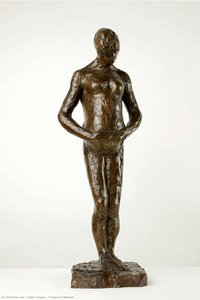
Bronz HeykelNeo-Dada
 133.0 x 114.0 cm
 Chrysler Museum of Art
Hızlı üretim ve esnek bitiş seçenekleriyle müze kalitesinde giclée veya kanvas baskı. ( El yapımı tablo satın al Görsel satın al)
Eserin orijinal oranlarıyla uyumlu, önceden belirlenmiş boyutlarımız arasından seçim yapın.

Belirli bir çerçeveye veya alana uyması için kendi ölçülerinizi girebilirsiniz. Seçtiğiniz boyut orijinal görüntünün oranlarıyla eşleşmiyorsa, sanat eserini kırpacağız veya görüntüyü aynalanmış ya da düz dolgulu bir kenarlıkla genişleteceğiz. Üretim başlamadan önce onayınız için bir dijital taslak gönderilecektir.
Lütfen ekrandaki önizlemenin gerçek kırpma veya genişletmeyi yansıtmadığını unutmayın. Nihai kompozisyonu yalnızca taslak doğru bir şekilde gösterecektir.
Özel boyutlar mevcut olsa da, orijinal oranları korumak için önceden tanımlanmış listeden bir boyut seçmenizi öneririz.
Dünya Çapında Teslimat (); standart 4/5 hafta yerine 2 haftada. (16 Ağustos)


Fancy
Reproduksiyon Boyutu
In the intersection of industrial decay and high art, few figures loom as large or as provocatively as John Angus Chamberlain. Born in 1927 in Rochester, Indiana, Chamberlain did not merely create sculpture; he orchestrated a metamorphosis of the discarded. To look upon his work is to witness a violent yet poetic dialogue between the mechanical past and the abstract present. He possessed a singular vision that allowed him to see not just rusted scrap, but a vocabulary of form, color, and texture. His journey from the son of a saloonkeeper in the American Midwest to a titan of the Neo-Dada movement is a testament to an unyielding creative impulse that sought to find beauty within the crushed and the broken.
Chamberlain’s artistic consciousness was forged through a diverse and rigorous educational odyssey. After serving in the United States Navy during the pivotal years of World War II, he utilized the GI Bill to immerse himself in the burgeoning avant-garde scenes of America. His time at the Art Institute of of Chicago provided him with a foundational mastery of form, but it was his tenure at the legendary Black Mountain College that truly expanded his intellectual horizons. At Black Mountain, he moved beyond the purely visual, studying under influential poets such as Charles Olson and Robert Creeley. This literary immersion profoundly shaped his sculptural language; he famously viewed his collection of automotive fragments as a reservoir of words, where the act of welding was akin to composing a stanza, seeking the perfect placement of one jagged edge against another to achieve a rhythmic, poetic resonance.
The hallmark of Chamberlain’s oeuvre lies in his revolutionary technique of assemblage. While many of his contemporaries were exploring the flat planes of Abstract Expressionist painting, Chamberlain sought to bring that same gestural energy into three-dimensional space. He became a master of the "crushed" aesthetic, meticulously dismantling abandoned automobiles and extracting their vibrant, enamel-coated metal components. Through the intense processes of welding, bending, and compressing, he transformed these industrial remnants into monumental forms that pulsed with an almost organic vitality.
His work defies easy categorization, existing in a fluid state between several major movements:
There is a palpable tension in his sculptures, a sense of captured motion and compressed energy. The bright flashes of Cadillac red or Chevrolet blue, often peeking through layers of rust and grime, create a chromatic intensity that mirrors the dynamism of urban life. He did not seek to represent the car, but rather to capture the spirit of its movement and the inevitable entropy of its decay.
Throughout his prolific career, Chamberlain’s presence was felt across the most significant art hubs of the world, from Manhattan and Los Angeles to Shelter Island and even Belgium. His ability to disrupt the boundaries between sculpture and painting left an indelible mark on the trajectory of modern art. He proved that the debris of the industrial revolution could serve as the medium for a profound spiritual and aesthetic inquiry. Critics often noted that while his materials were cold and hard, the emotional impact of his work was deeply visceral, aiming—as he himself desired—to "make the viewer’s heart beat."
As we reflect on his life, which concluded in 2011, Chamberlain remains a pivotal figure who bridged the gap between the mechanical and the lyrical. He taught us that art is not merely about the creation of something new, but about the radical reimagining of what already exists. His legacy lives on in every artist who looks at the wreckage of the world and sees the potential for a masterpiece, reminding us that even in the crushed and the discarded, there is an eternal, unyielding beauty waiting to be welded back together.

1927 - 2011 , United States of America

Dive into the high-energy world of Lyrical Abstraction. Explore how bold colors, fluid motion, and emotional depth define this modern masterpiece movement. Discover iconic artists and learn to bring this vibrant, soulful energy into your contemporary space.

Master the high-impact world of contemporary abstraction. Discover how bold colors, textures, and modern movements like Abstract Expressionism can transform your space with premium, high-energy art curated for the design-conscious professional.

Dive into the high-voltage world of Abstract Expressionism. Explore the raw energy of Action Painting and the legendary masters of the New York School through a visual journey of pure chaos and color. Discover how to bring bold, high-impact abstract art into your modern space.

Dive into the raw power of Abstract Expressionism. Explore the high-octane energy of action painting and color field mastery. Discover how these bold, visceral movements redefine modern interiors with high-impact, premium abstract art for the contemporary collector.


En son sanat haberlerinden, özel tekliflerden ve dekorasyon fikirlerinden haberdar olun.
Projenizden bize bahsedin; sanat uzmanlarımız size özel 3 sanat eseri önerisi sunsun.
Size Özel 3 Seçeneği Ücretsiz Olarak Hazırlayalım!


 Paylaş
 Paylaş
 Detayları Gör

 İndir
İndir
 Benzerlerini gör
 Slayt Gösterisi
 Tümünü Gör




































 Cam seçeneği yalnızca 110 cm altındaki boyutlar için mevcuttur.