
Hızlı üretim ve esnek bitiş seçenekleriyle müze kalitesinde giclée veya kanvas baskı. ( El yapımı tablo satın al Görsel satın al)
Eserin orijinal oranlarıyla uyumlu, önceden belirlenmiş boyutlarımız arasından seçim yapın.

Belirli bir çerçeveye veya alana uyması için kendi ölçülerinizi girebilirsiniz. Seçtiğiniz boyut orijinal görüntünün oranlarıyla eşleşmiyorsa, sanat eserini kırpacağız veya görüntüyü aynalanmış ya da düz dolgulu bir kenarlıkla genişleteceğiz. Üretim başlamadan önce onayınız için bir dijital taslak gönderilecektir.
Lütfen ekrandaki önizlemenin gerçek kırpma veya genişletmeyi yansıtmadığını unutmayın. Nihai kompozisyonu yalnızca taslak doğru bir şekilde gösterecektir.
Özel boyutlar mevcut olsa da, orijinal oranları korumak için önceden tanımlanmış listeden bir boyut seçmenizi öneririz.
Dünya Çapında Teslimat (); standart 4/5 hafta yerine 2 haftada. (18 Ağustos)


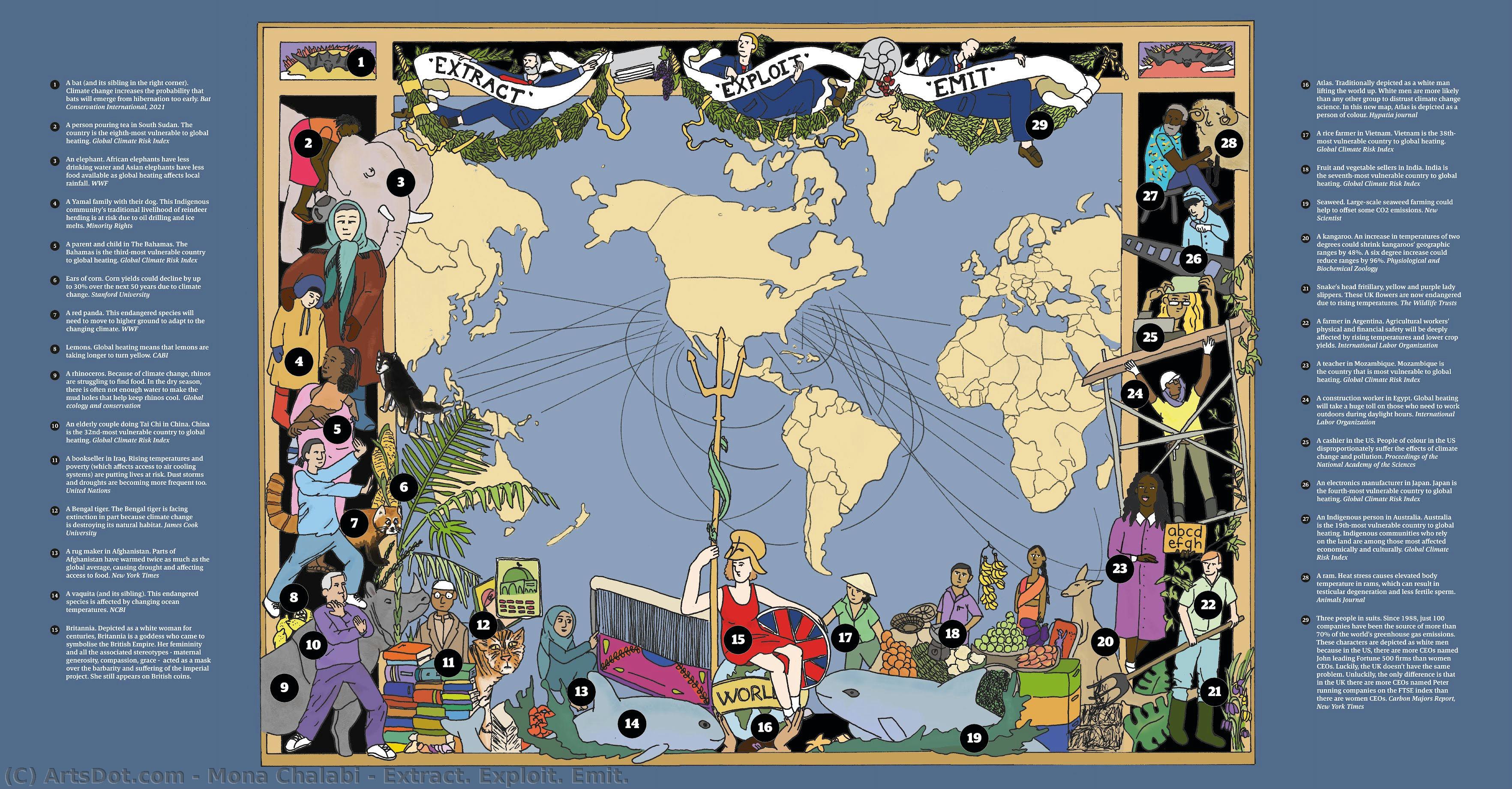
Extract. Exploit. Emit.
Reproduksiyon Boyutu

In an era often defined by the overwhelming deluge of raw data, Mona Chalabi emerges as a vital translator, turning the cold, clinical language of statistics into a deeply human narrative. A British data journalist, illustrator, and writer of Iraqi descent, Chalabi has mastered a unique form of visual alchemy. Her work does not merely present facts; it breathes life into them, using the precision of mathematical analysis to illuminate the profound social and emotional truths hidden within numbers. Born in London to Iraqi immigrants, her perspective is shaped by a rich cultural tapestry, fostering an innate ability to uncover the stories that often remain obscured by the perceived objectivity of spreadsheets and charts.
Chalabi’s intellectual journey began with a rigorous academic foundation that bridged the gap between social science and creative expression. Educated at Woodford County High School For Girls, she later pursued studies in International Relations at the University of Edinburgh and specialized in International Security at the Paris Institute of Political Studies. This background in global politics and security provided her with a sophisticated toolkit for dissecting complex power structures. Her early professional experiences—working within institutions such as the Bank of England, Transparency International, and the International Organization for Migration—offered her a front-row seat to the mechanics of global governance and the often-invisible impact of policy on human lives. It was here that she began to recognize the potential for art to act as a medium for accountability.
The brilliance of Chalabi’s technique lies in her ability to manipulate the visual language of information. She approaches every subject with a deliberate consideration of existing iconography, deciding whether to adopt established symbols or to deviate entirely to create something transformative. Her style is characterized by a striking juxtaposition: the meticulous precision of statistical reporting meets an evocative, hand-drawn aesthetic that feels intimate and urgent. This approach draws subtle inspiration from the masters of symbolic representation, such as Bosch and Van Eyck, whose works utilized intricate imagery to convey complex human experiences and moral landscapes.
Through her illustrations for prestigious publications like The New York Times and The Guardian, Chalabi transforms abstract concepts—ranging from racial dating preferences to the intricacies of wealth inequality—into accessible, emotionally resonant visuals. Her work serves as a powerful tool for social commentary, stripping away the intimidation of "big data" to reveal the human pulse beneath. By utilizing shapes, colors, and textures that feel organic rather than mechanical, she invites the viewer into a dialogue with the data, making the political personal and the statistical visceral.
The significance of Mona Chalabi’s contribution to contemporary media cannot be overstated. As a Pulitzer Prize winner, her recognition underscores the profound impact of merging investigative journalism with fine art. Her career has expanded far beyond the printed page, encompassing television documentaries on racism for the BBC, podcasting through her series Strange Bird, and even appearances on platforms like StarTalk. Whether she is presenting election results or exploring the physical and social aspects of women's bodies in her documentary series Vagina Dispatches, her mission remains consistent: to use visual storytelling to hold power to account and to challenge media bias.
Ultimately, Chalabi’s work represents a new frontier in journalism—one where the artist and the analyst are one. She has redefined what it means to "report" on the world, proving that numbers, when viewed through a creative lens, can be just as poetic and haunting as any traditional painting. Her legacy is found in the way she empowers audiences to look closer at the data that shapes our lives, transforming passive observers into informed, empathetic witnesses to the complexities of the modern age.

1987 - , Iraq


En son sanat haberlerinden, özel tekliflerden ve dekorasyon fikirlerinden haberdar olun.
Projenizden bize bahsedin; sanat uzmanlarımız size özel 3 sanat eseri önerisi sunsun.
Size Özel 3 Seçeneği Ücretsiz Olarak Hazırlayalım!


 Önizleme yap
 Paylaş
 Paylaş
 Detayları Gör

 İndir
İndir
 Benzerlerini gör
 X-Işını
 Slayt Gösterisi
 Tümünü Gör




































 Cam seçeneği yalnızca 110 cm altındaki boyutlar için mevcuttur.


